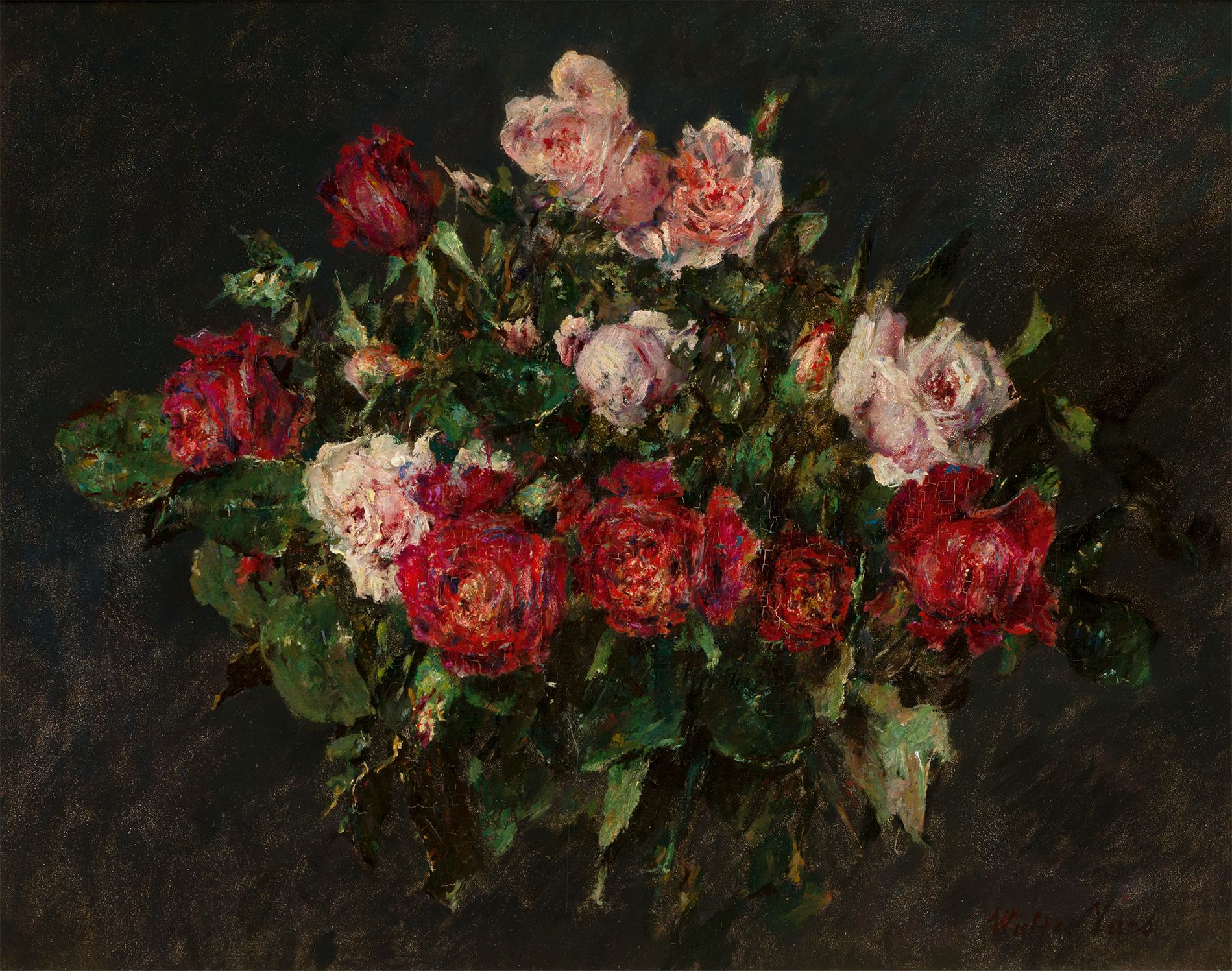
W. (WALTER) VAES
Artists
Biography
W. (WALTER) VAES
1882 Borgerhout (Belgium) - 1958 Antwerpen (Belgium)
Walter Constant Renerus Vaes grew up in Borgerhout in a milieu of local notables, intellectuals, and artists. Part of his childhood was spent in Liverpool. His training began in the studio of his uncle Piet Verhaert, a specialist in genre scenes and etchings, where he learned both techniques. At fourteen, he entered the Antwerp academic system under Albrecht De Vriendt (1843-1900), director of the Royal Academy. In 1904, aged twenty-two, he won the Prix de Rome. The accompanying stipend financed an extensive study trip to Italy, followed by Germany, Austria, Spain, Turkey, Egypt, and Lebanon. He was a co-founder of De Eenigen (1902) and of Kunst van Heden (1905).
During the First World War, he withdrew to Veere in Zeeland, where he remained, with interruptions, until around 1920. He lodged first at 'De Struijs' with the Ochs family, later at the 'Bordeaulx Oxhooft'. He already knew Zeeland through Verhaert. These years laid the foundations of his Dutch network: membership of Pulchri Studio, contacts with collectors such as Van Beuningen, and regular exhibitions in the Netherlands. Back in Antwerp, he became a teacher at the Nationaal Hoger Instituut voor Schone Kunsten (appointed in 1924, until his retirement in 1949), with still life as his teaching brief. In 1938, he was elected a member of the Royal Flemish Academy.
From 1905 onwards, Vaes relinquished historical and mythological subjects in favour of portraits and still lifes on a small scale. His still lifes belong to the Flemish tradition with a realist inflection: a single skate, a crab on its back, a fish head on a plate, a chicken carcass, motifs that connect directly to Courbet and to the Antwerp realist line of Henri Leys, Henri De Braekeleer, and Verhaert. Alongside these came flower pieces, aristocratic portraits, and townscapes, with Fantin-Latour as an important point of reference. Some authors regard him as stronger as an etcher than as a painter, particularly in his landscapes and in townscapes of Veere and Zierikzee. He consistently ignored new movements such as Expressionism, Neue Sachlichkeit, and Cobra, which probably explains his relative obscurity after his death.
His work can be found in the museums of Antwerp, Ghent, Liège, and Sint-Niklaas, and in the Antwerp print room. In 2021, Musée L in Louvain-la-Neuve received a gift of 158 etchings and devoted an exhibition to him. A retrospective was held at the Singer Museum in Laren in 1987.
1 results sorted by artist. Showing results 1 - 1.