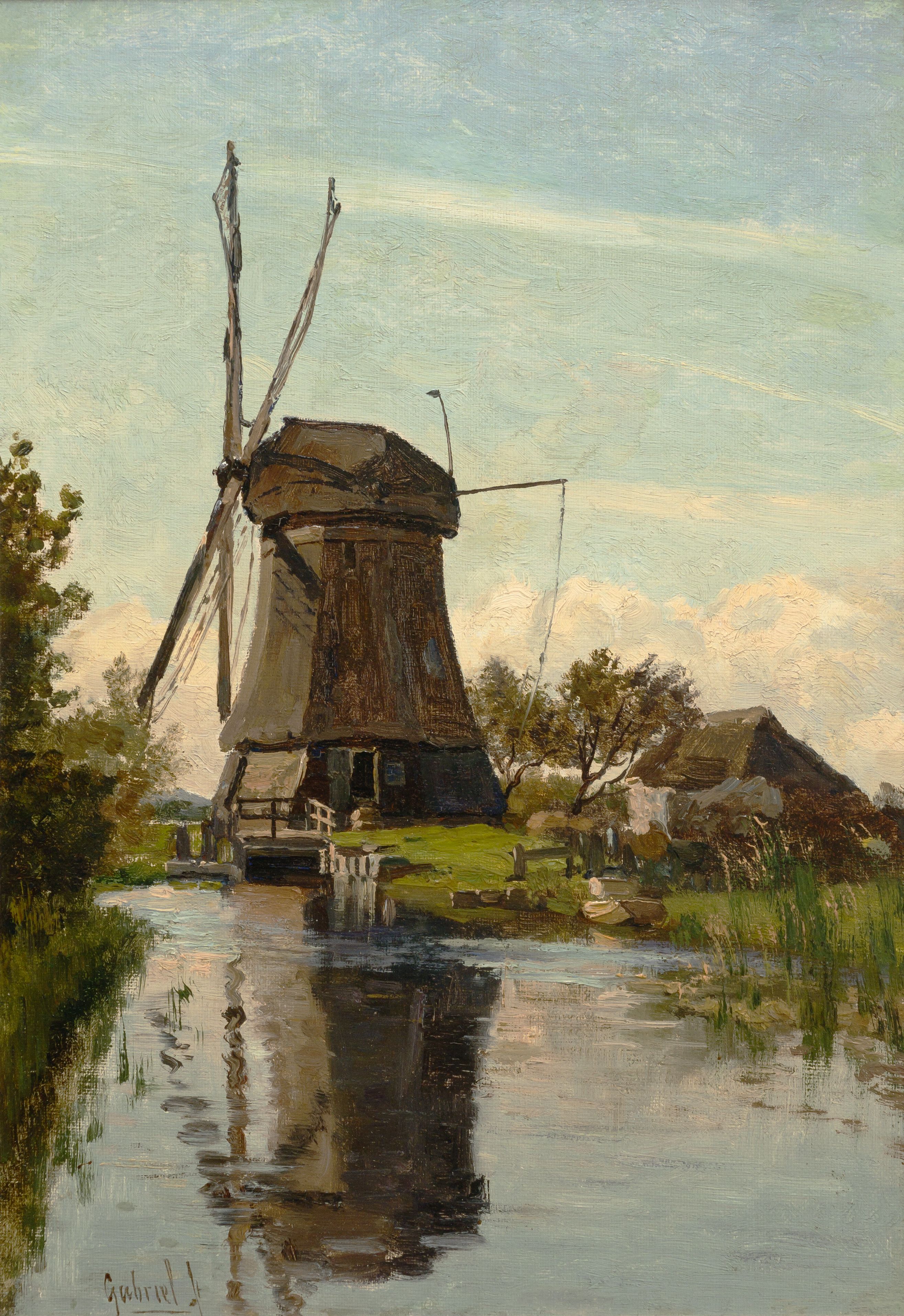
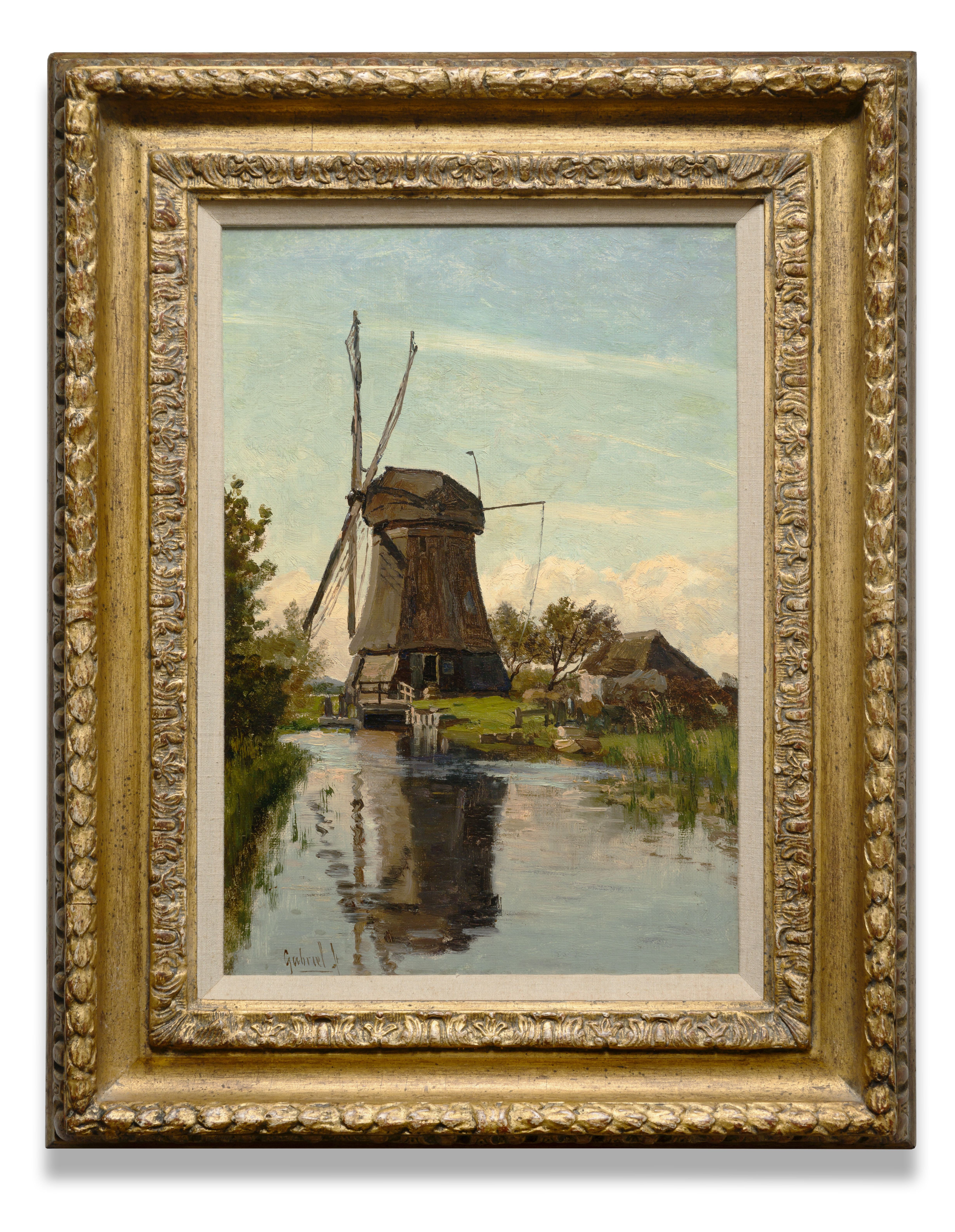
P.J.C. (PAUL) GABRIËL 1828 Amsterdam - 1903 Scheveningen The Achterste Molen in the Polder at Kortenhoef
Oil / Panel: 48 x 36 cm
- This artwork can be viewed in our gallery
- Call us for more information: +31 26 361 1876
- World wide shipping available
Details
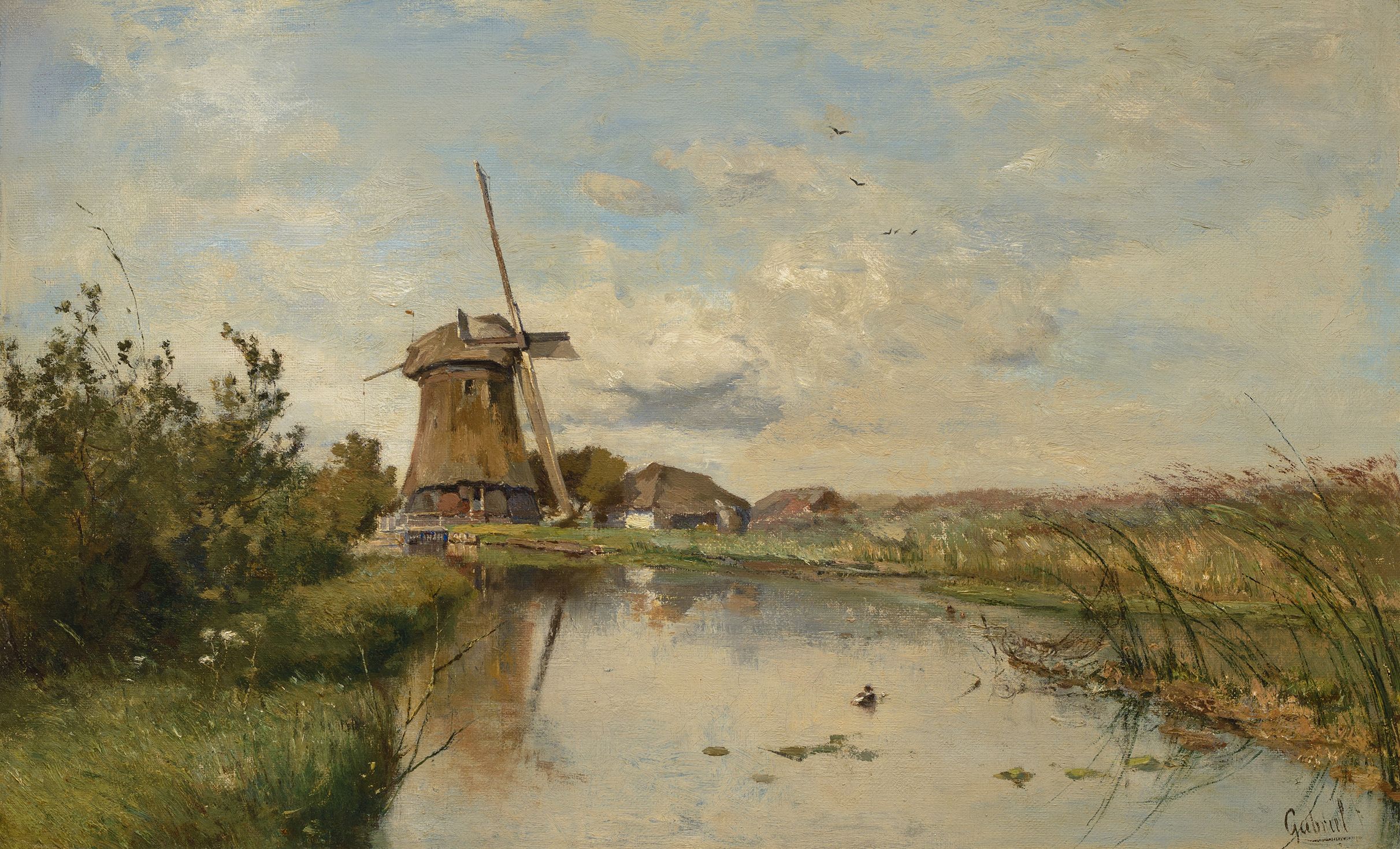
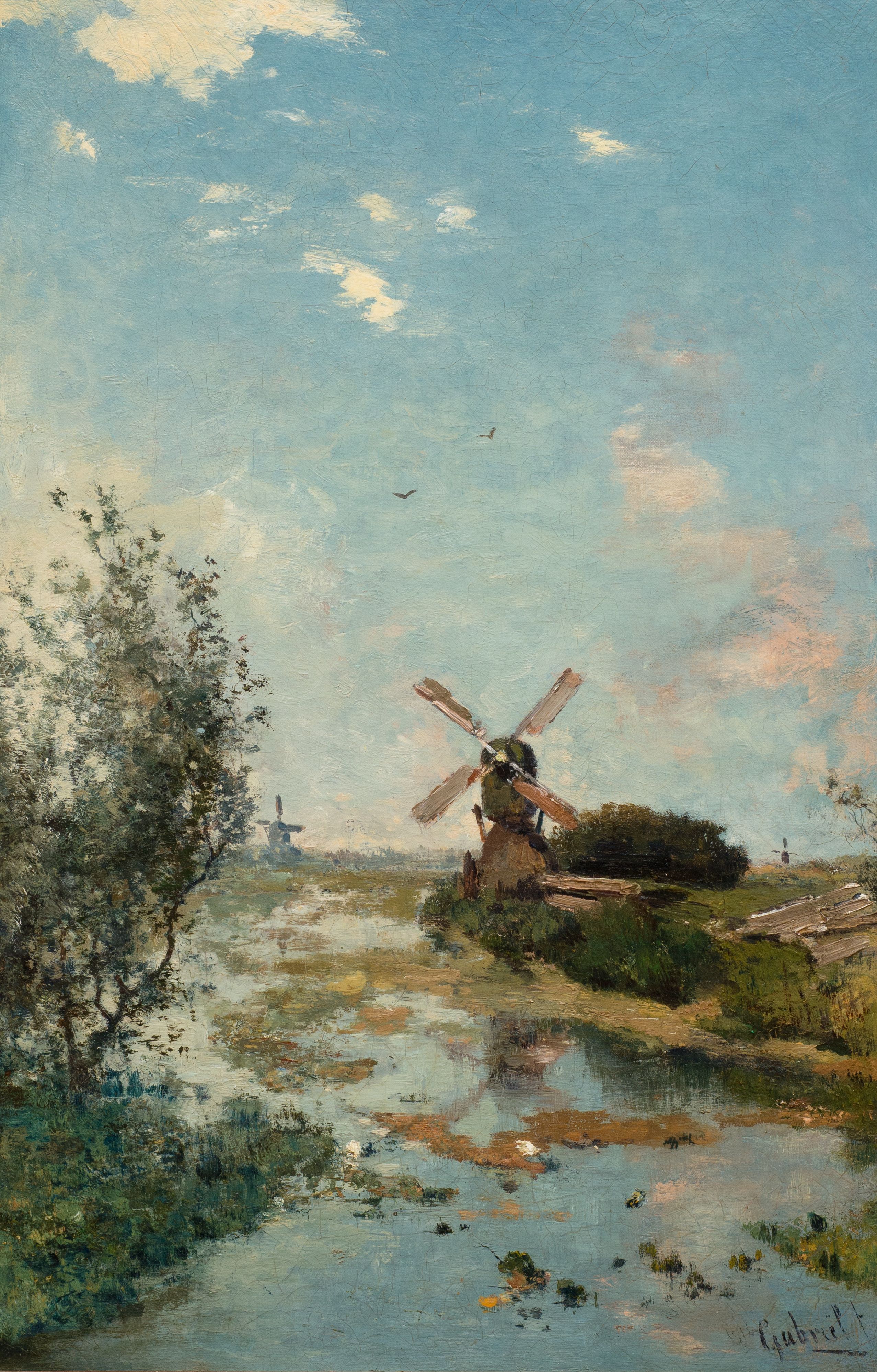
A monumental windmill reflects in the water of a Dutch polder canal. The sun sits low on the horizon; it is early evening on a fine summer's day. The rippling of the water betrays the current, yet the painting otherwise radiates tranquillity. The sails, which follow the diagonal of the bank, anchor the balanced, classical composition. The vivid colours are characteristic of the work of Paul Gabriël, the colourist among the painters of the Hague School.
Paul Gabriël grew up surrounded by art. His father, a sculptor, died when his son was only five years old. The young Paul helped his mother paint portraits to earn a living for the family. After his training at the Amsterdam academy, he was sent to Cleves to receive instruction at the Drawing Academy of the celebrated Romantic landscape painter B.C. Koekoek. This did not suit him, and back in the Netherlands, he studied for a time in Haarlem. Gabriël did not truly develop as a landscape painter, however, until he reached the Gelderland village of Oosterbeek, where many Dutch artists had by then discovered plein-air painting. There, he made studies from nature, often of details of branches and leaves, but also painted Romantic landscapes. Working outdoors was not without its hazards: when Gabriël and his colleague Kruseman van Elten painted outside in all weathers, both contracted ear infections. Gabriël suffered severe hearing loss as a result; his colleague became completely deaf. Oosterbeek, as a picturesque location, had been discovered by Willem Roelofs. Gabriël followed Roelofs to his place of residence, Brussels, where he would remain for twenty-five years. He continued to seek his subjects in the Netherlands, as the Belgian landscape held no appeal for him: "No, I feel little for it; it lacks that delicate atmosphere of Holland." Gabriël returned to the Netherlands every year for three months to work in the expansive Dutch polder landscape. He painted the polder near the village of Kortenhoef on many occasions. The windmill depicted in this painting no longer exists. In Gabriël's time, three mills stood in the area. The Achterste Molen, shown here, burnt down in 1891. The middle mill has also gone. The front mill is the subject of Gabriël's most celebrated painting, In July from 1889, now one of the highlights of the Rijksmuseum in Amsterdam. That mill, which still stands today, is now known as the Molen Gabriël.
Gabriël's work is strikingly colourful compared with that of the other painters of the "grey" Hague School. In a letter from 1901, Gabriël defended himself against criticism of his use of colour: "Although I can look rather grumpy myself, I am very fond of the sunshine reflecting in the water, but beyond that, I find my country colourful, and what struck me particularly whenever I returned from abroad: our country is coloured, lush, and rich. (...) I have often heard foreigners say: Those Dutch painters all paint grey, and their country is green."
Width: 36 cm
Over P.J.C. (PAUL) GABRIËL
Paul Gabriel is pre-eminently characterized as the portraitist of the Dutch polder. He learned to paint en-plein-air in Oosterbeek, where he spent some time with J.W. Bilders, among others. In 1860 he moved to Brussels where he became friends with Willem Roelofs, the leading landscape painter at the time. From Brussels he regularly returned to paint the Dutch ponds and polders. The time of day (preferably early in the morning) and the corresponding light are important elements in Gabriel's work. In doing so, he uses more than just the nuances of gray so beloved of his contemporaries and was thus called the colorist of the Hague School. Mesdag calls it "Gabriel's morning poetry." Until the 1980s, Gabriel painted mainly in the area around Kortenhoef, Abcoude and Vreeland. After moving to Scheveningen in 1884, he works in the area around The Hague. Gabriel belongs to one of the leading painters of the Hague School. Almost all important museums own work by him.