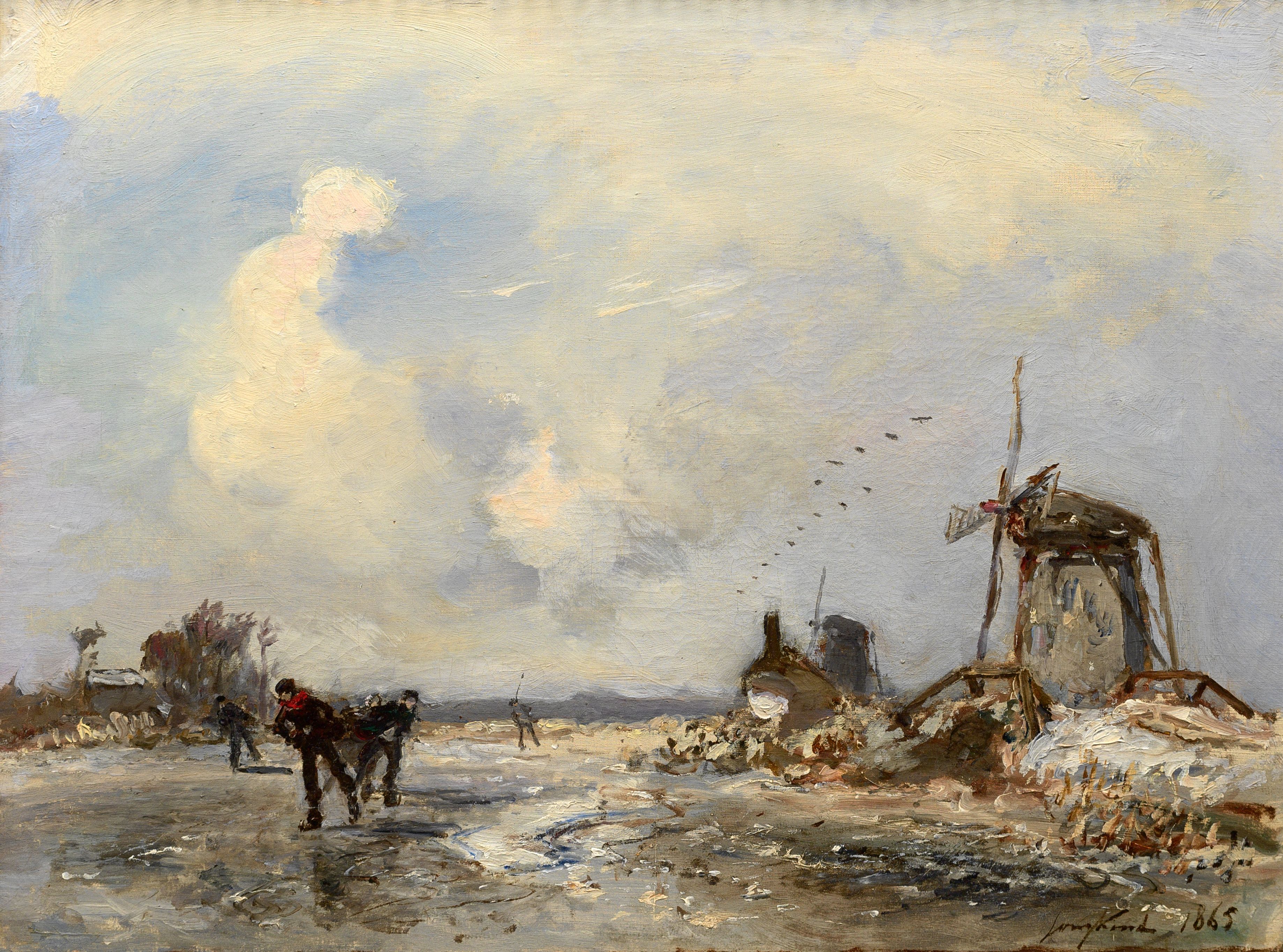
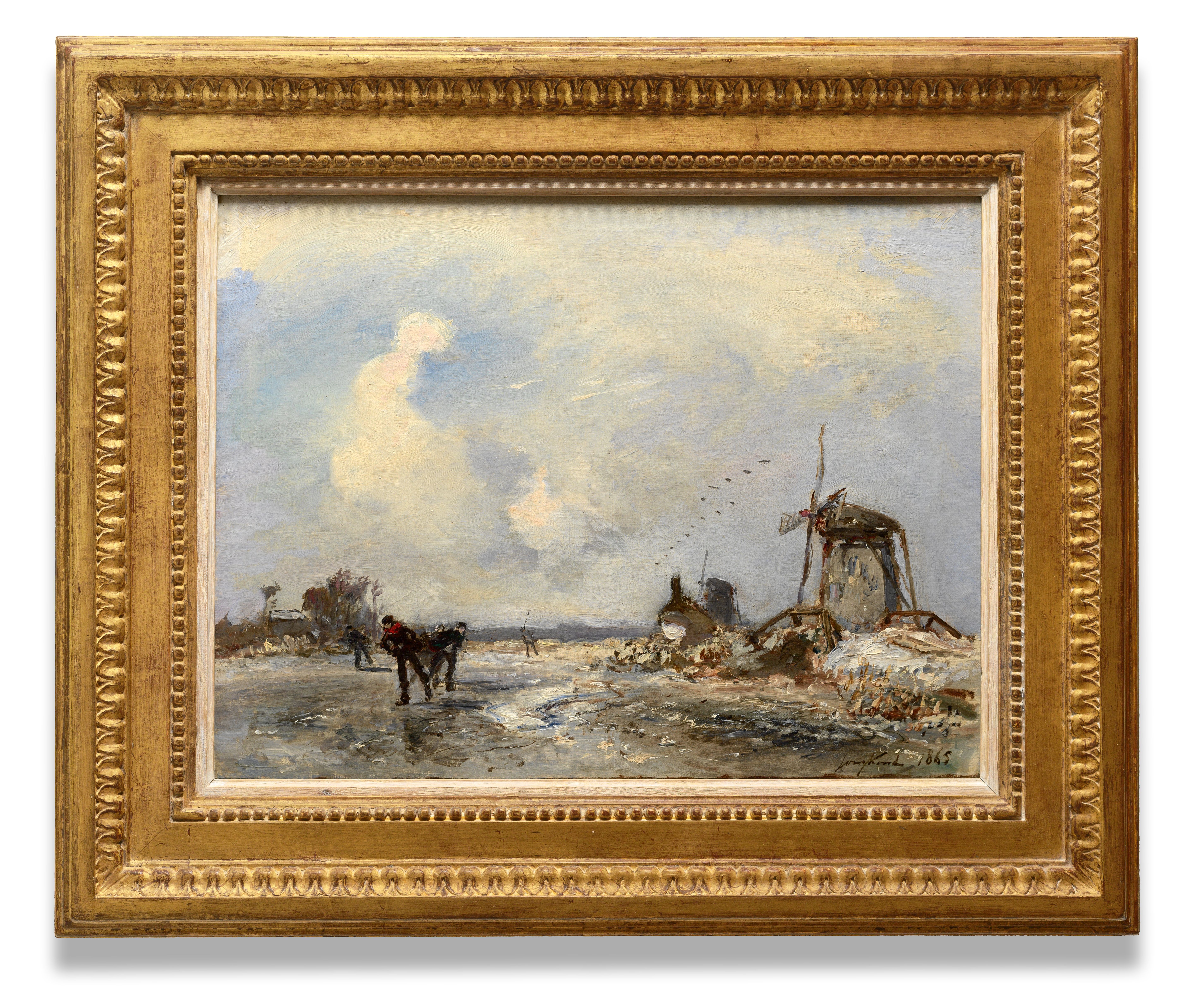
J.B. (JOHAN) JONGKIND 1819 Lattrop (The Netherlands) - 1891 Côte St.-André (France) Moulins et patineurs en Hollande
Oil / Canvas: 33,7 x 43,2 cm
- This artwork can be viewed in our gallery
- Call us for more information: +31 26 361 1876
- World wide shipping available
Details
It is hard to imagine a more quintessentially Dutch painting. Windmills and winter skating beneath a magnificent, cloudy sky that, in true Dutch fashion, occupies two-thirds of the canvas. Yet in France, the Dutch painter Johan Barthold Jongkind is celebrated as one of the greatest French painters of the nineteenth century. His work embodies the confluence of seventeenth-century Dutch and nineteenth-century French landscape painting.
Jongkind never achieved the same renown in the Netherlands as in France. He was, after all, discovered by a Frenchman, the Romantic painter Eugène Isabey. Jongkind had studied at the Hague Academy of Art and later worked in the studio of Andreas Schelfhout, then one of the most celebrated landscape painters in The Hague. Isabey brought Jongkind, who had just received a royal stipend, to Paris. There, Jongkind found himself more inspired by the young French painters of nature and everyday life, the School of Barbizon, than by Isabey's generation of Romantic painters. He became acquainted with numerous artists with whom he would spend his days in the artists' cafés, debating the latest developments in painting. His generous nature and excessive drinking, however, took their toll. To rescue him from his financial difficulties and his struggle with alcohol, Isabey took him to the spectacular coastline of Normandy. The rugged cliffs, broad beaches, and picturesque lanes he encountered there made a profound impression on him. Jongkind worked extensively outdoors and gradually developed into a plein air painter, though he continued to finish his oil paintings at leisure in his studio. It was there that he also met another pupil of Isabey, Eugène Boudin, with whom he formed a close and lasting friendship.
In France, Jongkind received growing recognition. He was awarded a gold medal at the Paris Salon, and his work was shown at the 1855 World Exhibition in Paris as a representative of France. Despite this success, his heavy drinking continued to generate substantial debts. Matters deteriorated to such a degree that he was forced to flee to the Netherlands. In the area around Rotterdam, he painted characteristically Dutch landscapes beneath characteristically Dutch skies, which he sent to France, where they met with considerable success. In Paris, his absence was keenly felt. A journalist wrote of his non-appearance at the Salon: "Jongkind — one of the absentees who leaves the greatest void — for the quality of Jongkind is exceedingly rare: he is honest." In 1860, Jongkind's French painter friends organised an auction, contributing works free of charge. The proceeds allowed Jongkind to settle in France, the country where he felt most at home, free from debt. He remained, nonetheless, a Dutch painter. Until the end of his life, he painted Dutch landscapes, which never lost their popularity in his adopted homeland. His success extended well beyond the public: Édouard Manet called him "the father of the modern landscape," Camille Pissarro observed that "the landscape without Jongkind would look quite different," and Claude Monet declared: "To him I owe the final education of my eye."
Width: 43,2 cm
Jean Dieterle, Paris
Christian Otto Zieseniss (1865-1938), acquired before 1929
Richard Green, London
Private collection The Netherlands
Will be included in the 'Supplément du Catalogue Critique de l'Oeuvre Peint de Jongkind' by Galerie Brame & Lorenceau and Janine Sinizergues
Will be included in the 'Catalogue Critique de l'Oeuvre de J.B. Jongkind' by the Comité Jongkind Paris-La Haye, archive reference H1059
Over J.B. (JOHAN) JONGKIND
Johan Barthold Jongkind began his education as a painter in the studio of the Romantic painter Andreas Schelfhout along with lessons at the Hague Academy. In 1846, with a royal scholarship, he left for France where the French marine painter Eugène Isabey (1803-1886) became his teacher. Together they traveled across France and eventually to the Normandy coast that would play an important role in Jongkind's later work. A few years later he would meet Eugène Boudin and Claude Monet in Honfleur. Jongkind was successful from the start, although he didn't win prizes at the Paris Salons. Suffered with depression and haunted by financial problems, Jongkind returned to the Netherlands in 1855 and settled in Rotterdam, where he led a more quiet life but continued to paint. Among his French artist friends, he had remained popular and they arranged his return to France. He would not return to the Netherlands after 1869. Meeting Joséphine Fesser, with whom he would share the rest of his life, put his life more peaceful. Until today, Jongkind is considered the father of Impressionism. Together with his friend Boudin, he made this genre great. He was very successful especially with his landscapes by moonlight. When we look back and compare the years of the works of the later impressionists who came after him, we can truly speak of a pioneering artist.