J. (JOAN) CARDONA I LLADÓS 1877 Barcelona (Spain) - 1958 Barcelona (Spain) Au promenoir, in a Parisian Variety Show
Mixed media/paper/cardboard: 34,5 x 24 cm
- This artwork can be viewed in our gallery
- Call us for more information: +31 26 361 1876
- World wide shipping available
Details
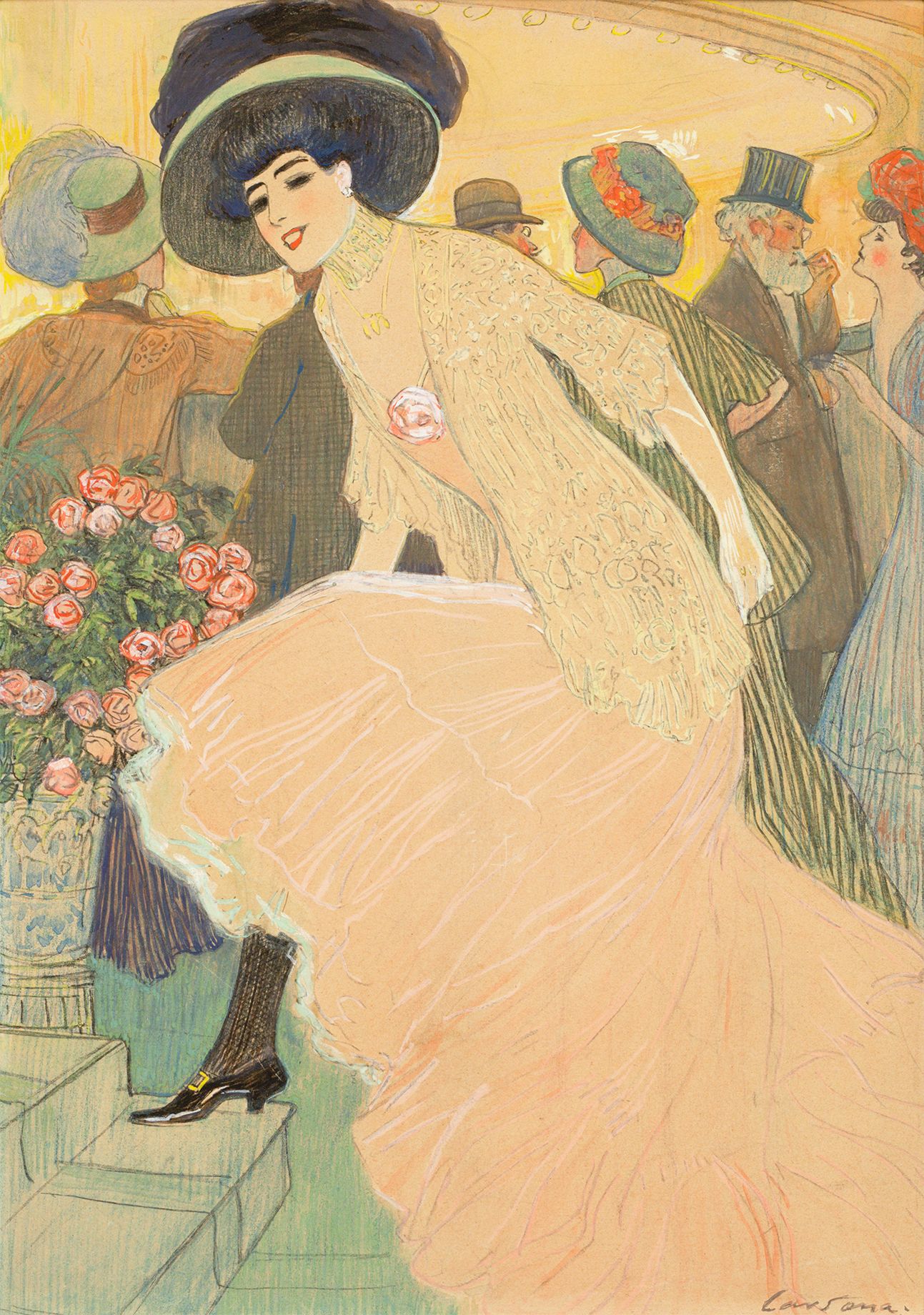
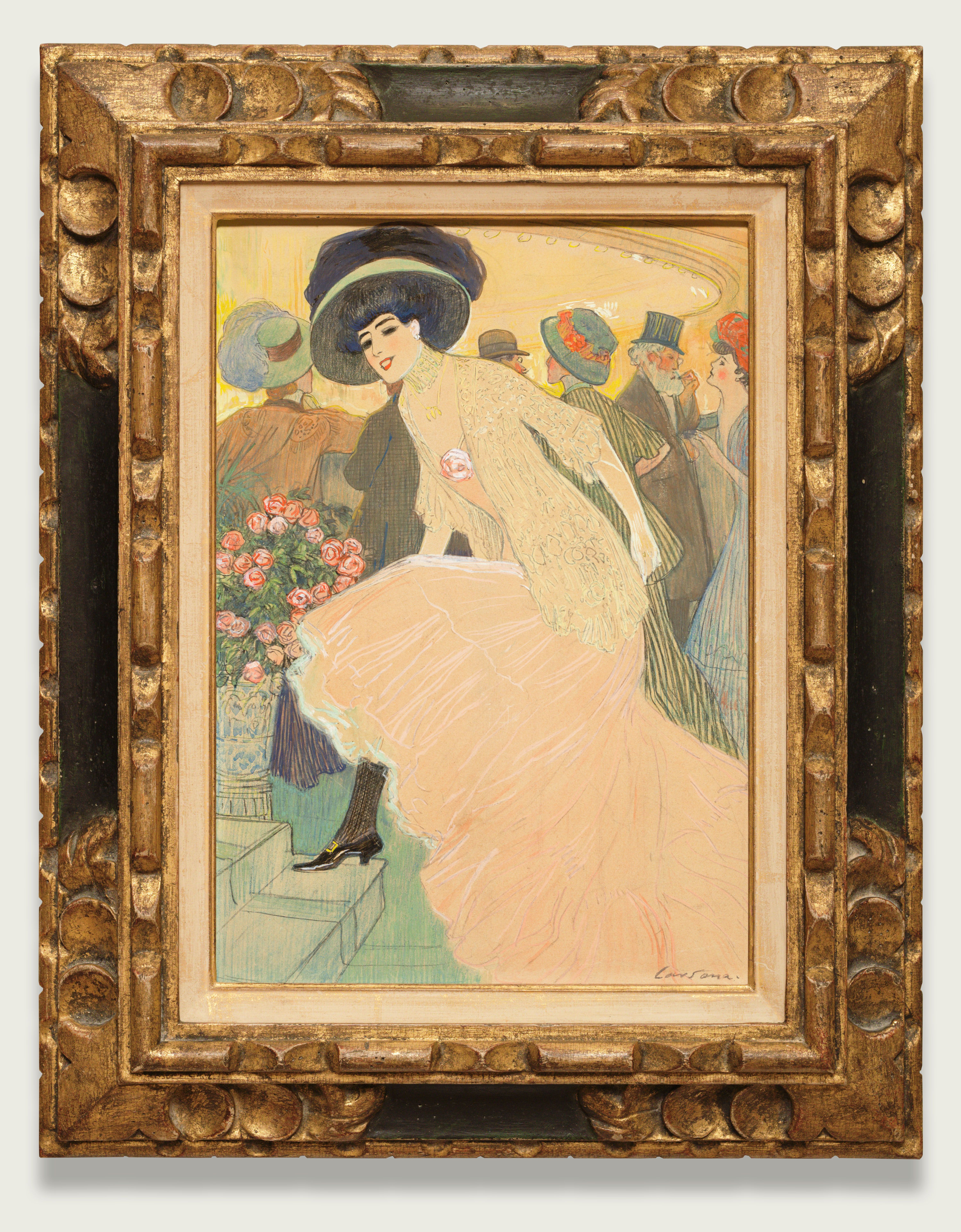
Au Promenoir by the Spanish artist Joan Cardona i Lladós distils the essence of Parisian nightlife during the Belle Époque into a single image. We find ourselves in the promenoir of a Parisian variety theatre, the covered walkway where the audience strolls, watches and is watched between acts. At the centre stands an elegant young woman about to ascend a staircase. Her body leans forward, her face half-turned towards the viewer, her skirt fanning out into a light mass of pink and cream. On closer inspection, that skirt, which fills a large part of the work, is barely drawn: only a few thin pink, white and green lines on the paper. The elegantly shod lower leg, by contrast, is carefully finished and forms a statement in itself. The large dark hat with its green band also provides a forceful counterweight to the delicate dress and finely drawn lace bodice. Cardona has caught the woman in motion: on her way to her box, to the stalls, or walking along the promenade where the social game unfolds. She is not a performer on the stage, yet she appears here as the leading player. In the background, other visitors move about: ladies in large hats, a gentleman in a top hat, faces in profile, bodies sketched with a few lines in a mildly caricatural manner. With only a handful of figures, Cardona evokes the atmosphere of a busy evening out: noise, movement, light, perfume, music. Everything around her is suggestion; she herself is the focal point. This is a characteristically illustrative approach: the draughtsman communicates at a glance where the eye should travel and what story is unfolding.
This illustrative quality in Cardona is no accident. He was not only a painter but, above all, an artist of the line, closely connected to the world of the illustrated magazine, the poster, and the print. Early in his career he worked in Spain for various periodicals. Later, in Paris, he moved within the vibrant world of the Belle Époque, where painters, draughtsmen, caricaturists and poster artists gave new visual form to modern city life. His ability to combine chic, bearing and femininity became so recognisable that a certain type of fashionable woman came to be called “a Cardona”.
Yet the present work is more than fashion illustration. The clothing is almost a setting in itself: the transparent wrap, the long transparent glove, the hat with a green band, the light dress with fleeting white highlights. But it is the woman who commands the composition. Her oblique posture, red mouthlend, and heavily made-up eyes give her an air of enigma. She is aware of the gazes around her yet remains elusive: part of the spectacle and at the same time its director. She is a typical woman of the Belle Époque: elegant, urban, modern and faintly theatrical.
It was Henri de Toulouse-Lautrec who had elevated Parisian poster art to new heights. He, too, found his subjects in the world of entertainment: the Moulin Rouge, the café-concerts, the dancers and singers, and, from artists such as La Goulue and Jane Avril, he made modern celebrities. His compositions were monumental and radical, with large colour planes and bold silhouettes, for the sheet had to work from a distance in the street. That Cardona is indebted to his predecessor is immediately apparent. Yet the difference is equally telling. Cardona’s work is more refined, softer and more decorative. Where Lautrec reduces the figure to a forceful sign, Cardona stays closer to the charm of fashion illustration: his lines are fluid but less aggressive, his colours lighter, his atmosphere more elegant. In Cardona, you hear the rustle of silk and the murmur of conversation in the foyer. In Au Promenoir, the woman is no star on the stage, but a fashionable figure from the Belle Époque. Cardona presents the era’s entertainment culture as a dreamlike vision: light, refined, full of movement, with a touch of satire.
Width: 24 cm
Emballeur de Beaux-Arts, A. Robinot, Paris, Monaco, 1909, no. 254
Emballeur de Beaux-Arts, A. Robinot, Paris, Vienna, 1909, no. 86
Private collection Austria
Austria, Vienna, 'Exposition', Emballeur de Beaux-Arts, A. Robinot, Paris, 1909, no. 86
Over J. (JOAN) CARDONA I LLADÓS
Joan Cardona i Lladós was a Catalan painter and draughtsman who ranked among the most internationally celebrated illustrators of the Belle Époque. He was born in Barcelona on 30 June 1877 into a modest household, in which his stepfather, a pupil of the guitarist Francesc Tàrrega, instilled in him from an early age a pronounced artistic and musical sensibility. Cardona trained at the private Acadèmia Baixas and subsequently at the renowned Escola de la Llotja in Barcelona, where he formed part of the generation that shaped Catalan modernisme. From 1894 onwards, he participated in the Exposiciones de Bellas Artes in his native city. In 1900, he settled in Paris, where he would live and work until the outbreak of the First World War in 1914. In the French capital, Cardona moved within the circle of the foremost poster and press illustrators of his day, including Cappiello, Sem, Steinlen and Roubille. Rooted in the example of Toulouse-Lautrec and Steinlen, his style is distinguished by an incisive, synthetic line and a refined sense of elegance. He became known above all for his depictions of women of Parisian high society: fashionable ladies in theatres, at balls and in intimate boudoir moments, as well as Spanish types such as manolas and flamenco dancers, with which he tapped into the prevailing taste for the españolada. Critics spoke of an unmistakable 'Cardona style' that helped to define the visual identity of glamorous fin-de-siècle Paris.
As an illustrator, he contributed to leading French periodicals such as Le Rire, Gil Blas, L'Assiette au Beurre, Le Frou-Frou and La Vie Parisienne, to the German magazines Jugend and Simplicissimus, and to Catalan publications including Hispania, Forma, El Gato Negro and La Il·lustració Catalana. His brother-in-law, Ricard Opisso, belonged, together with Ramon Casas and Xavier Gosé, to the same circle of Catalan modernists who made their name in Paris. As a painter, Cardona also devoted himself to landscape, in an idiom that evolved from Impressionism towards Post-Impressionism, and to female figure pieces in which the influence of Hermen Anglada Camarasa is palpable. Following his return to Barcelona, he remained active well into old age. He died in his native city on 16 September 1958. Works by Cardona are held in the collections of, among others, the Museo Nacional del Prado, the Museu Nacional d'Art de Catalunya (MNAC), the Museo Carmen Thyssen-Bornemisza and the Musée d'Orsay.