J. (JOAN) CARDONA I LLADÓS
Artists
Biography
J. (JOAN) CARDONA I LLADÓS
1877 Barcelona (Spain) - 1958 Barcelona (Spain)
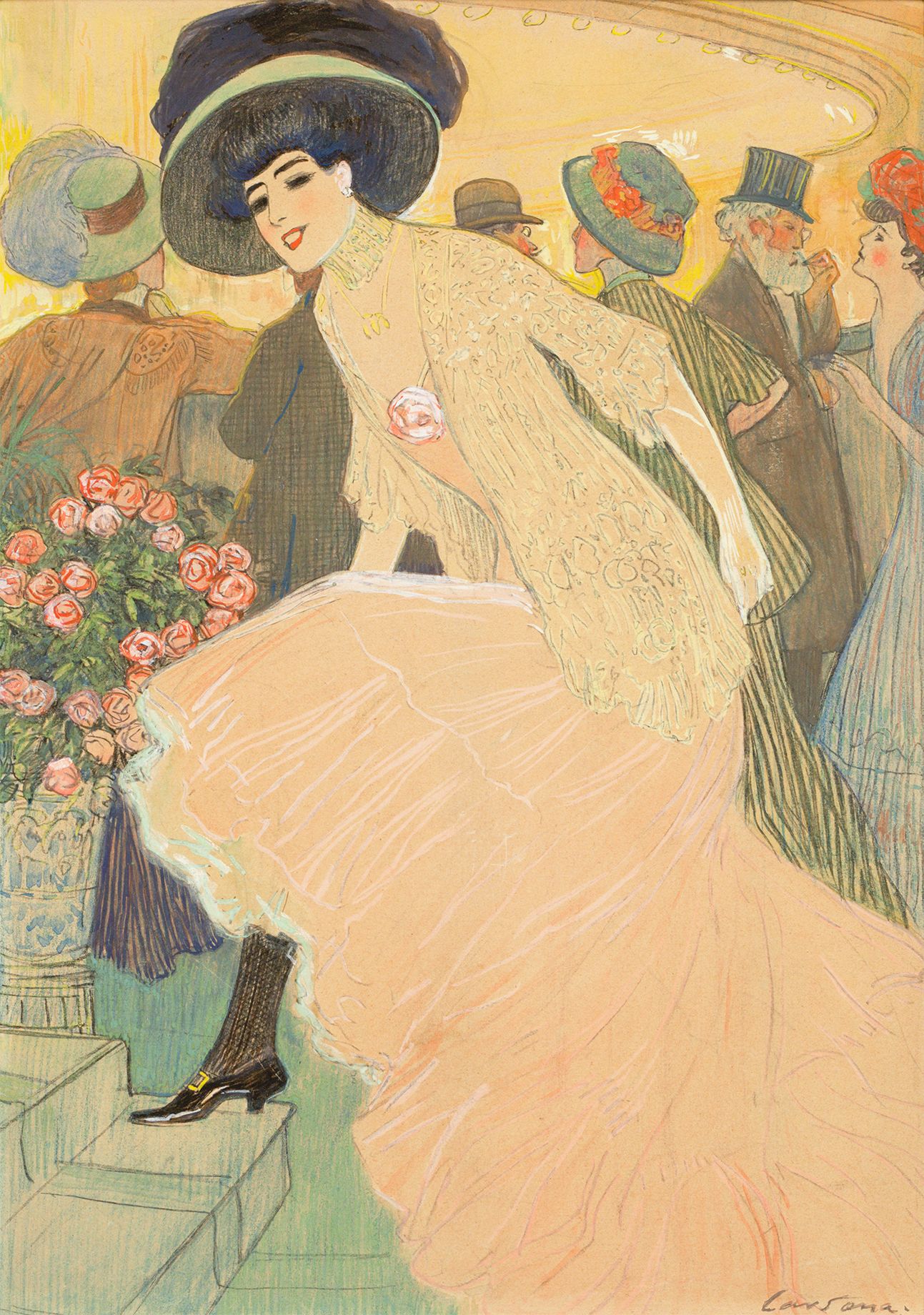
Joan Cardona i Lladós was a Catalan painter and draughtsman who ranked among the most internationally celebrated illustrators of the Belle Époque. He was born in Barcelona on 30 June 1877 into a modest household, in which his stepfather, a pupil of the guitarist Francesc Tàrrega, instilled in him from an early age a pronounced artistic and musical sensibility. Cardona trained at the private Acadèmia Baixas and subsequently at the renowned Escola de la Llotja in Barcelona, where he formed part of the generation that shaped Catalan modernisme. From 1894 onwards, he participated in the Exposiciones de Bellas Artes in his native city. In 1900, he settled in Paris, where he would live and work until the outbreak of the First World War in 1914. In the French capital, Cardona moved within the circle of the foremost poster and press illustrators of his day, including Cappiello, Sem, Steinlen and Roubille. Rooted in the example of Toulouse-Lautrec and Steinlen, his style is distinguished by an incisive, synthetic line and a refined sense of elegance. He became known above all for his depictions of women of Parisian high society: fashionable ladies in theatres, at balls and in intimate boudoir moments, as well as Spanish types such as manolas and flamenco dancers, with which he tapped into the prevailing taste for the españolada. Critics spoke of an unmistakable 'Cardona style' that helped to define the visual identity of glamorous fin-de-siècle Paris.
As an illustrator, he contributed to leading French periodicals such as Le Rire, Gil Blas, L'Assiette au Beurre, Le Frou-Frou and La Vie Parisienne, to the German magazines Jugend and Simplicissimus, and to Catalan publications including Hispania, Forma, El Gato Negro and La Il·lustració Catalana. His brother-in-law, Ricard Opisso, belonged, together with Ramon Casas and Xavier Gosé, to the same circle of Catalan modernists who made their name in Paris. As a painter, Cardona also devoted himself to landscape, in an idiom that evolved from Impressionism towards Post-Impressionism, and to female figure pieces in which the influence of Hermen Anglada Camarasa is palpable. Following his return to Barcelona, he remained active well into old age. He died in his native city on 16 September 1958. Works by Cardona are held in the collections of, among others, the Museo Nacional del Prado, the Museu Nacional d'Art de Catalunya (MNAC), the Museo Carmen Thyssen-Bornemisza and the Musée d'Orsay.
1 results sorted by newest. Showing results 1 - 1.