H.J. (HENDRIK JAN) WOLTER 1873 Amsterdam - 1952 Amersfoort Rocky Coast near St Ives, Cornwall
Oil / Canvas: 60 x 73 cm
- This artwork can be viewed in our gallery
- Call us for more information: +31 26 361 1876
- World wide shipping available
Details
A rugged coast, with the blue of the sea all around. From the rocks we look into an inlet where the waves break against the jagged boulders. On the left the sun falls on the rock face, on the right the rocks lie in deep shadow. Further out, small fishing boats with brown sails ride the turbulent waves. Wolter gave the rocks striking, powerful colours: green and yellow beside orange-red, with purple and brown in the shadows. The warm colours of the rocks return in the small sails in the distance. Between them the water sparkles in light and dark shades of blue. Wolter painted this work in England, on the coast of Cornwall, one of his favourite destinations.
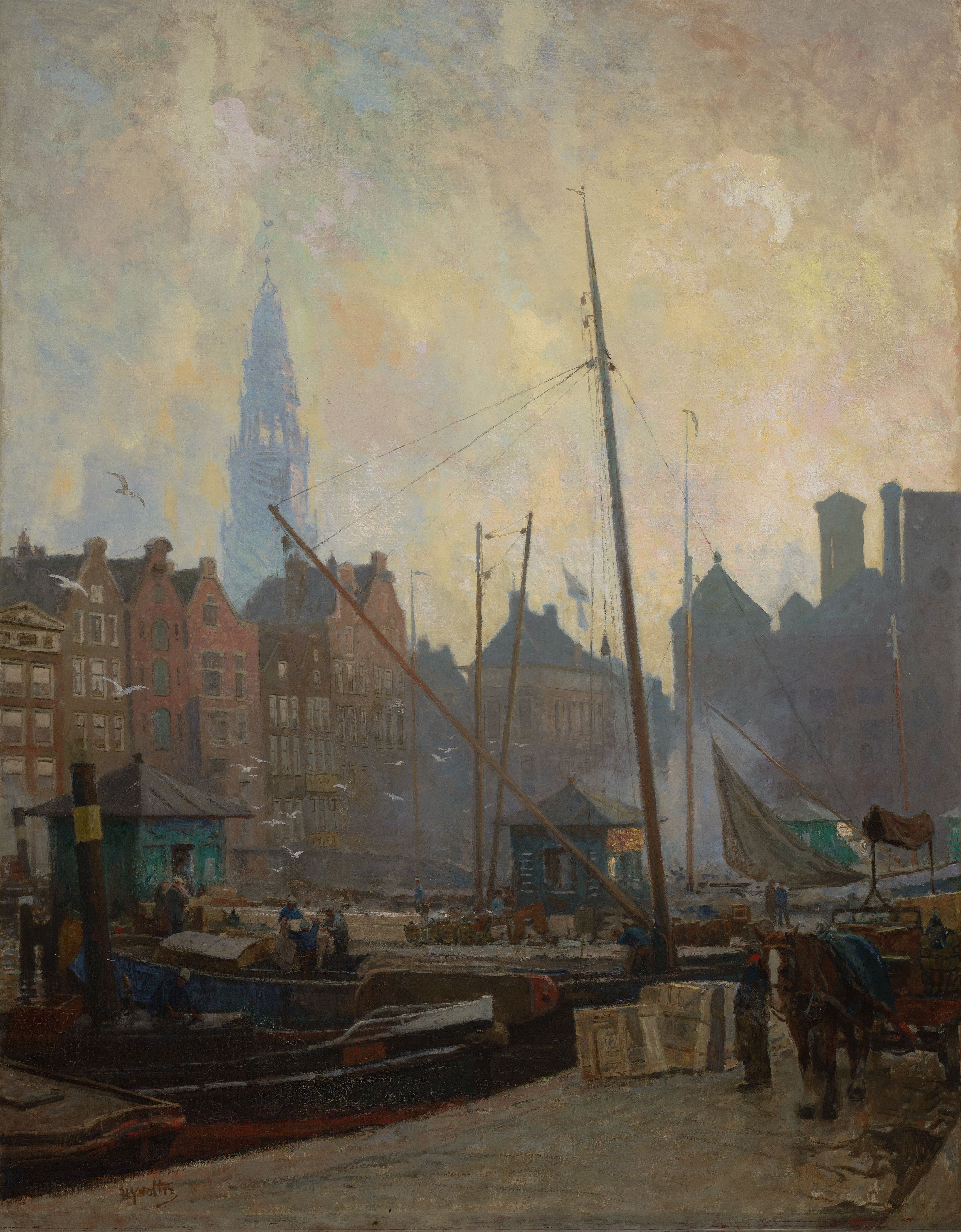
Wolter was fascinated by the painting of water throughout his life. On his travels he sought out the harbours and coasts of England, France and Italy. When the First World War made travel impossible, he needed only to look out of the window. From his studio in Amsterdam he looked out over the Amstel, which he painted at every hour of the day and in every season. The changing light on the water prompted one painting after another.
The views of the Cornish coast are perhaps the high point of Wolter’s paintings of water. Here the subject is the vast, wild sea, framed by forbidding rocks. With short strokes of blue, green and white he gave the water its movement. The small boats underline the insignificance of man amid the forces of nature.
Wolter had discovered the south coast of England before the First World War, painting in Polperro, on the south coast of Cornwall, among other places. The fishing boats, the harbours and the rocks along the coast offered him ever new subjects. During the war he had to confine himself to the Netherlands, working at home in Amsterdam, in Veere and in other towns in Zeeland. After the war he returned to England. He painted a large number of London cityscapes, most of which take the River Thames as their subject. Between 1921 and 1924 he painted a great deal in St Ives, on the north coast of Cornwall. Our painting can therefore be dated to the early 1920s. The coastal landscape around St Ives is one of the most dramatic and photogenic in Europe. Rugged granite cliffs enclose small sheltered beaches with water of an almost tropical blue. The surf and the shifting light were the ideal subject for a painter as sensitive to colour as Wolter.
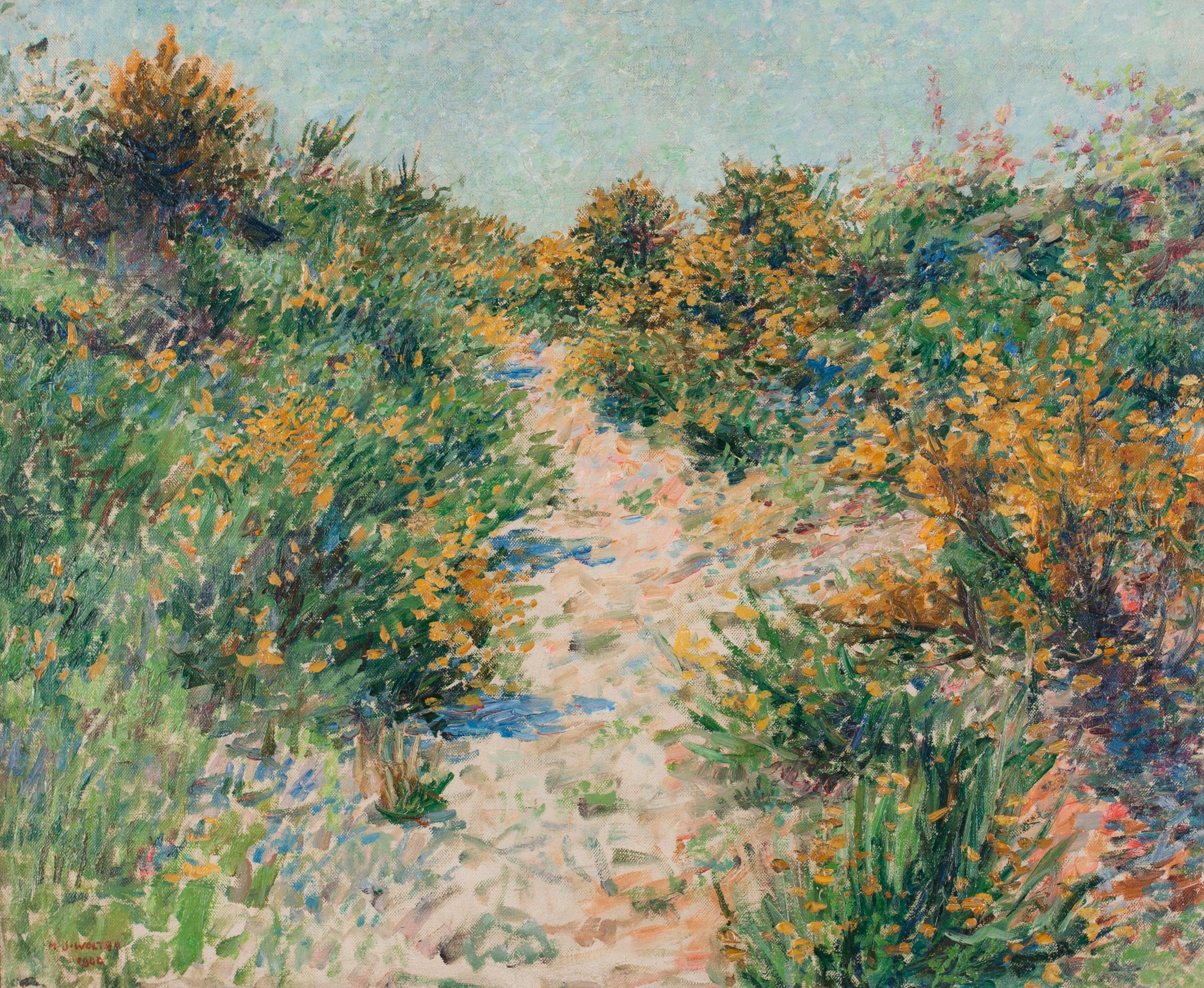
After a solid, traditional training at the academy in Antwerp, he gradually exchanged his dark palette for lighter colours and a freer handling of the brush. With bright colour contrasts and colourful shadows he made the sunlight dance across his landscapes. In doing so he aligned himself with the modern art of his time. In 1909 his work hung beside that of Sluijters, Gestel and Mondrian in the ‘Luminists’ room’ of the Stedelijk Museum Amsterdam, mockingly known as the ‘sick ward’. Such vivid colour was still unusual at the time. The Luminists sought to intensify the effect of light with bright, contrasting colours. Wolter too made his shadows colourful and set vivid colours side by side in small strokes.
Wolter was not the first to discover the picturesque fishing town of St Ives. The sea, the surf on the rugged coast, the life of the harbour and the clear light made it attractive to artists. The great English marine painter J.M.W. Turner came here as early as 1811. From the late nineteenth century onwards artists arrived from various European countries, America and Australia. James McNeill Whistler also worked here. The arrival of the railway made St Ives easy to reach and a lively cultural life developed. The St Ives Arts Club, founded in 1890, brought painters, writers and musicians together. There were drawing evenings, performances and gatherings. St Ives continued to inspire each new generation. Later came Ben Nicholson, Barbara Hepworth and Naum Gabo. Today Tate has a museum there, Tate St Ives.
Width: 73 cm
Private collection The Netherlands
Over H.J. (HENDRIK JAN) WOLTER
Hendrik Jan Wolter painted mostly impressionist and naturalistic cityscapes. He was educated in Antwerp and lived for a long time in Het Gooi, where he belonged to the artistic circle around Hotel Hamdorff in Laren, such as Jan Sluijters, Co Breman, Ferdinand Hart Nibbrig. He exhibited regularly and was a (board) member of several societies. From 1914 he lived in Amsterdam. Even though he was aware of the various new developments and movements that succeeded each other after 1914, Wolter did not participate in them. In 1924 Wolter became a professor at the Rijksacademie in Amsterdam. He was known as a teacher who valued tradition but also recognized new movements. During his lifetime, he traveled extensively, painting landscapes and cityscapes on his travels. In 1938, Wolter returned to Laren. He died over there in 1952. Did Wolter need Amsterdam and the Amstel to get more magic, more play, more finesse in his 'light'? It seems so, when you see "the Morning on the Amstel" and "the Afternoon". In both the painting is full of light. This is how Albert Plasschaert wrote about the artist.
Wolter was born in Amsterdam, but moved with his family to Amersfoort in 1885, where his father owned an engineering firm. He went to high school and was admitted as a student to the Académie des Beaux Arts in Antwerp in 1895. The following year he passed his exams for the Institut Supérieur, where he was granted his own studio. The award of a Royal Grant allowed him to continue his studies in Antwerp for three years. After further training in Paris, where he studied mainly the impressionists around Alfred Sisley (1840-1899), he returned to the Netherlands in 1899 and set up his own studio in Leusden. Here he painted mostly figurative subjects. With his wife Koosje van Hoorn, Wolter moved to Laren in Het Gooi in 1904, where he worked mostly en plein air. He alternated his Gooi subjects with river scenes. Water continued to play an important role in his work ever since. In addition, the artist was fascinated by the atmosphere of the town and its lively harbor. This was the reason why Wolter moved from picturesque Laren to Amsteldijk 47 in Amsterdam in 1914, where he had his studio on the third floor. He no longer had to sit along the shore. From his third-floor studio window he had a beautiful view of the Amstel River. Wolter was immediately captivated by what he saw: the Ceintuurbaan bridge, across the water the student union's boathouse and behind it the large Amstel hotel. In the distance, a shadow of Carré and the Magere Brug could still be seen.
From his studio, Wolter painted several "Amstel canvases. He was intrigued by the light and by the mists on the water, which changed every moment of the day. In the morning everything was still shrouded in a gray haze, but when the sun broke through and set the buildings in a warm glow, those warm hues against a clear blue sky came out sparkling. If the weather remained misty, the moisture-saturated atmosphere enveloped the cityscape in a bluish haze of delicate pastel colors. In De Groene, Plasschaert wrote: "It is certain that the city makes these finer, and internalizes them as far as possible. The latter was necessary. He lacked it in order to get more out of skill alone. Certainly he lacked it of late, when he adopted luminism as truth. But whatever, nothing applies without the Dream. And still it is not strong in this work. But there is tenderness, more than before, in the views of the Amstel river seen from Wolter's house. Wolter regularly traveled abroad, where he was inspired by various picturesque port towns.
Thus, between 1908 and 1914, he visited the fishing town of Polperro in Cornwall and went to the Thames in London. Even after Wolter was appointed professor at the National Academy in 1924, he continued to travel, seeking the water each time. The sparkle of light on the rivers and the sea enchanted him. Many of Wolter's paintings are characterized by a tight composition, often almost photographical in conception, a strong use of color, showing light and dark contrasts and tingling sunlight on the water very well, an excellent skill of métier. He painted both in a classical manner and in a divisionist technique à la Théo Van Rysselberghe (1862-1926) and Georges Lemmen (1865-1916), but was at the same time a skilled draughtsman and watercolorist. This did not escape the critics of his time either, and before 1920 he was usually mentioned in the same breath as such important modern painters as Jan Sluijters (1881-1957), Jan Toorop (1858-1928) and Leo Gestel (1881-1941). Consequently, he spent several summers as a guest of Toorop in Domburg and participated in exhibitions on the dune.