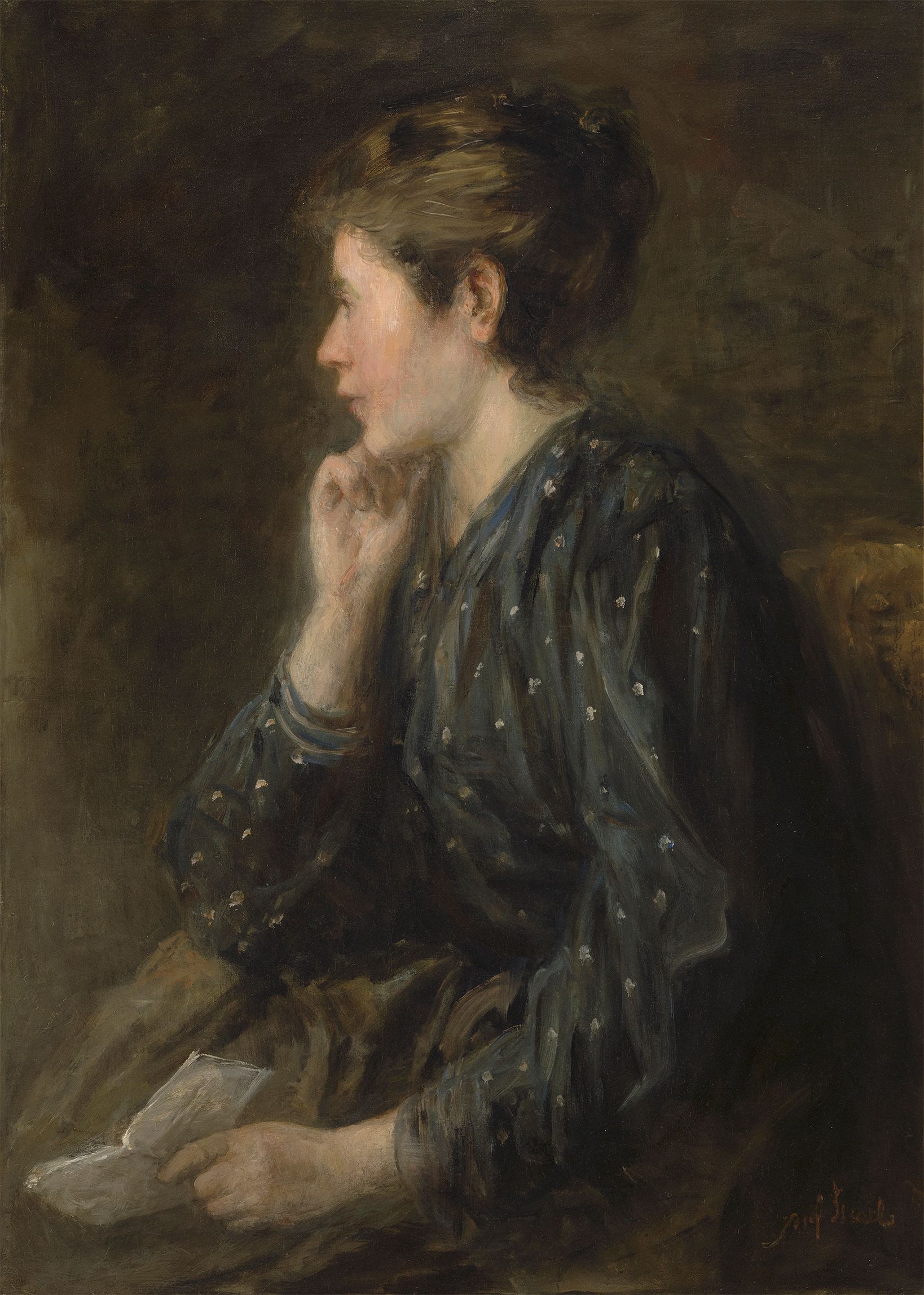
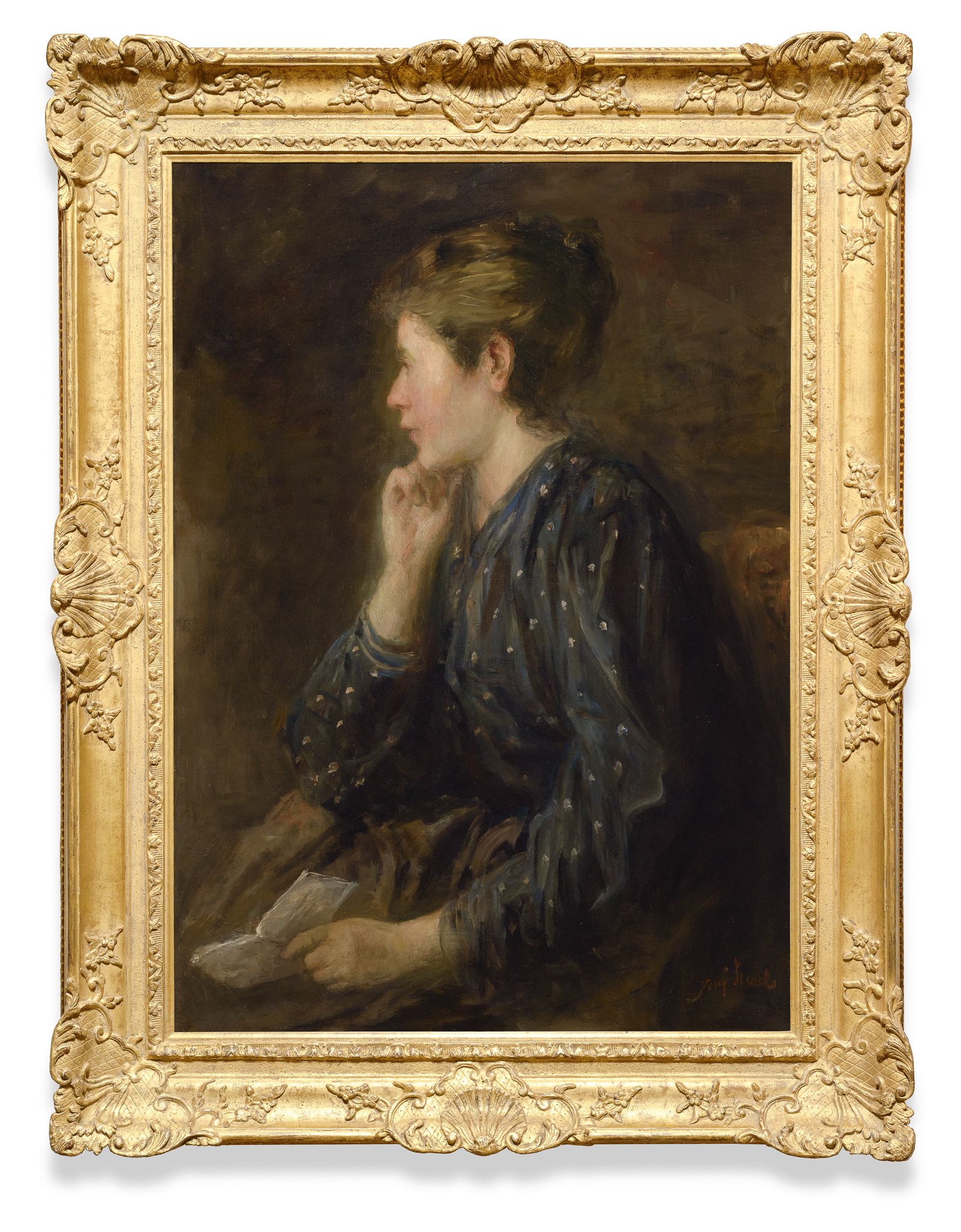
J. (JOZEF) ISRAELS 1824 Groningen - 1911 Den Haag La Lettre (The Letter)
Oil / Canvas: 96,5 x 68,5 cm
- This artwork can be viewed in our gallery
- Call us for more information: +31 26 361 1876
- World wide shipping available
Details
Jozef Israels achieved his greatest renown as a painter of beach scenes and subjects drawn from the lives of fishermen in Scheveningen, Katwijk and Zandvoort. In Israels’ work, the emotional dimensions of the harsh fishing life take precedence, in contrast to his friend and colleague Hendrik Willem Mesdag, who focused more specifically on fishing boats at sea and fishermen battling the elements.
Initially, Israels trained as a landscape painter, receiving his first instruction in his native Groningen. Gradually, his interest shifted towards history painting, and at the age of eighteen he went to Amsterdam to study with Jan Adam Kruseman and Jan Willem Pieneman. Between 1845 and 1847 he spent a period in Paris, where he came under the influence of the history painter François-Édouard Picot and other artists such as Horace Vernet, James Pradier and Paul Delaroche. While in Paris, he worked at the Louvre copying after Rembrandt and Diego Velázquez.
After completing his studies in Paris, Israels settled in The Hague, while also spending extended periods in Amsterdam. During the 1850s he found a new source of inspiration in the arduous lives of fishermen and their families. With deep empathy, he sought to convey the atmosphere and the difficult circumstances they endured. The titles of his works—such as Along Mother’s Grave, Drowned Fisherman, After the Storm, Alone in the World, As One Grows Older, The Unfortunate Woman, and The Last Breath—reflect the somewhat sombre themes that captivated him. Through a strong use of chiaroscuro and impasto brushwork, Israels rendered the poignant and often melancholic mood surrounding the fishing community.
At the same time, Israels was equally sensitive to the more light-hearted aspects of coastal life. He frequently depicted children playing by the sea: paddling in the shallow pools left behind by the receding tide, playing with toy boats, and delighting in the simple pleasures of the shore. The boy with a small sailing boat already anticipates his future role as a fisherman, following in his father’s footsteps. In these scenes, the palette shifts noticeably to lighter, more luminous tones, capturing the sunny and cheerful atmosphere of the beach and the sea.
From the 1870s onwards, Jozef Israels increasingly devoted himself to portraiture and to genre scenes with a pronounced portrait-like character. The present painting, entitled The Letter, represents a subject to which Israels returned on several occasions. Closely related is a theme best described as Reverie: women, usually depicted within an interior, gazing out of a window, absorbed in thought, sometimes holding a letter in their hand. Titles such as Waiting, Gazing into the Distance, Sorrowful Thoughts, Melancholy, and Contemplation reflect variations on this same introspective motif. The theme of the “woman with a letter” is, in fact, as old as the Bible itself.
Of Jewish descent, Israels was thoroughly familiar with the Old Testament. Themes drawn from Judaism, such as A Jewish Wedding, recur regularly in his oeuvre. As a history painter, he was moreover well acquainted with the work of the great seventeenth-century masters—foremost among them Rembrandt, who famously painted Bathsheba at Her Bath (1654, Louvre). That painting depicts the married Bathsheba at the moment she receives a letter from King David, summoning her to his palace (Old Testament, 2 Samuel 11:2–15). Rembrandt masterfully conveys her inner conflict and the moral dilemma she faces as a married woman.
In Israels’ treatment of the subject, the letter likewise functions as a catalyst for introspection. The emotional life of the sitter—her anticipation, doubt, longing or melancholy—forms the true subject of the work.
Width: 68,5 cm
St. Paul, Minnesota U.S.A., Minnesota Museaum of Art (on loan from R.E. Peters)
Art Gallery Ivo Bouwman, The Hague, 1975
Collection Ploum, Limburg, 1975
Private collection The Netherlands
Minnesota Museum of Art (on loan from R.E. Peters), St. Paul, Minnesota U.S.A.
Over J. (JOZEF) ISRAELS
Jozef Israels derived his greatest fame as a painter of beach scenes and themes from the lives of Scheveningen, Katwijk, and Zandvoort fishermen. Here, the emotional aspects of the harsh fishing life are especially central. His life spanned nearly a century. Jozef Israels began painting when he was eleven. His art gently changed with the century to finally use the looser touch like that of his son Isaac. Born in Groningen, Jozef was raised in a traditional Jewish family. His parents wanted him to become a rabbi, but at an early age, his talent for drawing became apparent. After studying at the Academy in Amsterdam, Jozef briefly left for Paris, where he learned about Ary Scheffer and Romanticism, Jongkind and the Barbizon painters, among others. Despite his training, Israels did not become a history painter. Recovering from an illness, brought Israels to Zandvoort where he saw the often wretched conditions in which fishermen and their families lived. Painting grief, sorrow, anxious waiting, vigilance, parenthood; in short, the great emotions surrounded by dunes and sea, rendered in a sober and subdued manner. Later in his life, he also devoted himself to painting Jewish scenes. From 1871 until his death, Jozef Israels lived and worked in The Hague. There, he became close friends with H.W. Mesdag, with whom he founded several drawing and painting societies, like the Hague School. In 1865, his son Isaac was born and trained until he departed for Amsterdam 20 years later. Father and son Israels traveled throughout Europe, which is documented in their travel stories and drawings. Jozef Israels' work is internationally known and can be found in major museums and private collections.