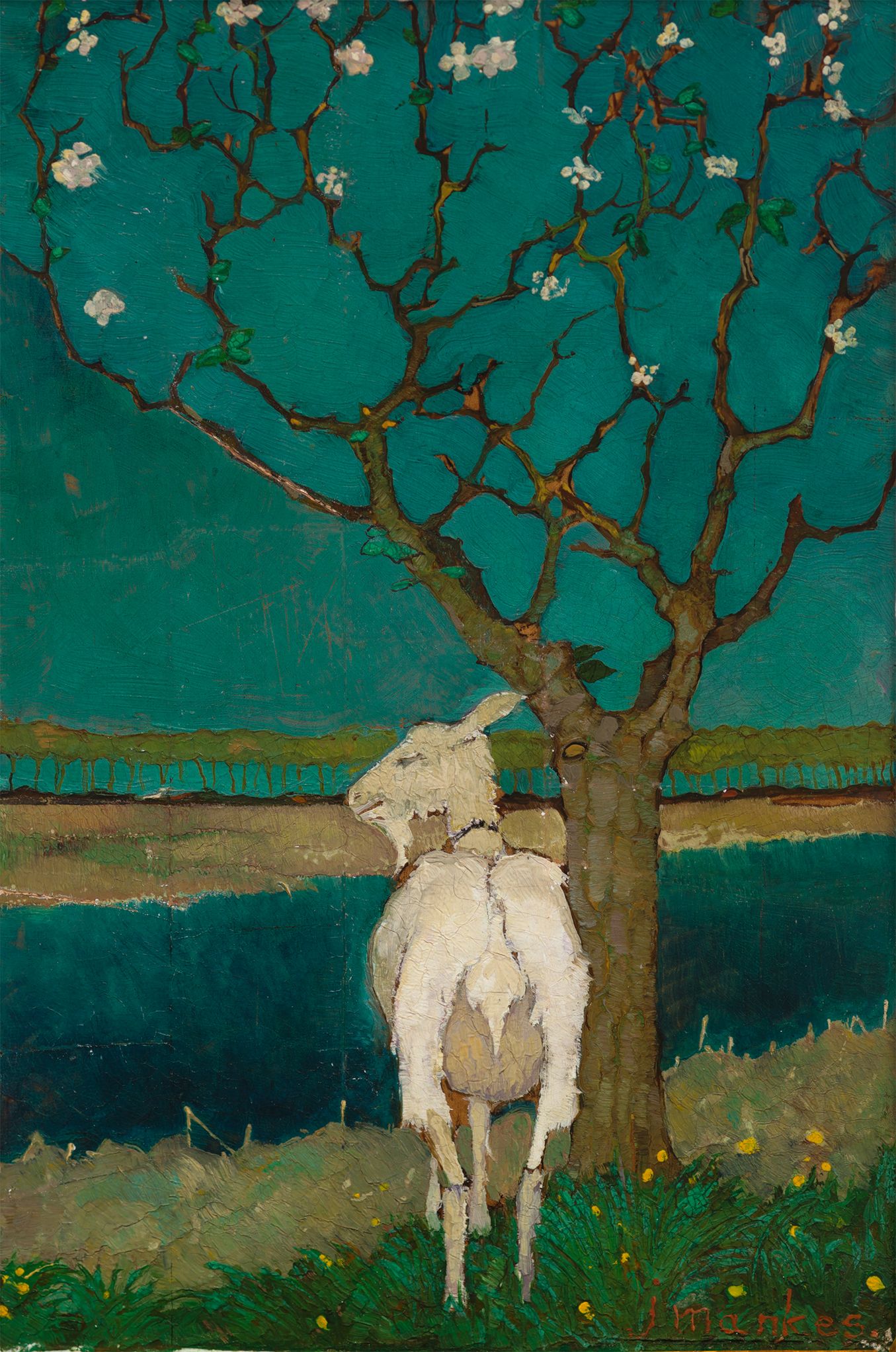
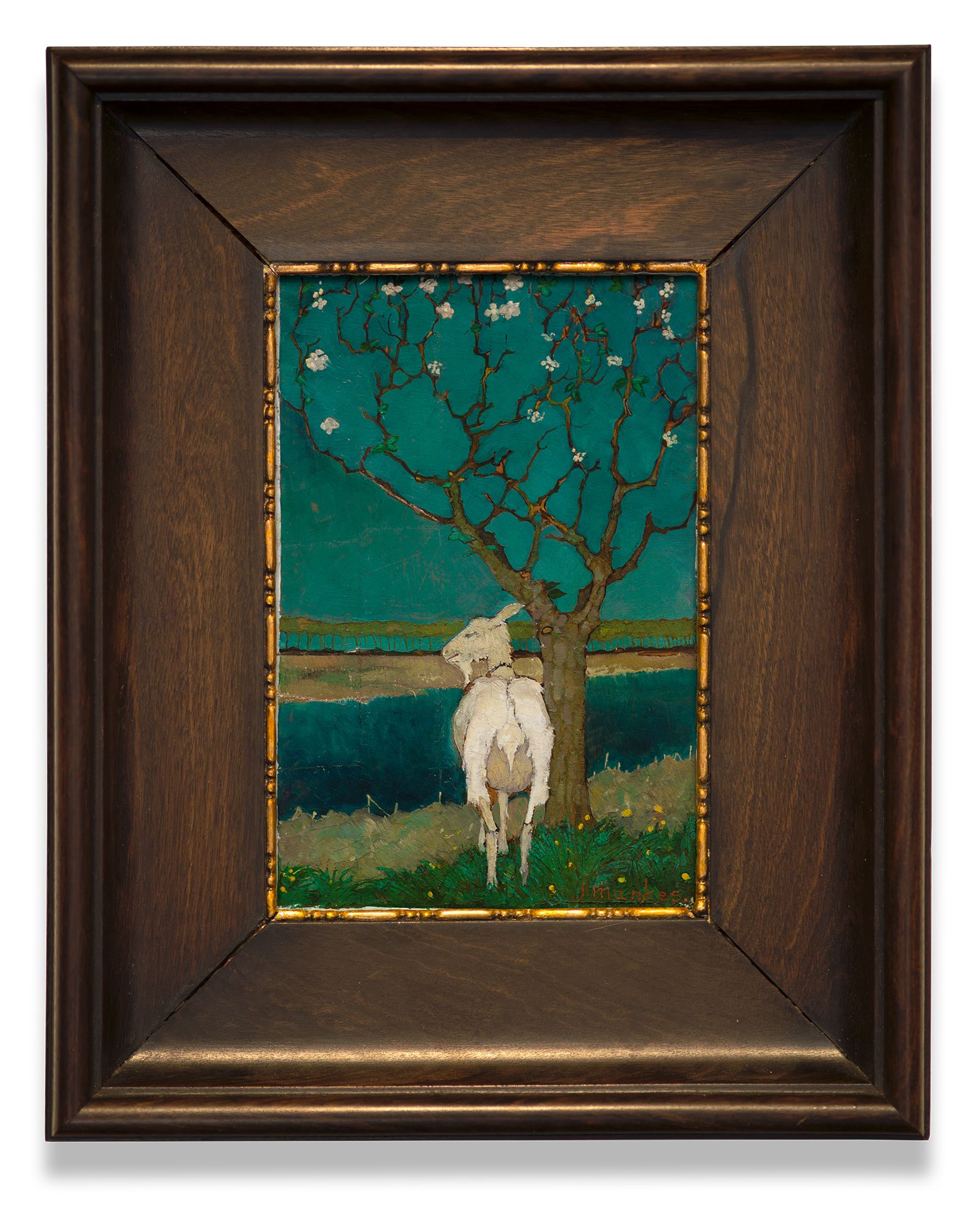
JAN (JAN) MANKES 1889 Meppel - 1920 Eerbeek Goat by Blossoming Tree
Oil/panel: 15 x 10 cm
- This artwork can be viewed in our gallery
- Call us for more information: +31 26 361 1876
- World wide shipping available
Width: 10 cm
Private collection The Netherlands, since 1919
J. Bouwhuis, H. Steenbruggen, 'Jan Mankes. Mooie dingen zijn zoo eenvoudig', Arnhem, Heerenveen, 2025, p. 162, no. A25-210
Over JAN (JAN) MANKES
Jan Mankes is regarded as one of the most cherished and singular painters in early twentieth-century Dutch art. In a life of only thirty years, he created a small but exceptionally refined oeuvre: restrained still lifes, landscapes, studies of birds and animals, and self-portraits, painted with an almost meditative attention to light, silence, and detail.
Mankes was born in Meppel on 15 August 1889, the son of a tax official. When the family moved to Delft in 1903, he was apprenticed to the stained-glass studio of J.L. Schouten, then engaged in restoring the celebrated windows of the Sint-Janskerk in Gouda. He also took drawing lessons from Hermanus Veldhuis and attended evening classes at the academy in The Hague, but he received no formal training as a painter; Mankes was largely self-taught. In 1909, the family settled in De Knipe, near Heerenveen in Friesland. In the stillness of the Frisian countryside, Mankes found his subjects close to home: an owl, a young goat, a row of trees along the canal. He painted the visible world, yet always sought the essence of things, working with a delicate, pearlescent palette and a hushed, controlled touch. His work has been associated with the Dutch fine painters and the Luminists, but ultimately resists classification within any movement. In 1915, Mankes married Anne Zernike, the first female minister in the Netherlands. The couple lived in The Hague for several years. After Mankes was diagnosed with tuberculosis, they moved in 1918 to the wooded village of Eerbeek in Gelderland, where their son was born. Jan Mankes died there on 23 April 1920, aged thirty. His grave monument in Eerbeek was designed by his friend, the artist Chris Lebeau. Mankes left around 150 paintings, along with drawings and prints. His work is represented in Museum Arnhem, Museum Belvédère in Heerenveen-Oranjewoud, and Museum MORE in Gorssel, among other collections, and remains highly sought after by collectors to this day.