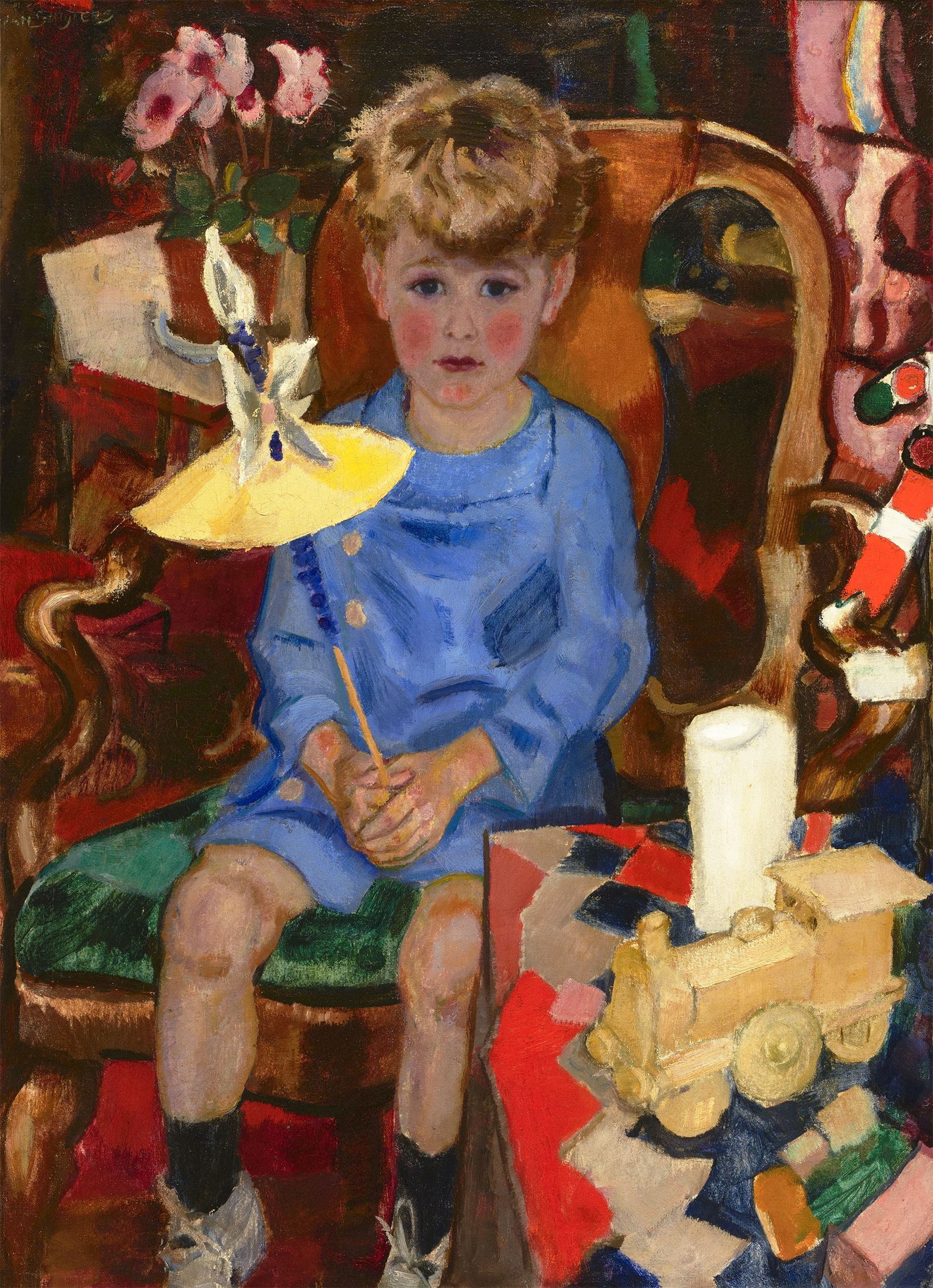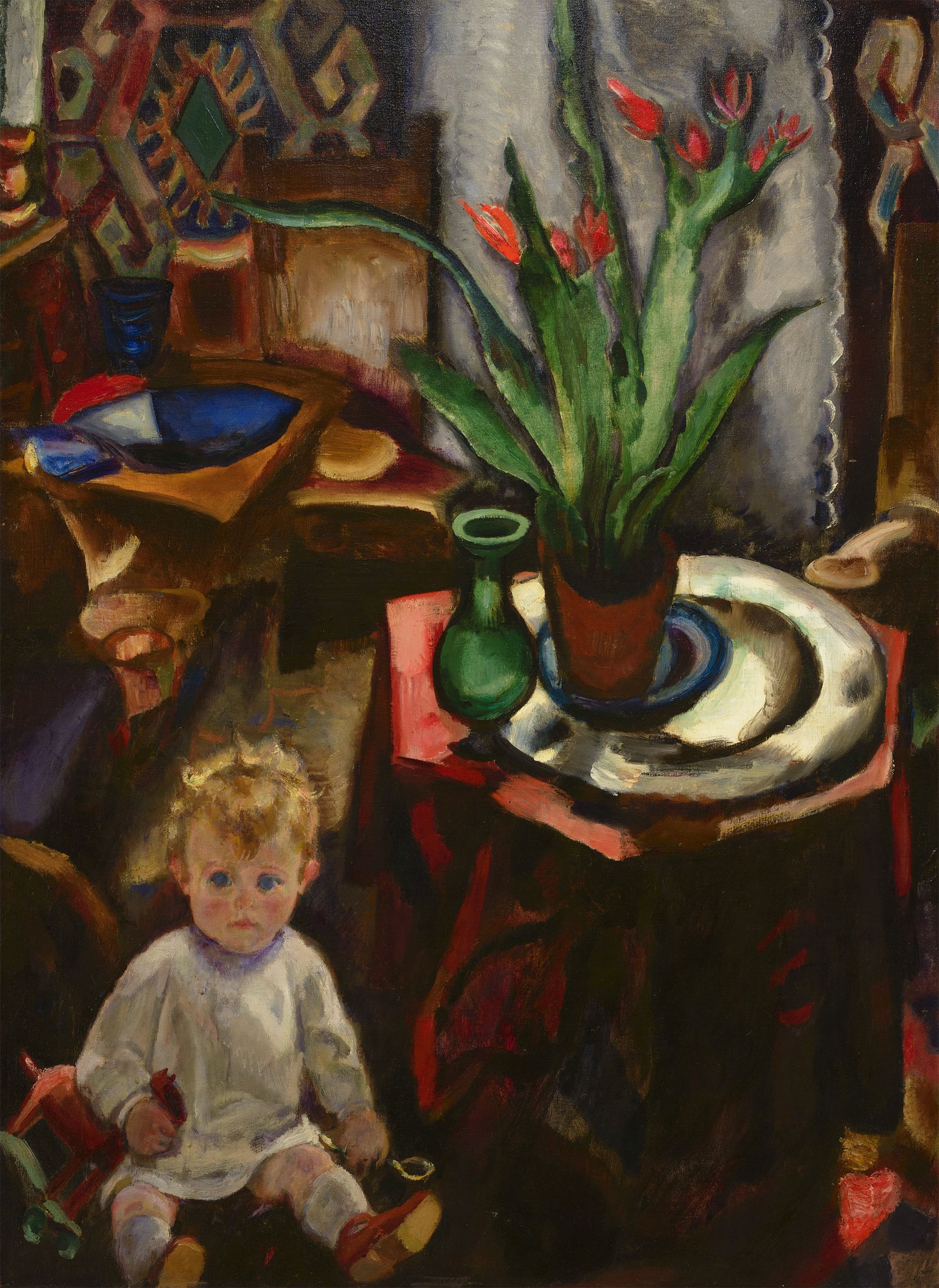
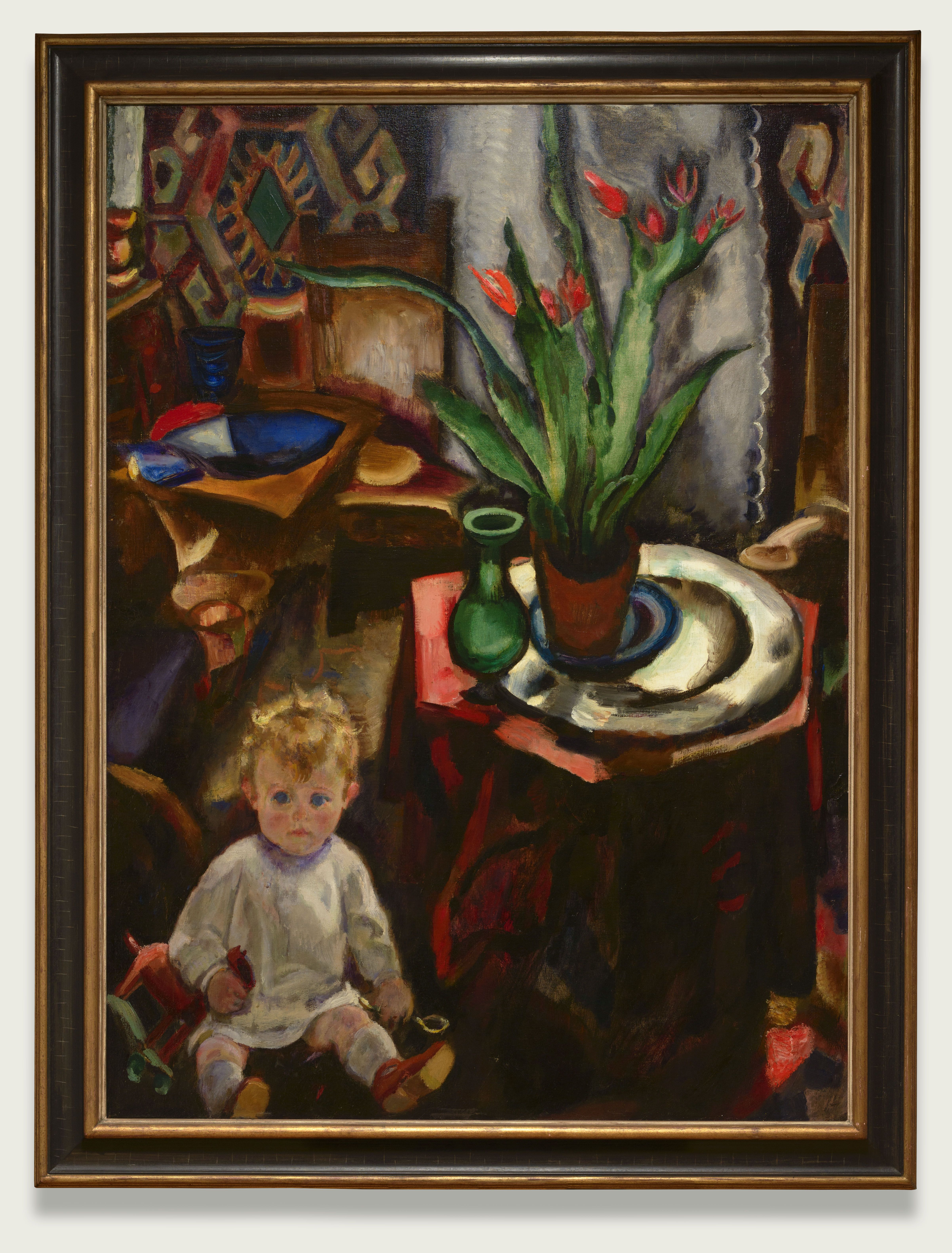
J.C.B. (JAN) SLUIJTERS 1881 Bois-le-Duc - 1957 Amsterdam A Child with a Cactus | On loan for exhibition 'De kinderen van Sluijters', 3 October 2026 - 21 February 2027, Het Noordbrabants Museum
Oil / Canvas: 129 x 96 cm
- This artwork can be viewed in our gallery
- Call us for more information: +31 26 361 1876
- World wide shipping available
Details
Jan Sluijters: Portraits of Children
Jan Sluijters's (1881–1957) portraits of children occupy a special place within his oeuvre. He painted his own children, as well as children from his immediate circle, and on commission. In these often intimate works, Sluijters combined a keen power of observation with the free, colourful manner of painting so characteristic of his art.
With loose brushwork and pronounced contrasts of colour, he gave his young sitters a remarkable presence. Clothing and backgrounds are frequently rendered freely and spontaneously, while attention is concentrated on the face and above all on the gaze. The result is portraits that not only capture a striking likeness but also seem to convey something of the child's character and inner world.
For a long time, these works were valued chiefly for their charm and were sometimes even dismissed as sentimental. Today, their painterly significance is more widely recognised. It is precisely in the portraits of children that Sluijters's ability to unite intimacy and recognisability with the achievements of modern painting comes to the fore.
These portraits thus form a chapter of both personal and artistic significance within his oeuvre and within Dutch portraiture of the first half of the twentieth century.
This painting belonged to the art dealer Jacques Goudstikker, who died while fleeing the Nazis. His collection was seized, and part of it was auctioned at Mensing & Zoon in Amsterdam in October 1940. In 2023, it was restituted to Jacques Goudstikker's sole heir.
Width: 96 cm
Art Gallery Jacques Goudstikker-Miedel, Amsterdam 1923, inv.no. 6166
Sale at Mensing en Zoon, estate of J. Goudstikker, Amsterdam, 10-09-1940, lot 117
Art Gallery G.J. Scherpel, Bussum 1981
Sale Sotheby's, Amsterdam, 29-09-1986, lot 243
Private collection The Netherlands, 1986-2023
Restituted to the heirs of Jacques Goudstikker, Amsterdam, 2023
Amsterdam, Stedelijk Museum Amsterdam, 'Tentoonstelling van, ter gelegenheid van het regeringsjubileum 1898-1923', 1923
Amsterdam, Gebouw voor Beeldende Kunst, 'Overzicht van het werk van Jan Sluijters', 1923-11 (see review)
Rotterdam, Rotterdamsche Kunstkring, 'Tentoonstelling werken van Jan Sluijters', 1923-02-11, no. 4 (title: Kinderportret in interieur; zie artikel in het NRC, 21 Feb. 1923)
The Hague, Pulchri Studio, 'Jan Sluijters', 1930-04-06, no. 54
Laren, Singer Museum, 'Jan Sluijters', ca. 2000
Bois-le-Duc, Noordbrabants Museum, ‘De Kinderen van Sluijters’, 21-09-2026 – 7-02-2027
W.J. de Gruyter, 'Jan Sluyters. Pulchri Studio', Het Vaderland, .. April 1930, avondblad C (' In het laatste doek is de kamer de schoone droomtuin van het kind geworden en bloeien al de groote, bonte dingen als vreemde gewassen rond het kind omhoog...')
..., 'Kunst in Den Haag. Jan Sluyters in "De Opbouw", Algemeen Handelsblad, 12 October 1922 ('.. Zoo'n interieur als dat met de zittende baby op den voorgrond schijnt haast in drift gedaan. Maar hoe ontwart zich uit de veelheid van lijnen en kleuren bij nadere beschouwing een zuivere harmonie die zonder overleg, bij intuitie schijnt te zijn bereikt.')
..., 'Rotterdamsche Kunstkring. Jan Sluyters. II', NRC, 21 Feb. 1923 ('..Heerlijk is daarbij dat dreumesje op den grond, boven hem heel de kamerrommel.')
..., 'Rotterdamsche Kunstkring. Jan Sluijters (Slot)', NRC, 4 March 1923 ('En ook het ouder geworden kind: het groot-blauwoogige ventje met ballon en pop, met heel zijn wereldje van speelgoed rondom; of, kruipend op den grond, door zijn domein "de kamerruimte" - achter in de zaal rechts -, waar het als een kleine dreumes, naast het donkere vlak van het tafelkleed, zijn groote, ronde blauwe kijkoogen op den schilder heeft gericht, verwonderd starend, een beetje schuchter, "wat die vreemde man daar moet?". Zijn speelgoed laat het liggen, zijn handjes zijn werkeloos, alles in hem concentreert zich op die verbazing! Het licht valt over zijn blonde bolletje, over het witte jurkje heen. Onder in den hoek zit het, amper boven de lijst uitkomend, en boven hem is heel de kamerruimte met al de dingen, kleurvlekkend, daarin nauwelijks te onderscheiden; doch waarin toch alles zijn beteekenis heeft. Neem de roode vlak rechts onderop weg, en het evenwicht is verstoord.')
..., 'Gebouw voor Beeldende Kunsten. Jan Sluyters. II', NRC, 9 Dec. 1923 ('.. en dat heerlijke blauwoogige krullekopje, in een hoek van de lijst gezet /.../ Of hij zijn blauwoogig jongske schildert, daar preutsch in een hoek van de kamer zittend; of die wonderlijke Staphorster landschappen, waar een stijf boerinnetje even voorbij scheert onder op het doek (in de achterbovenzaal): /.../, om het even, een sterke suggestie gaat van alles uit.')
The work is included in the Catalogue Raisonné by the Netherlands Institute for Art History (RKD) in The Hague
Permalink: https://rkd.nl/images/100770
Over J.C.B. (JAN) SLUIJTERS
Jan Sluijters is among the most important Dutch painters of the first half of the 20th century. In 1904, he won the Prix de Rome. Sluijters became familiar with modern French painting in Paris in 1906/1907 and had a decisive influence on his work. Here he came into contact with new movements in art such as Fauvism (Matisse, De Vlaminck, Roualt, Van Dongen) and Luminism (Seurat, Signac). In the years 1906 - 1916 he earned recognition as one of the great innovators of Dutch painting. In the period when Sluijters was one of the most important representatives of Dutch luminism, especially in the years 1907-1911, the subject of woods, trees, avenues and country roads regularly recurred in his work; more than 15 times - as far as is known - this theme was treated by him either separately or combined. The forest scenes from 1907 and 1908 remind us of the compositions and use of color of Vincent van Gogh (1853-1890). The topography, perspective and accurate rendering of trees and foliage dominate the compositions from these years. Due to private circumstances, Sluijters moved to Heeze in Brabant with his girlfriend Greet van Cooten. There he painted a number of exuberant forest scenes, orchards and farms. Color contrasts, divisionist short paint strokes in horizontal and vertical shapes alongside the longer lines of tree trunks characterize the handwriting. Influence, choice of the same subjects and collaboration between Piet Mondrian (1872-1944), Leo Gestel (1881-1941) and Sluijters has been addressed by many authors. Again, the nature studies of trees in non-realistic colors, which are meant to express an expression of the observation of nature, reveal not only similarities but also differences between the three artists. In 1908 Mondrian painted his famous and monumental "Forest near Oele" (collection Haags Gemeente-museum), which particularly emphasizes horizontal and vertical lines in yellow and blue-violet color contrasts. This painting, first exhibited in January 1909 at a joint exhibition of Kees Spoor (1867-1928), Sluijters and Mondrian at the Stedelijk Museum in Amsterdam, must have made a great impression on Sluijters. The way the trees in the 1910 "Boschlaantje" are given shape and color attests to this influence, but also to Sluijters' greater emphasis on the more colorful range of colors: blue, violet, yellow, red, black and many varieties of green. Perspective played less and less of a part in forest scenes of 1910 and 1911; in the "Boschlaantje" indicated only by the location of the trees and the short brushstrokes of the road. As in the "Forest near Oele," the trees and crests reach into the sky and conclude the painting at the top. Horizon and foliage flow smoothly into each other. The paintings Sluijters made in 1910 are some of the finest works of his luminist period. Such is the case with "Boschlaantje," in which the interplay of short and long lines, broad and narrow areas of color plays out in an almost abstract manner. Yet Sluijters continues to see the forest through the trees; the composition remains recognizable. Sluijters was not concerned with "the search for effect, to show off colors," as he confided to his painter friend Kees Spoor in 1910, but with expressing in paint "a fiercer sense of superiority of spirit, which is moved by the things that stand above the mere optical perceptible." During 1911, coinciding with his departure from Laren, Sluijters broke with luminism and took a different artistic path.
More from this artist