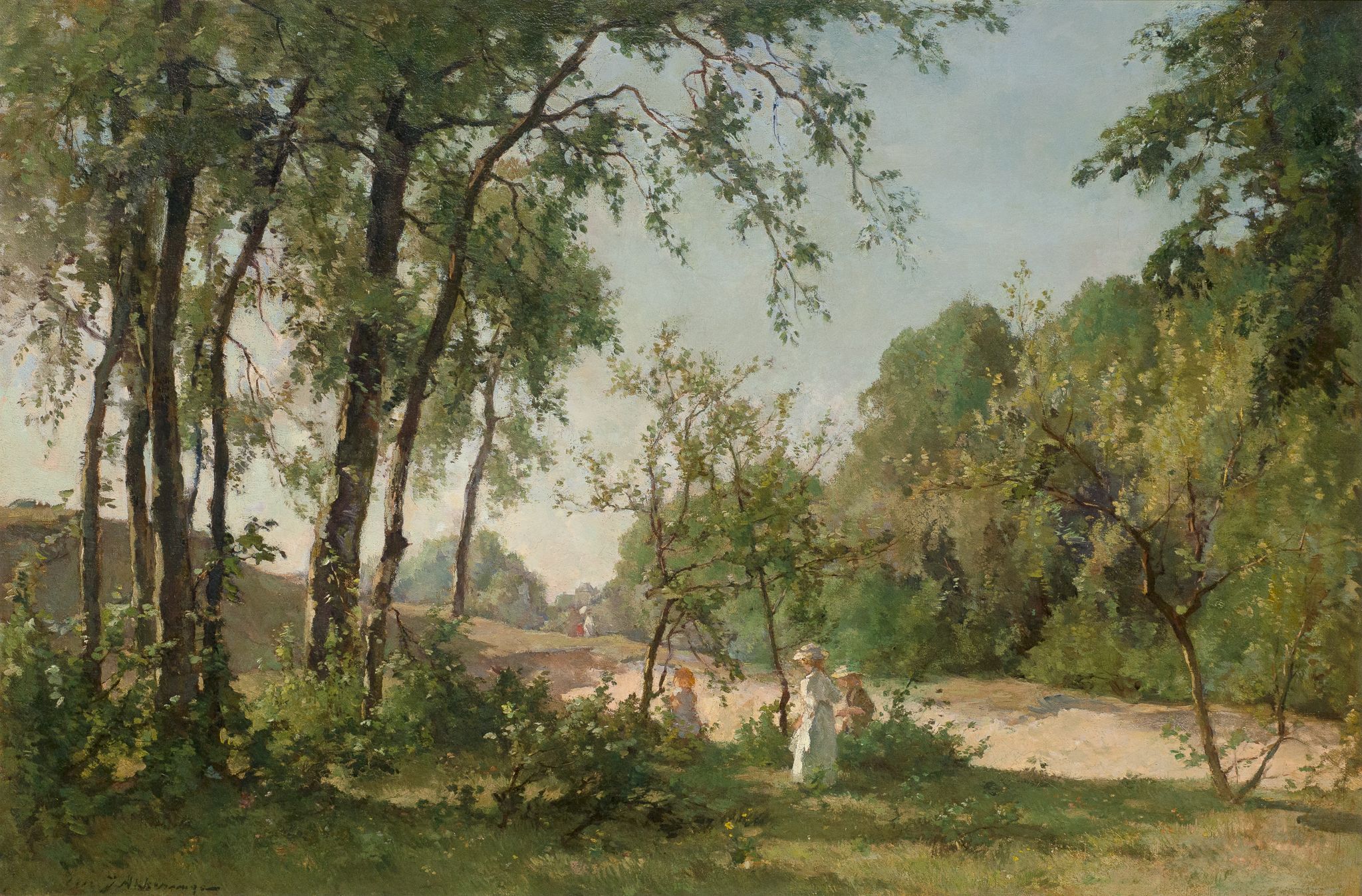
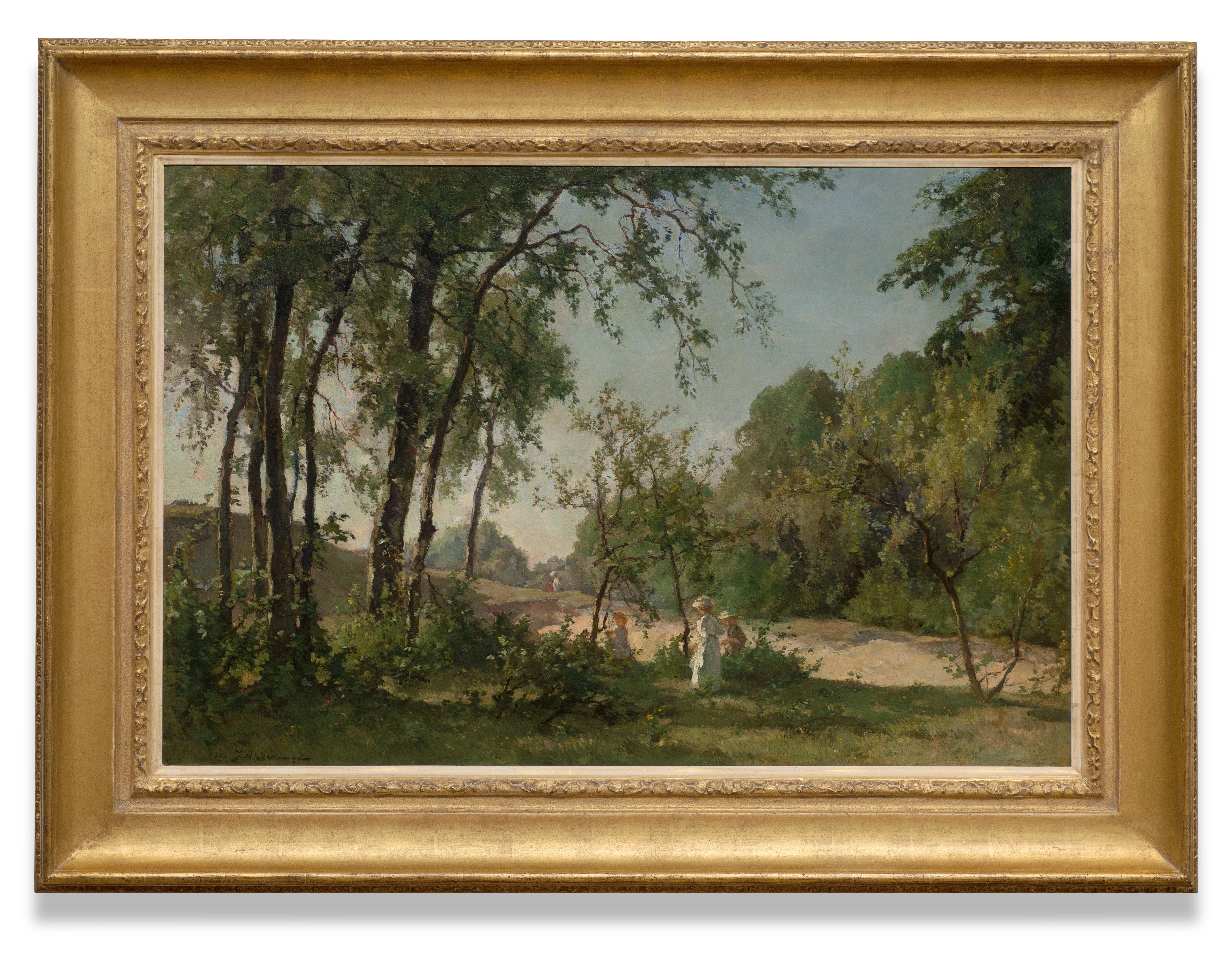
J.E.H. (JOHANNES) AKKERINGA 1861 Banka - 1942 Amersfoort In the Dunes
Oil / Canvas: 60 x 90 cm
- This artwork can be viewed in our gallery
- Call us for more information: +31 26 361 1876
- World wide shipping available
Details
Johannes Akkeringa was born in the Dutch East Indies, on the island of Bangka near Sumatra, the son of a Dutch engineer employed at the tin mines and a Javanese Chinese mother. When he was barely two years old, his father died suddenly, and he was sent to the Netherlands together with his brother and sister. He never saw his mother again. Akkeringa grew up with relatives in The Hague, surrounded by the subjects that would define the Hague School: the dunes, the fishermen, their wives and children, and the beach formed the backdrop of his childhood. At seventeen, he was admitted to the Academy of Fine Arts in The Hague, where he met Willem de Zwart, Floris Verster, and Marius Bauer. Like him, they ventured into the countryside around the city to draw and paint, developing a fresh, bright-coloured Impressionism that set them apart from the older generation of Hague School painters.
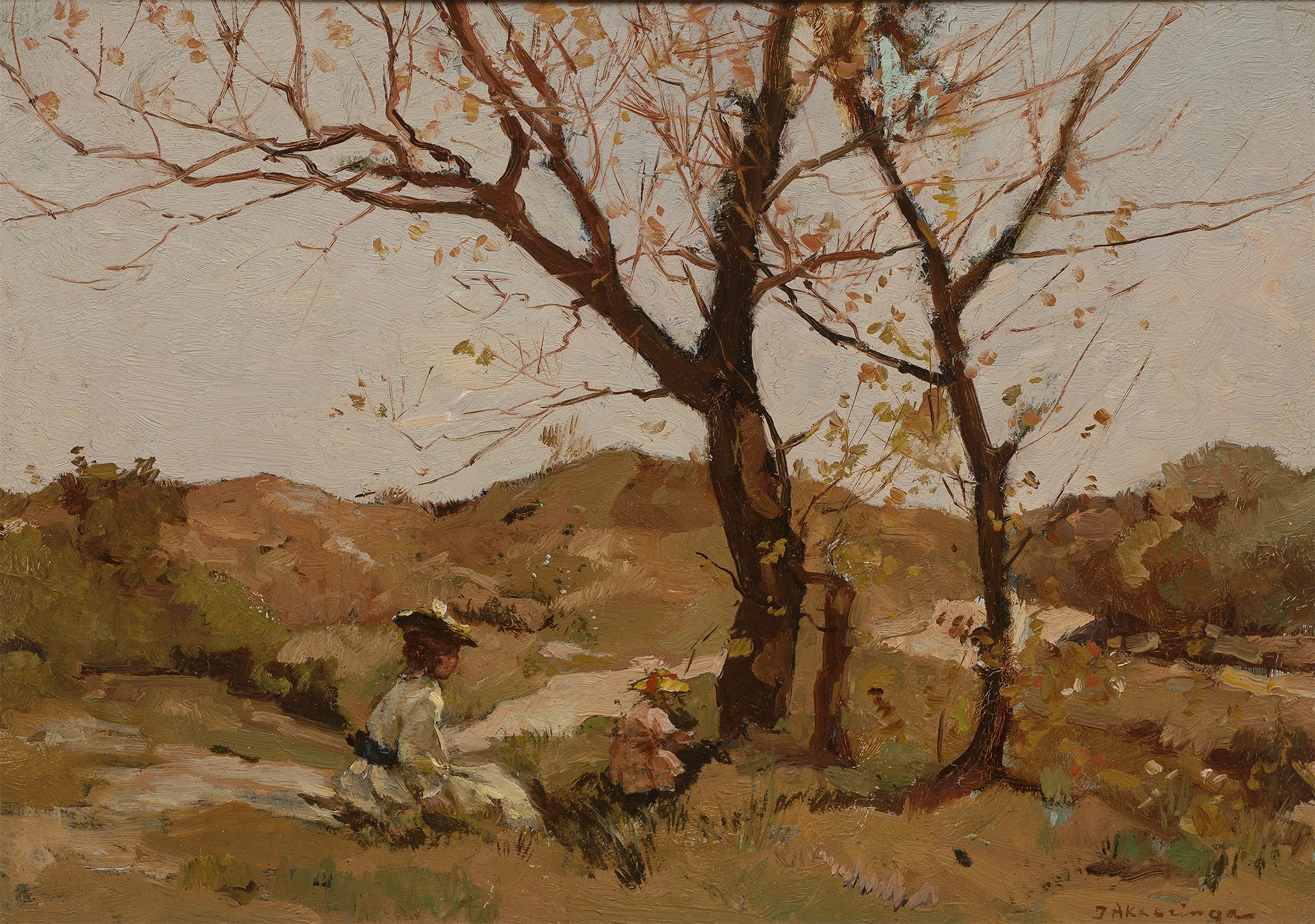
For Akkeringa, the dunes outside The Hague were not the setting for a hard, impoverished fishing life, but an idyllic landscape in which contented family life unfolds. The world of the fishermen was a favourite subject, though treated very differently from the approach of older Hague School painters such as Josef Israels. In Akkeringa's work, fishermen's children build sandcastles, dig holes, or paddle in the sea, while their mothers mend nets in picturesque traditional dress and their fathers busy themselves with their boats. In later years he favoured depictions of tea parties in flower-filled gardens. His interest in such subjects has often been attributed to his own childhood as an orphan. He was known as a devoted family man, and his wife, sons, and friends' children appear regularly in his paintings.
The painting In de duinen is a particularly appealing example of Akkeringa's gift for evoking the carefree atmosphere of a summer's day. The composition is subtly constructed in layered planes. The foreground lies in shadow; behind it, where the slope of a dune draws a diagonal across the canvas, a dune hollow gleams in the sunlight. Two girls are playing there, watched closely by their mother or a governess. In the distance, a few more figures and some fishermen's cottages are just visible.
Akkeringa moved frequently but generally remained in the vicinity of The Hague, painting the world immediately around him. The city was growing and changing rapidly, and painters continually sought out places that still felt authentic and unspoilt. For a time, he had a studio in Loosduinen, a village that Vincent van Gogh had already praised, a few years earlier, for its pristine dune landscape. A small artists' colony briefly took shape there, known as the 'Hague Barbizon'. He later lived near the Scheveningen Woods, where city children were brought by their mothers or nursemaids to play. When he was based in the city centre, he was drawn to painting the genteel pleasure gardens on the outskirts of town.
Through carefully considered compositions, a refined touch, and a scrupulously balanced palette, Akkeringa created atmospheric and intimate scenes that quickly found favour with art lovers. His long-standing contract with the Amsterdam art dealer E.J. van Wisselingh & Co. brought his work to international attention.
Width: 90 cm
Private collection The Netherlands
Over J.E.H. (JOHANNES) AKKERINGA
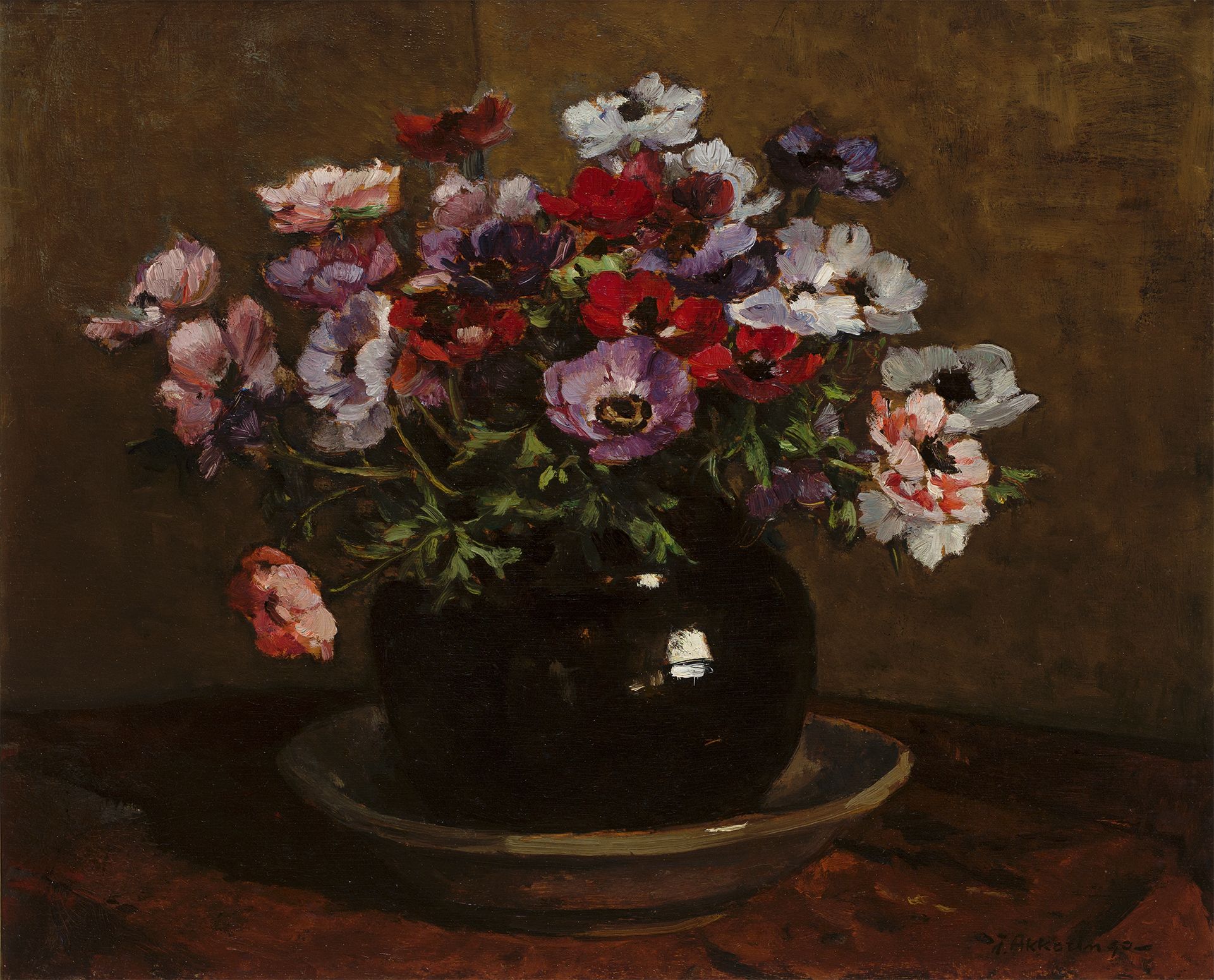
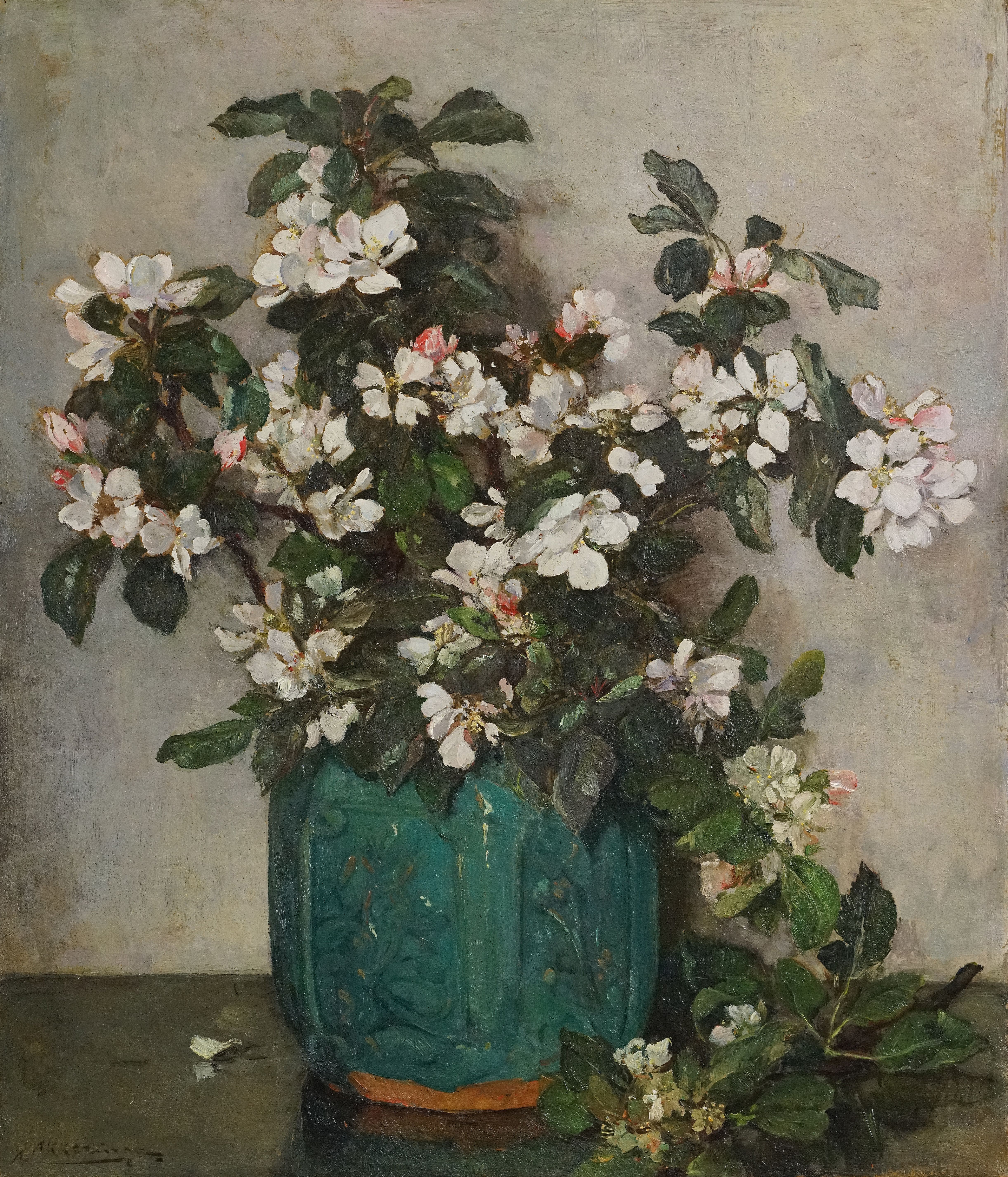
The title of a retrospective exhibition at the Katwijk Museum in 2010 “Akkeringa, painter of the carefree life” is a good description of his work. Born in the Dutch East Indies, he lost his father early in life and was sent to The Netherlands as a young boy to grow up in the household of an aunt. His difficult youth is probably the reason his subjects ranged from children happily playing by the seaside, tea parties in lush summer gardens, mothers with children in parks or walking in the countryside to peaceful still lives of flowers; the depiction of a happy world. As an artist he followed the traditional academic path first in The Hague, later in Rotterdam. Akkeringa became a member of all the well-known artists societies of his time and worked together with several famous Dutch artists like Jan Toorop, Willem de Zwart and George Breitner. In 1887 Akkeringa moved to Loosduinen, near The Hague, as the area was viewed as one of the last remaining authentic unspoilt landscapes in the region. Together with several contemporaries the so-called “Loosduinse painters colony “or “The Hague Barbizon “began. In mid-1909 Akkeringa built a studio in the dunes at Meijendel, between The Hague and Wassenaar. The studio was financed by his art dealer Van Wisselingh and served as a classroom in which Akkeringa taught his students. He was married twice and had several children who often were the subjects of his paintings. In 1903 he moved from The Hague to the province of Brabant away from the coast. He died in 1942 at the age of eighty-one. His style throughout his successful career can be described as subtle impressionism: a combination of strong and pastel colour hues rendered in confident brushstrokes catching the atmosphere and the light of the moment. His still lives are realistic in their simplicity with usually one type of flower in traditional Dutch vases on a bare table. Apart from a trip in 1932 to visit his oldest son Leo, who lived in Paris, Akkeringa did not travel abroad. His paintings though, did. Not only were they exhibited in Amsterdam at E.J.van Wisselingh’s gallery but also at the London branch of the company. He participated in several international exhibition in Europe and then sending them as far as Buenos Aires in 1910 and Winnipeg in 1913. His work remains popular to this day.