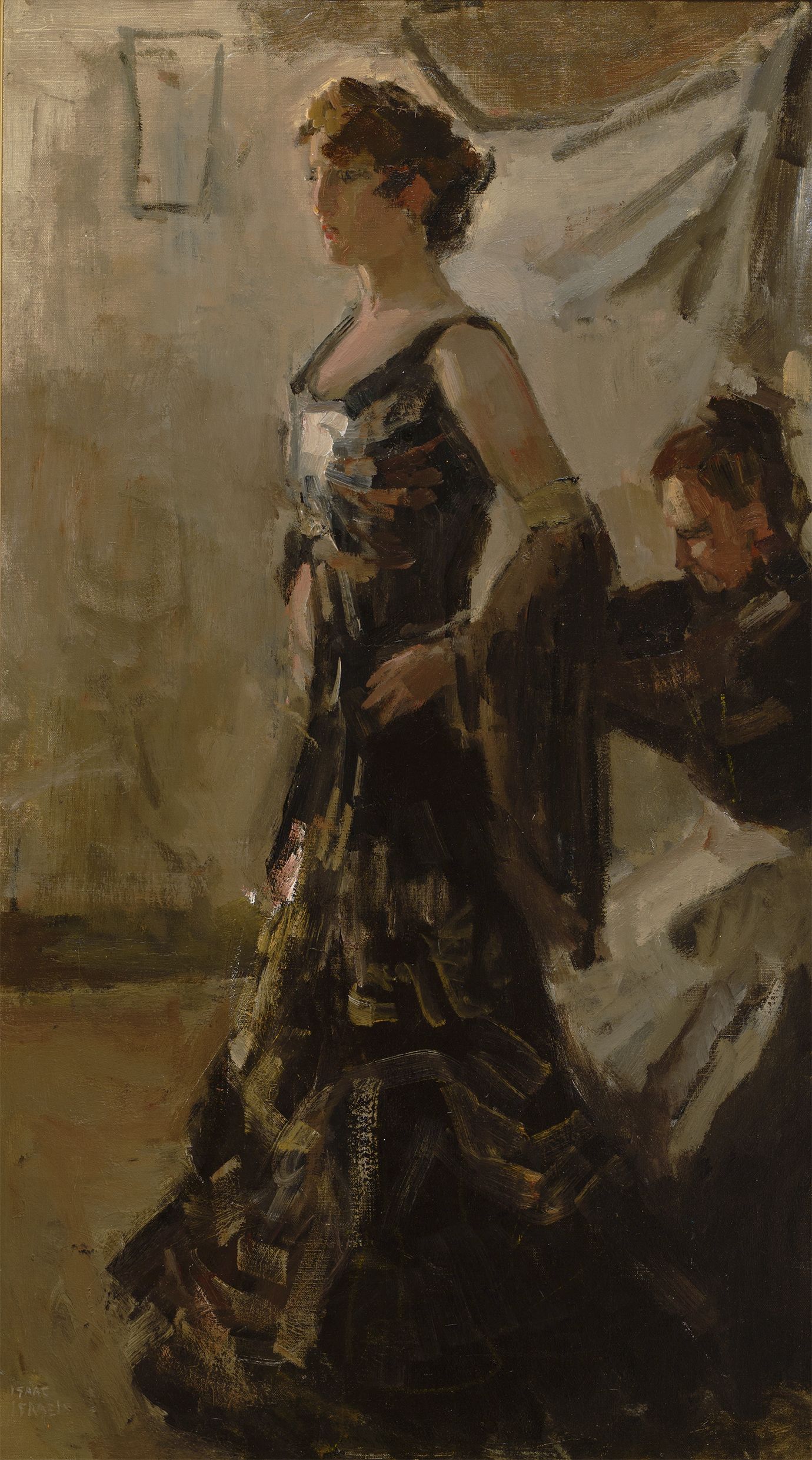

I.L. (ISAAC) ISRAELS 1865 Amsterdam - 1934 The Hague At the Seamstress, Hirsch
Oil / Canvas: 92 x 52 cm
- This artwork can be viewed in our gallery
- Call us for more information: +31 26 361 1876
- World wide shipping available
Details
Isaac Israels (1865–1934), one of the most important representatives of Amsterdam Impressionism, found in the fashion house Hirsch & Cie on Leidseplein in Amsterdam a subject that perfectly suited his fascination with modern urban life. Around 1915, through his friend Thérèse Schwartze, he gained access to the ateliers and fitting rooms of the prestigious fashion house, where the latest Parisian couture was presented. There, he painted a series of works that captured the world of fashion intimately and vibrantly.
Hirsch & Cie was then the very symbol of luxury and modern femininity. Israels became fascinated by the combination of elegance and industry: the seamstresses who worked diligently on dresses, the mannequins who fitted clothing, and the clients who posed in the fitting rooms. His best-known models were the sisters Ippy and Gertie Wehmann, mannequins who regularly posed for him in fashionable gowns. For Israels, their appearance embodied the new, independent woman of the twentieth century—cosmopolitan, stylish and self-assured.
Israel's style in these works is characteristically Impressionist: loose, lively brushwork, subtle play of light, and a preference for capturing fleeting moments. He did not paint the women as idealised beauties but as real people caught in the rhythm of their work. The light that fell through the windows of the fashion house reflected off glossy fabrics and silk, giving the scenes an almost tactile atmosphere of movement and activity. What makes these paintings remarkable is the double layer that Israels managed to incorporate. On the one hand, they show the glamour of haute couture, with sumptuous fabrics and elegant poses. On the other hand, they offer a glimpse behind the scenes of the fashion world: the seamstresses, the ateliers, the fittings and measurements. Israels thus reveals the tension between luxury and labour, between outward splendour and the quiet dedication of those who made fashion possible.
In the works at Hirsch, Amsterdam, he captures this world in balance: young women pose in stylish dresses, surrounded by the soft light of the atelier. The painter avoids theatrical composition, opting instead for a moment of stillness and concentration. In doing so, he transcends the merely decorative and makes fashion a mirror of modern times. Israels' paintings from the Hirsch fashion house belong to the most intriguing chapters of his oeuvre. They show how, like his French contemporaries Degas and Renoir, he linked the daily lives of women in the modern city to questions of beauty, work and identity. In the combination of elegance and realism, Israels captured the essence of his age: a world where art, fashion and modernity meet.
Width: 52 cm
Over I.L. (ISAAC) ISRAELS
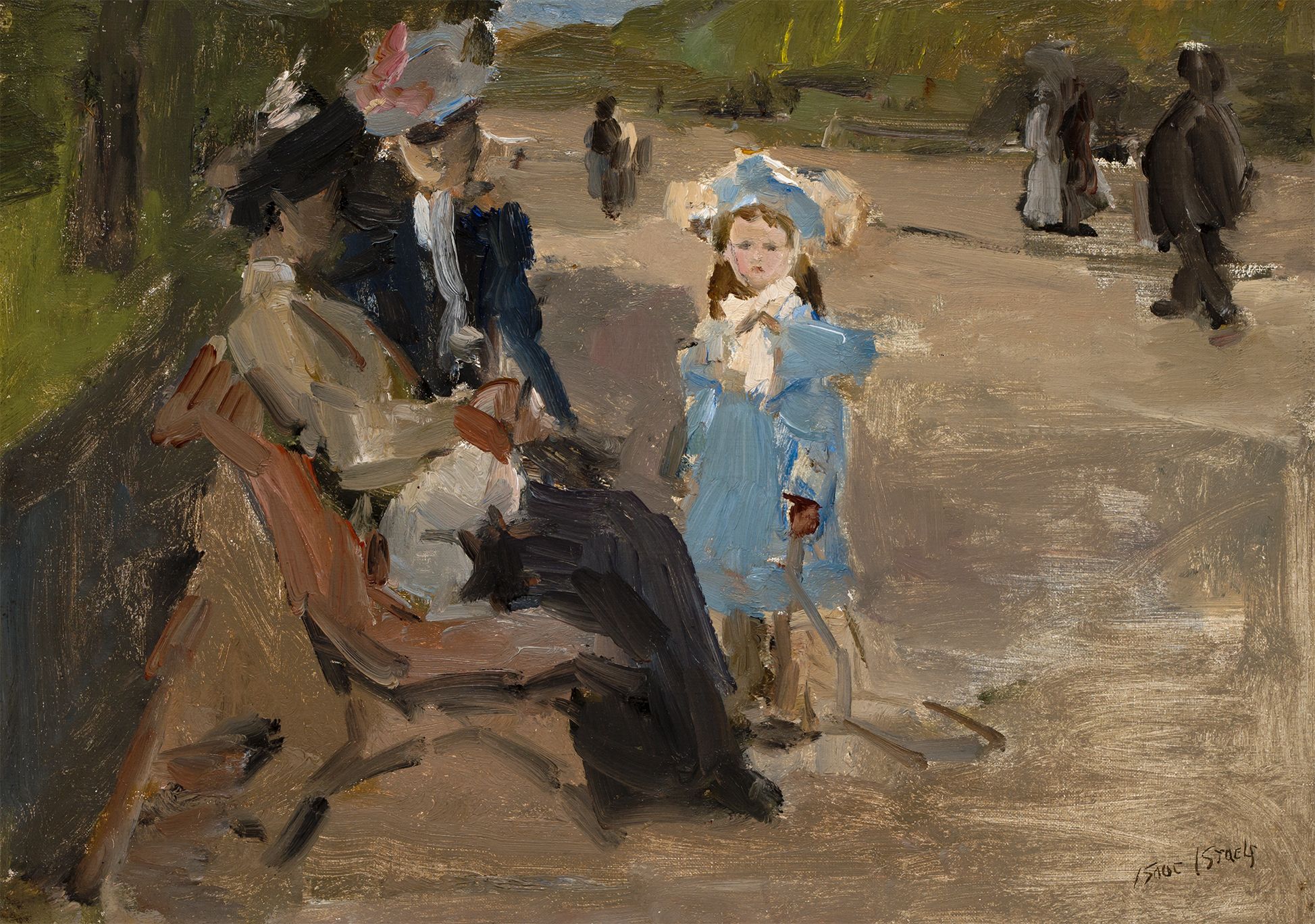
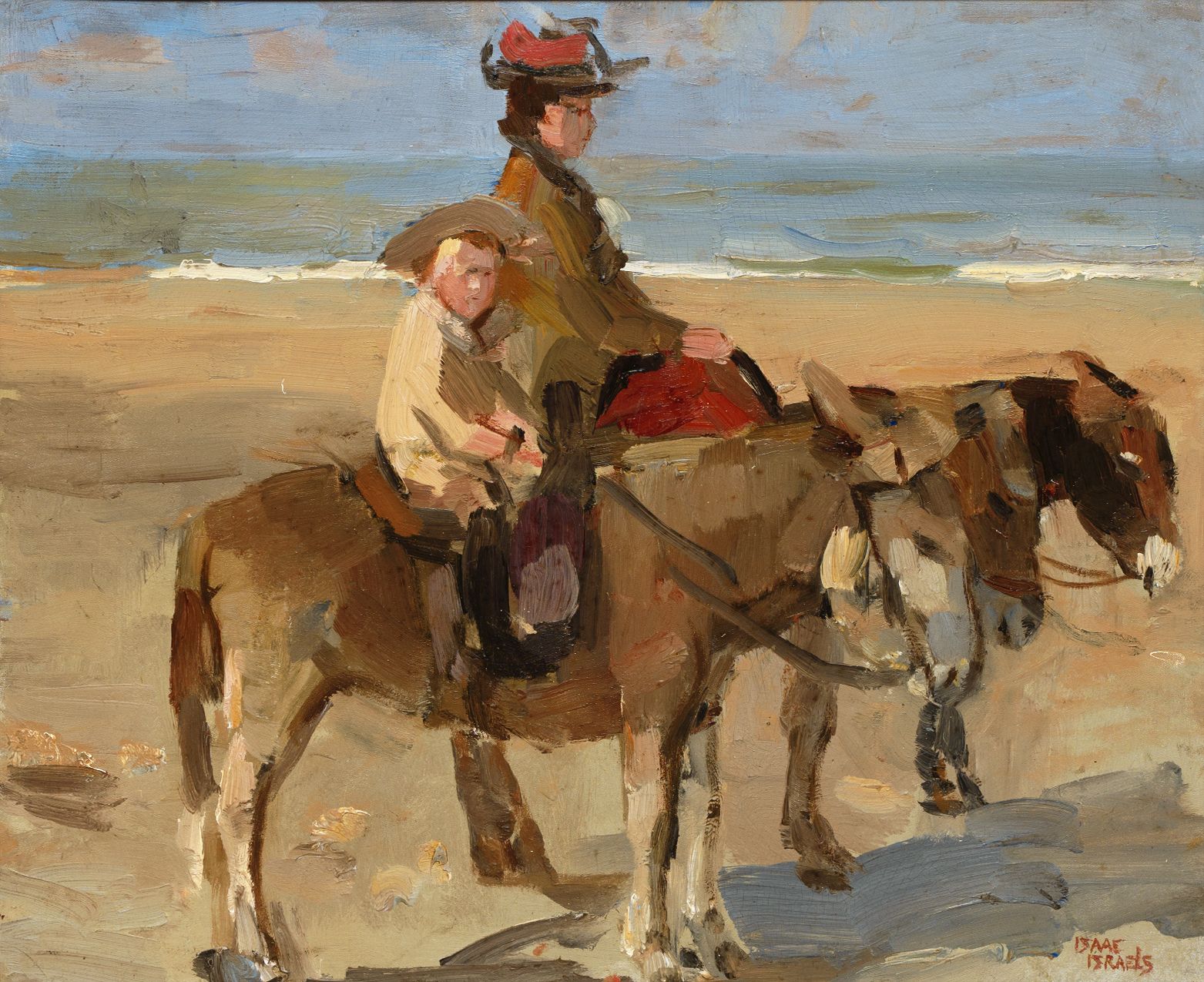
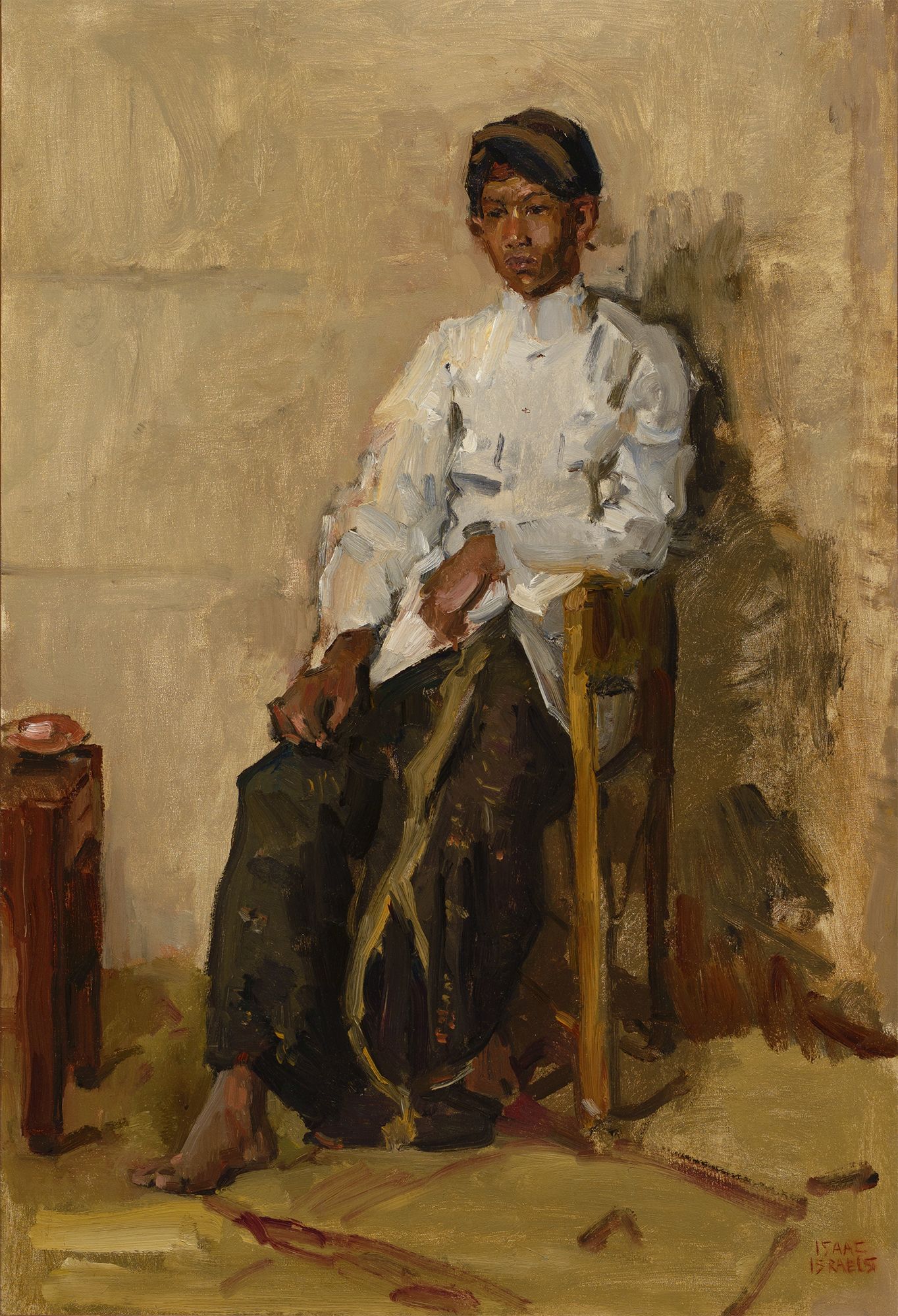
Isaac Israels was the only son of the painter Jozef Israels. The family moved from Amsterdam to The Hague in 1871. Isaac also received his training at the academy at the same time as George Breitner, Floris Verster and Marius Bauer, among others. He was a promising artist from an early age and won awards for his paintings. In the '80s, Isaac specialized in military subjects, an interest he shared with Breitner and Verster. Despite this promising start, he felt his education was not yet complete and went to Amsterdam, where he was accepted into the circle of the Tachtigers. Turbulent city life became the common thread through his work. Between 1887 and 1894, things were quiet around him: few paintings are known from this period. Starting in the mid-1890s, Israels went back to The Hague in the summers where he and his father would paint at the beach. They rented a villa in Scheveningen. His paintings of donkey-riding children were crowd pleasers and are still extremely popular. Israels joked that selling a painting was "the Highest of Arts." His donkey-riding children were eagerly purchased at high prices, and can be considered highlights of his oeuvre for just that reason. Isaac Israels was not only the virtuoso painter of modern (city) life, he was also a gifted portraitist. Especially in the last phase of his life, he commissioned portraits of important Dutchmen. Even in this genre, women remained his favorite subject. All his life he preferred to draw and paint maids, Amsterdam street girls, telephone operators, mannequins in department stores and nude models. His portraits of women are also highlights of his oeuvre, such as of the spy Mata Hari, the first female doctor Aletta Jacobs and the actress Fie Carelsen. Isaac Israels was accustomed to giving a quick characterization of his models. A crisp characterization had to appear on the canvas at once. As such, his best paintings are vivid, spontaneous and struck just right. 'I had an attack of patriotism the other day when I looked out my window to my surprise. Surely the Hollandsche is to my mind the most beautiful thing there is,' Isaac Israels on his way to London from Hamburg to the painter Willem Witsen. That did not prevent him from traveling up and down the continent. Israels always loved to travel. Even as a child, he went to Paris with his parents every year. He made trips to Italy, Spain and North Africa, Switzerland, Spain and Scandinavia to draw and paint. In the 1920s, he even spent some time in the Dutch East Indies. Starting in 1903, Israels had his own studio in Paris, where he found his favorite subjects among fashionable Parisians and was able to immerse himself in the modern art on display there. In the spring of 1913, he traded that city for London, where he had his own studio for a time. Despite all the travel and all the impressions, Israels always remained himself. He was a neighbor to Picasso in Paris, went into town with Kees van Dongen, admired the symbolist Odilon Redon and for a time had one of Vincent van Gogh's Sunflowers on his wall. All these modern impressions, however, did not allow him to be diverted from his laboriously developed path. After his Amsterdam years, his palette became lighter and his subjects more mundane, but he stuck to his virtuoso impressionist style until his death. In 1923 he settled permanently on Koninginnegracht in The Hague, where he had left his father's studio vacant until long after his death.