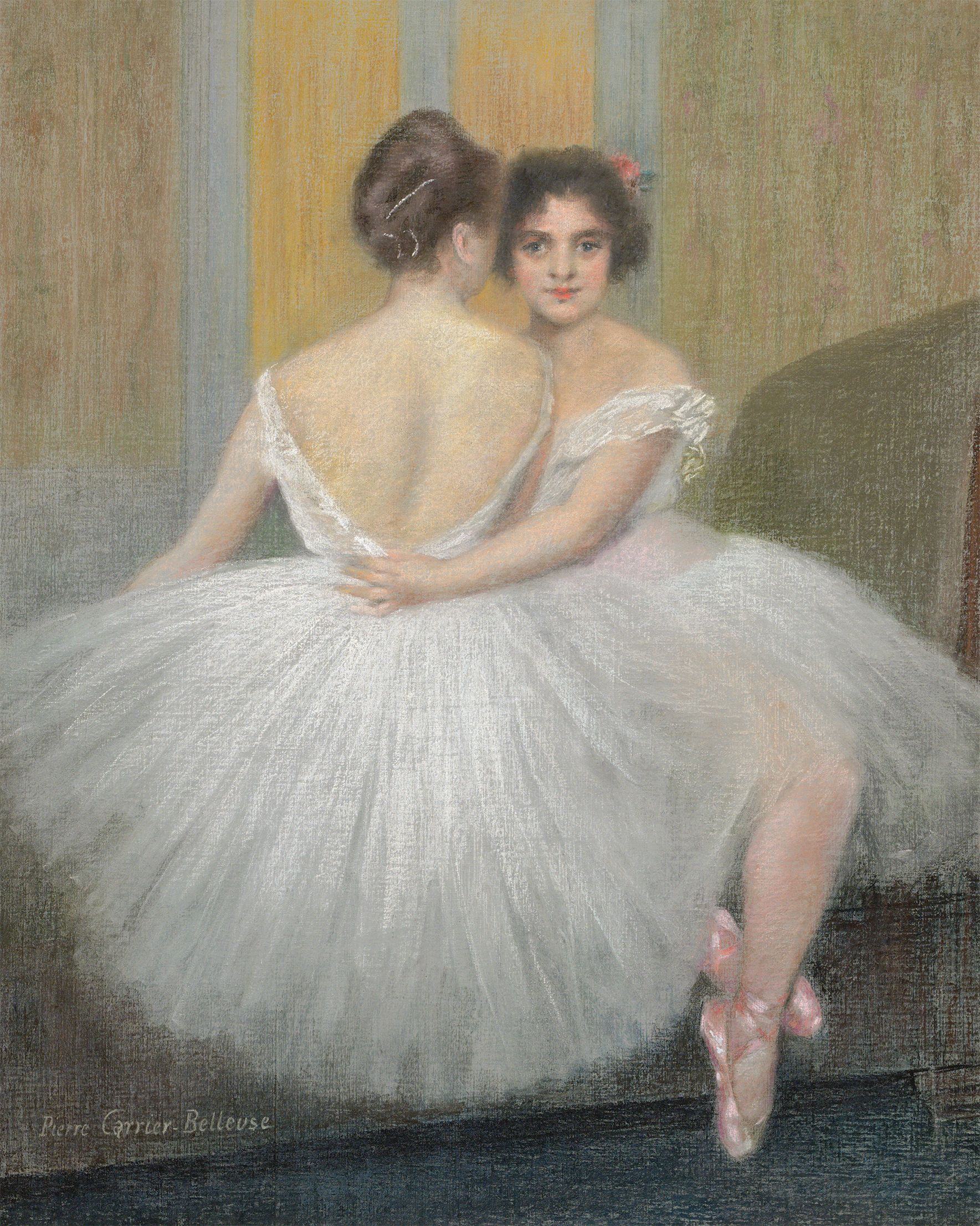
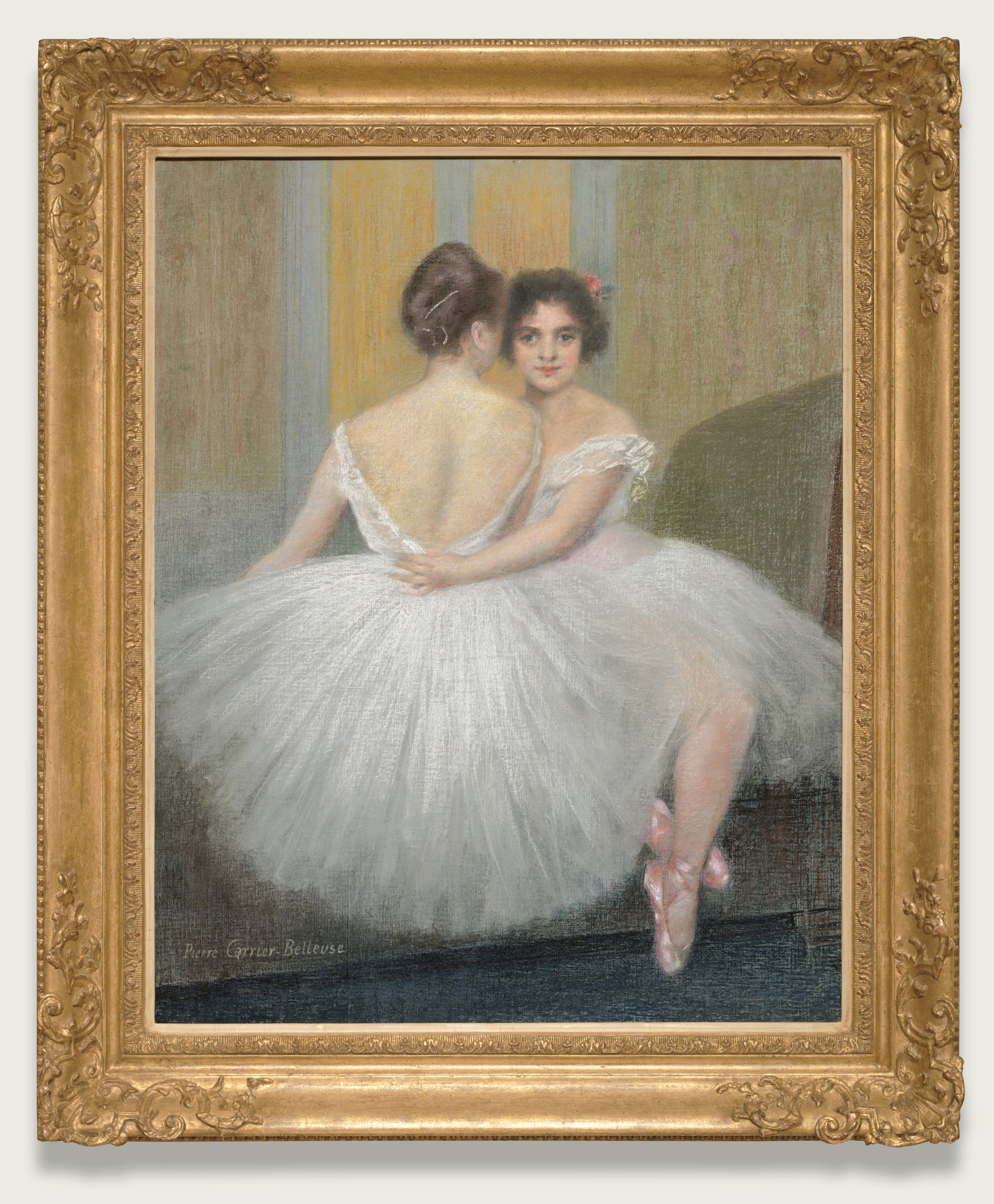
P. (PIERRE) CARRIER-BELLEUSE 1851 Paris (France) - 1932 Paris (France) Ballerinas
Pastel / Canvas: 80 x 64 cm
- This artwork can be viewed in our gallery
- Call us for more information: +31 26 361 1876
- World wide shipping available
Details
Two young ballerinas sit on a bench in a cloud of tulle. Perhaps they are sharing a moment before the performance begins, or adjusting each other’s costumes. One girl is seen from behind, the other looks directly at us. It seems like a moment just before they step on stage: a threshold between the everyday world and the performance. These are the scenes for which Pierre Carrier-Belleuse became best known: not dramatic stage moments, but intimate instants around ballet, softly captured in pastel on canvas.
In this, Carrier-Belleuse engaged with one of the most beloved subjects in late nineteenth-century Parisian art. The ballet of the Opéra was a dreamworld of grace, discipline, light and music. Edgar Degas had made the subject famous by depicting not only the performance itself but also the rehearsal, the waiting, the exhaustion and the concentration backstage. Carrier-Belleuse looked at the same world, but with a different sensibility. Where Degas observed with sharper, more investigative eyes, at times almost mercilessly, hinting at the darker side of ballet life, Carrier-Belleuse remained closer to the poetry of the scene. His pastels have a charm more reminiscent of that other great master of the ballet, Auguste Renoir.
Carrier-Belleuse was also a master of pastel, a medium particularly well suited to this subject. Pastel can be soft and powdery, yet surprisingly vivid. It captures the airiness of tulle, the matt light on skin, the sheen of satin and the fleeting movement of an arm or a skirt. In his finest works, the ballerinas seem not to stand heavily on the ground but to float up from the paper. The contours are sometimes loose, the colours tender. The concern here is not merely academic precision but, above all, elegance and atmosphere.
Carrier-Belleuse was not an Impressionist in the strict sense. His work is often too polished, too salon-worthy, too oriented towards charm and refinement for that. He stood rather on the boundary between academic tradition, Belle Époque taste, and a looser, more modern feeling for the fleeting moment.
As the son of the celebrated sculptor Albert-Ernest Carrier-Belleuse, Rodin’s master, he had grown up within the academic tradition. He made portraits, genre scenes, landscapes and illustrations. After a period in America, he worked almost exclusively in pastel. In his ballet scenes, he softened his academic background into a characteristically charming, light and direct body of work. His dancers belong to the world of the Belle Époque: a Paris of theatres, opera, posters, fashion, cafés and evening entertainment. They are images of a city that liked to see itself as the centre of elegance and artistic refinement.
Pierre Carrier-Belleuse had an exceptional sense of the theatre's intimacy. His ballerinas are young girls in a moment of intense preparation, surrounded by tulle, satin, pink stockings and gleaming pointe shoes. He painted not so much the effort of dancing as the tension just before or just after a performance. That is what makes his ballet scenes so appealing. They possess the charm of the in-between moment. A dancer straightens her ribbon, rests her foot on a chair, gazes into the distance or waits for her turn. The focus is not on the leap or the pirouette, but on the gesture that precedes it. It is precisely this that creates a sense of intimacy.
Remarkably, Pierre Carrier-Belleuse also became known as the painter of a very different world. In 1914, he joined other painters to work on what became known as the largest painting in the world: a panorama 123 metres in circumference and 14 metres high. The _Panthéon de la Guerre _was unveiled in 1918 and featured portraits of leading Allied commanders, heads of state and military figures from the First World War. Some six thousand soldiers were depicted, each painted at full length. Parts of it survive to this day and can be seen in a museum in Kansas City.
Width: 64 cm
Private collection Belgium
Over P. (PIERRE) CARRIER-BELLEUSE
Pierre-Gérard Carrier-Belleuse was born in Paris on 28 January 1851, the son of the celebrated sculptor Albert-Ernest Carrier-Belleuse, from whom he received his earliest training. He went on to study at the École des Beaux-Arts under Alexandre Cabanel and Pierre Victor Galland. From 1875, he exhibited regularly at the Paris Salon, receiving an honourable mention in 1887, and was awarded a silver medal at the Exposition Universelle of 1889. He joined the Société Nationale des Beaux-Arts in 1890 and taught at the Académie Julian during the 1890s. Although he produced landscapes, portraits, and genre scenes, Carrier-Belleuse is best remembered for his intimate depictions of women, and above all for his ballet subjects, in which he captured the poise of the corps de ballet of the Paris Opéra. From around 188,5 he worked almost exclusively in pastel, a medium he handled with marked virtuosity, and he also contributed drawings and lithographs to Le Figaro Illustré. He spent extended periods on the Côte d'Opale, where he owned a villa at Wissant and associated with the artists' colony gathered around Adrien Demont and Virginie Demont-Breton. Between 1914 and 1916, he conceived and supervised, together with Auguste François-Marie Gorguet, the Panthéon de la Guerre, then the largest painting in the world, comprising nearly five thousand portraits of Allied wartime figures. He died in Paris in 1932.
Pierre Carrier-Belleuse's pastel technique From around 1885, Carrier-Belleuse shifted his artistic focus almost entirely to pastel, a decision that coincided with the broader revival of the medium in Parisian artistic life during the last quarter of the nineteenth century. That revival, in which Degas, Manet and Berthe Morisot played leading roles, and which was institutionally consolidated by the founding of the Société des Pastellistes Français in 1885, freed pastel from its eighteenth-century reputation as a refined portrait medium and opened it to distinctly modern, sensuous subjects: the theatre, the wings, the body in movement. Carrier-Belleuse positioned himself emphatically within this development. Technically, his work is marked by a number of deliberate choices. He frequently worked on a large scale, at times well over a metre in height, and used canvas as his support rather than the more conventional paper. Pastel on canvas requires a prepared, lightly granular ground that grips the dry pigment stick, and it allows the artist to build up successive layers without the colour quickly becoming saturated. This choice partly accounts for the painterly density of his ballet scenes: the tutus acquire their characteristic, almost luminous volume through layers built up from dark to light, the uppermost touches often applied with the side of the chalk to produce a powdery, light-refracting texture. For skin and faces, by contrast, he worked with finer, more thoroughly blended strokes, occasionally smudged with the finger or a stump, yielding the smooth, porcelain-like surface so typical of his portraits of dancers. His reputation as a colourist, repeatedly noted by contemporary critics, is directly bound up with this layered procedure. Pastel does not permit optical mixing on a palette: every nuance must be selected as a separate stick and then reconciled with adjacent tones on the support itself. Carrier-Belleuse handled this register with notable assurance in the transitions between warm stage lighting and cooler areas of shadow, an effect he carried to a particular pitch in his backstage scenes. Although his name is often invoked alongside Degas, he is less inclined towards the compositional experiments and radical croppings of his more famous contemporary, remaining closer to Salon conventions of a centred, legible figure. Within the Belle Époque, he therefore occupies a distinct position: technically allied to the Impressionist pastellists, yet in subject matter and presentation still anchored in the refined academic tradition in which he had been trained.