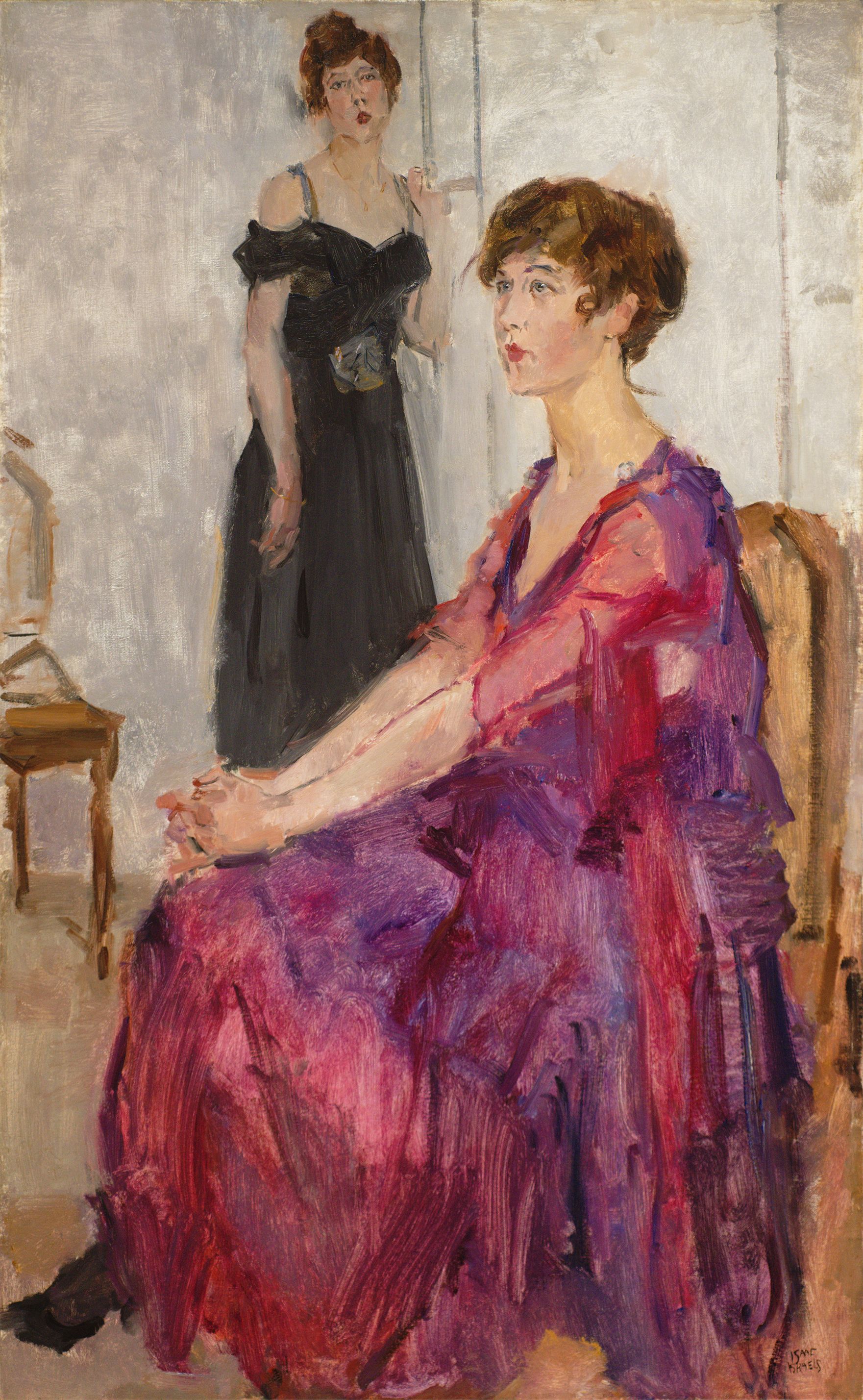
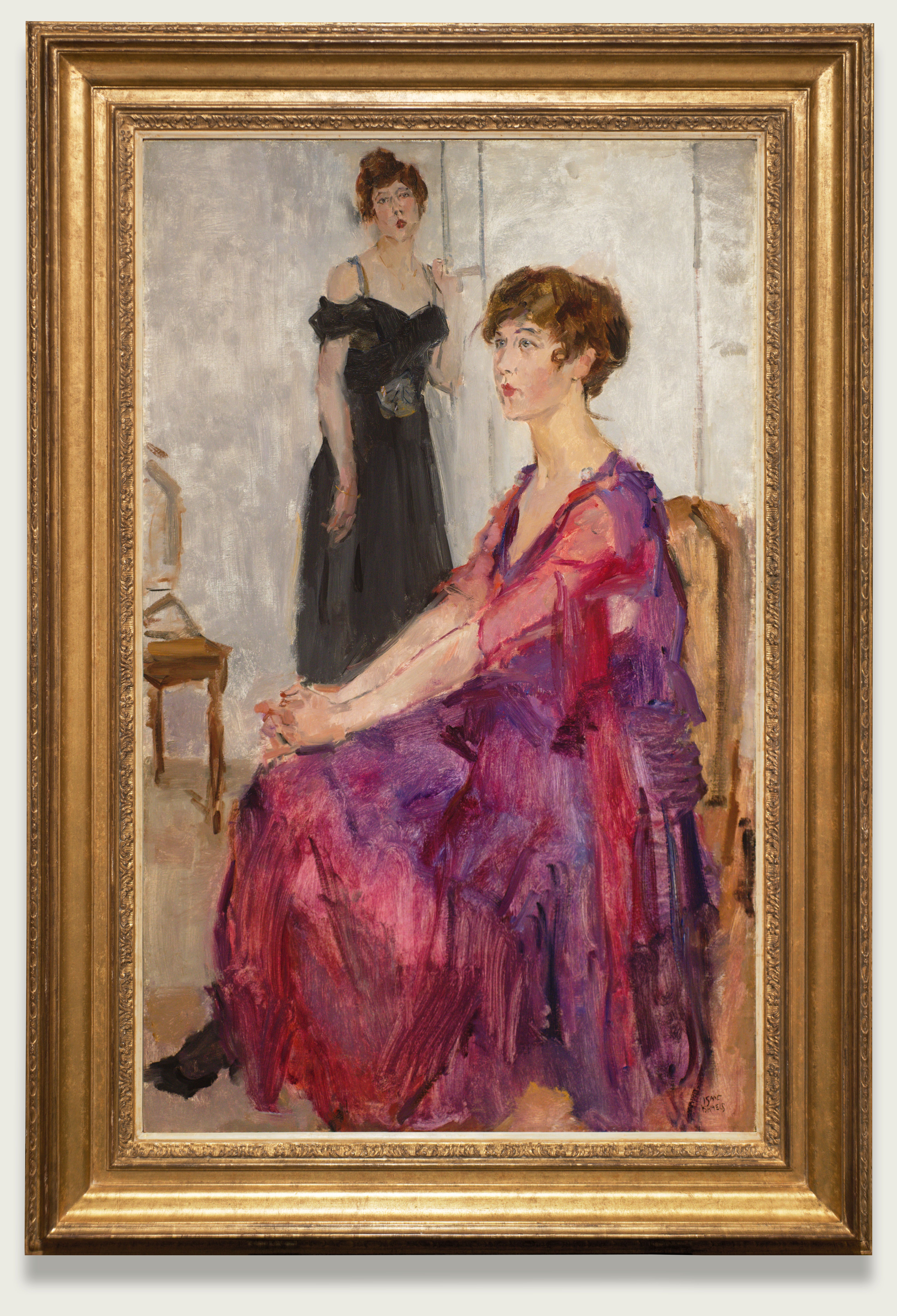
I.L. (ISAAC) ISRAELS 1865 Amsterdam - 1934 The Hague Ippy and Gertie at Fashionhouse Hirsch in Amsterdam
Oil / Canvas: 127 x 78 cm
- This artwork can be viewed in our gallery
- Call us for more information: +31 26 361 1876
- World wide shipping available
Details
One afternoon in 1916, tea is being served in a salon or fitting room at the fashion house Hirsch & Cie on the Leidseplein. It is a thé-select: a private fashion show for clients who had previously had to travel to Paris for such occasions. Two mannequins present the collection. One looks away, past the viewer. The other looks back, towards the spot where Isaac Israels stood and where the viewer now stands.
In the Hirsch salon, these roles are fixed: the buyer looks, and the model is looked at. The distinction goes beyond etiquette. In the salon, girls from modest backgrounds modelled gowns for the female elite and even for the Dutch royal family, while the seamstresses sat upstairs. Israels knew the entire building and recorded all of it: the shows, the fitting rooms, and the workrooms, observed with a matter-of-fact eye. The seated woman stays within these conventions. The standing woman steps outside them by meeting our gaze. This painting is as much about looking as it is about fashion.
Israels composed the scene with care. A diagonal runs between the heads of the two figures, spanning a quarter of the picture plane. He left the upper left corner almost empty. The seated woman in the right foreground is turned three-quarters, her head towards the left and her hands resting in her lap. The standing woman is shown frontally, her left hand presumably resting on a curtain rail. The pink-violet gown spreads across the lower half of the canvas, while the muted black of the standing figure is confined to a narrow vertical strip against the flat grey-white wall. Both faces are finely worked. The bodies and gowns, by contrast, are painted with broad, loose brushwork, wet-in-wet. In the background, the weave of the canvas remains visible, as he applied the paint far more thinly there.
The series of Israels painted at Hirsch is regarded as one of the most important of his later career. Within it, this canvas stands out for its generous size and its muted palette of pink, violet, black, and grey-white. At 127 centimetres high, the standing figure is almost life-size: whoever stands before the painting looks her in the eye. In 2002 and 2003, the work was shown at the Gemeentemuseum in The Hague (now Kunstmuseum Den Haag) as an example of how the fashion world was recorded in the years around the First World War.
The Amsterdam branch of Hirsch was opened on 25 September 1882 by Sylvain Kahn and Sally Berg, financed by Leo Hirsch, who already owned a fashion house in Brussels. Kahn and Berg introduced haute couture to the Netherlands: for the first time, women of the elite could have couture made in their own country. The new building of 1912, designed by the architect A. Jacot with the assistance of J.G. Snuif, further strengthened the house's position. Hirsch was forward-looking: to mark the opening of the new building it staged the first fashion show for an invited audience in the Netherlands, with mannequins brought over from Paris. This was the Amsterdam world in which Israels found his subject: fashion in the modern age.
The twin sisters Helena (1895–1964) and Geertruida Wehmann (1895–1975) worked under the names Ippy and Gertie respectively. At sixteen they were sent to London by their parents to gain work and life experience and to learn English. There they were discovered as models and in all likelihood went to work for Lucile in Burlington Street: the house of Lucy Duff-Gordon, who devised the mannequin parade, trained the first professional mannequins and survived the sinking of the Titanic in 1912. By way of Paris the sisters returned to Amsterdam, where between 1916 and 1918 they were among the most sought-after mannequins in the city. Their own names played no part there: Israels titled his canvases with the names their profession had given them.
Through his colleague and friend Thérèse Schwartze, Israels gained access to Hirsch around 1900, where he painted the models during fashion shows, in the fitting rooms and in the sewing workrooms. Hirsch in turn introduced him to the fashion house Paquin in Paris. Around 1903 he settled there, working for Paquin and for the fashion house Drecoll. In 1913 he left Paris for London, and in 1915 he returned to the Netherlands. Between 1916 and 1918 he attended the thé-selects at Hirsch with his partner Sophie de Vries and became captivated by the twin sisters. He portrayed them often, both together and individually.
In 1941 the occupying forces appointed a German administrator (Verwalter) and the Jewish management was forced out. Arnold Bernard Kahn, son of the co-founder Sylvain Kahn, died in Buchenwald that same year. Several members of staff did not survive the war either. Stock and fittings were shipped to Germany, and in 1943 the business was liquidated. Hirsch & Cie returned in 1948 to part of the old building, but on a fraction of its former scale.
Geertruida Wehmann died in 1975, a year before the house for which she had modelled closed its doors for good. The building still stands as a national monument and has housed an Apple Store across two floors since 2012. The name Hirsch still appears in elegant lettering on the corner turret. Of the salon itself, only this canvas remains.
Width: 78 cm
Private collection The Netherlands
Artwork is included in the "Catalogue Raisonné" by the 'Rijksbureau voor Kunsthistorische Documentatie (RKD),' The Hague
Over I.L. (ISAAC) ISRAELS
Isaac Israels was the only son of the painter Jozef Israels. The family moved from Amsterdam to The Hague in 1871. Isaac also received his training at the academy at the same time as George Breitner, Floris Verster, and Marius Bauer, among others. He was a promising artist from an early age and won awards for his paintings. In the '80s, Isaac specialized in military subjects, an interest he shared with Breitner and Verster. Despite this promising start, he felt his education was not yet complete and went to Amsterdam, where he was accepted into the circle of the Tachtigers.
Turbulent city life became the common thread through his work. Between 1887 and 1894, things were quiet around him: few paintings are known from this period. Starting in the mid-1890s, Israels went back to The Hague in the summers, where he and his father would paint at the beach. They rented a villa in Scheveningen. His paintings of donkey-riding children were crowd pleasers and are still extremely popular. Israels joked that selling a painting was "the Highest of Arts." His donkey-riding children were eagerly purchased at high prices and can be considered highlights of his oeuvre for just that reason. Isaac Israels was not only the virtuoso painter of modern (city) life, but he was also a gifted portraitist. Especially in the last phase of his life, he commissioned portraits of important Dutchmen. Even in this genre, women remained his favorite subject. All his life, he preferred to draw and paint maids, Amsterdam street girls, telephone operators, mannequins in department stores, and nude models. His portraits of women are also highlights of his oeuvre, such as those of the spy Mata Hari, the first female doctor Aletta Jacobs, and the actress Fie Carelsen. Isaac Israels was accustomed to giving a quick characterization of his models. A crisp characterization had to appear on the canvas at once. As such, his best paintings are vivid, spontaneous, and struck just right. 'I had an attack of patriotism the other day when I looked out my window to my surprise. Surely the Hollandsche is to my mind the most beautiful thing there is,' Isaac Israels on his way to London from Hamburg to the painter Willem Witsen. That did not prevent him from traveling up and down the continent.
Israels always loved to travel. Even as a child, he went to Paris with his parents every year. He made trips to Italy, Spain, North Africa, Switzerland, Spain and Scandinavia to draw and paint. In the 1920s, he even spent some time in the Dutch East Indies. Starting in 1903, Israels had his own studio in Paris, where he found his favorite subjects among fashionable Parisians and was able to immerse himself in the modern art on display there. In the spring of 1913, he traded that city for London, where he had his own studio for a time. Despite all the travel and all the impressions, Israels always remained himself. He was a neighbor to Picasso in Paris, went into town with Kees van Dongen, admired the symbolist Odilon Redon, and for a time had one of Vincent van Gogh's Sunflowers on his wall. All these modern impressions, however, did not allow him to be diverted from his laboriously developed path. After his Amsterdam years, his palette became lighter and his subjects more mundane, but he stuck to his virtuoso impressionist style until his death. In 1923, he settled permanently on Koninginnegracht in The Hague, where he had left his father's studio vacant until long after his death.