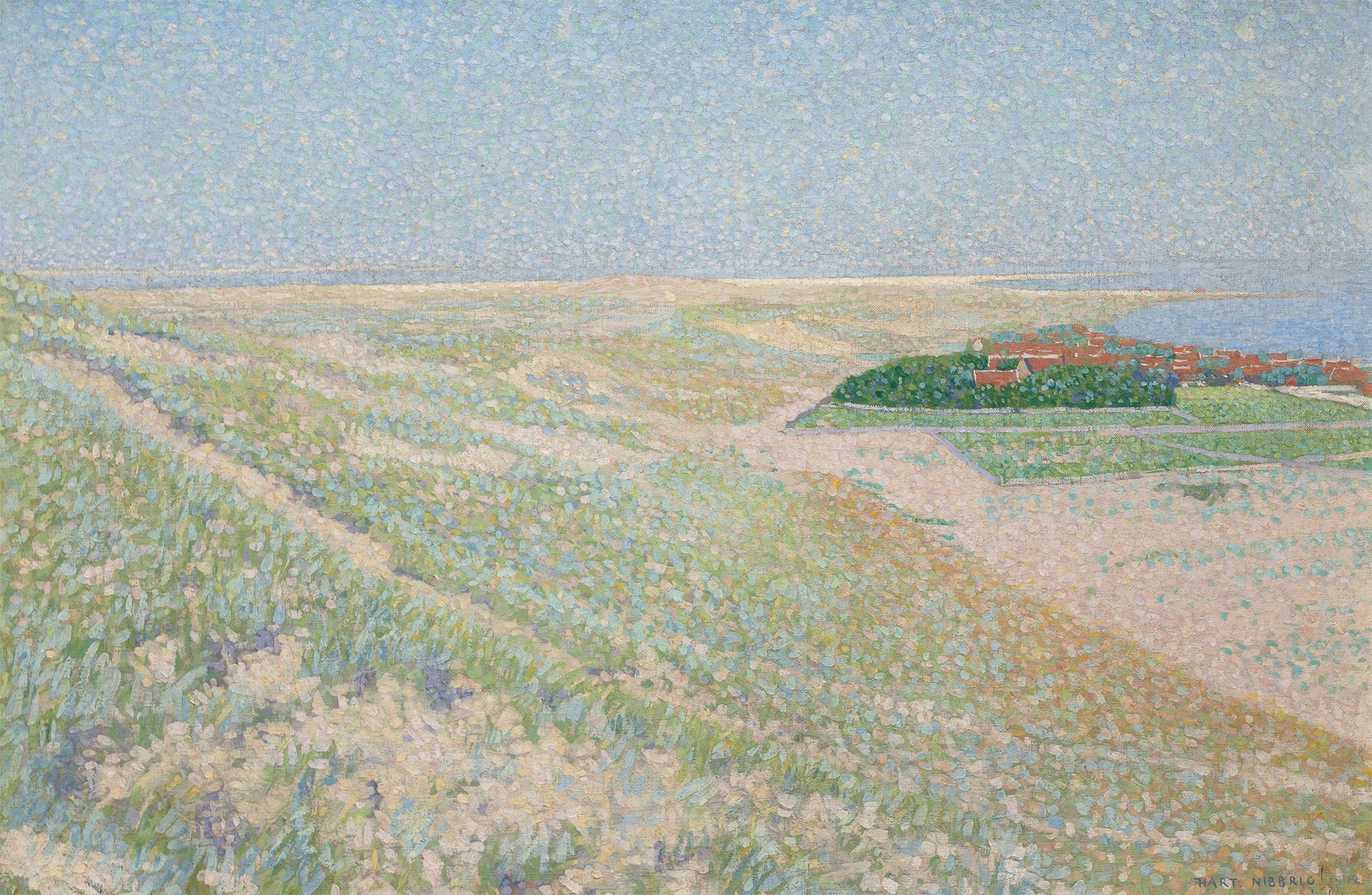
F. (FERDINAND) HART NIBBRIG 1866 Amsterdam - 1915 Laren Blaricum
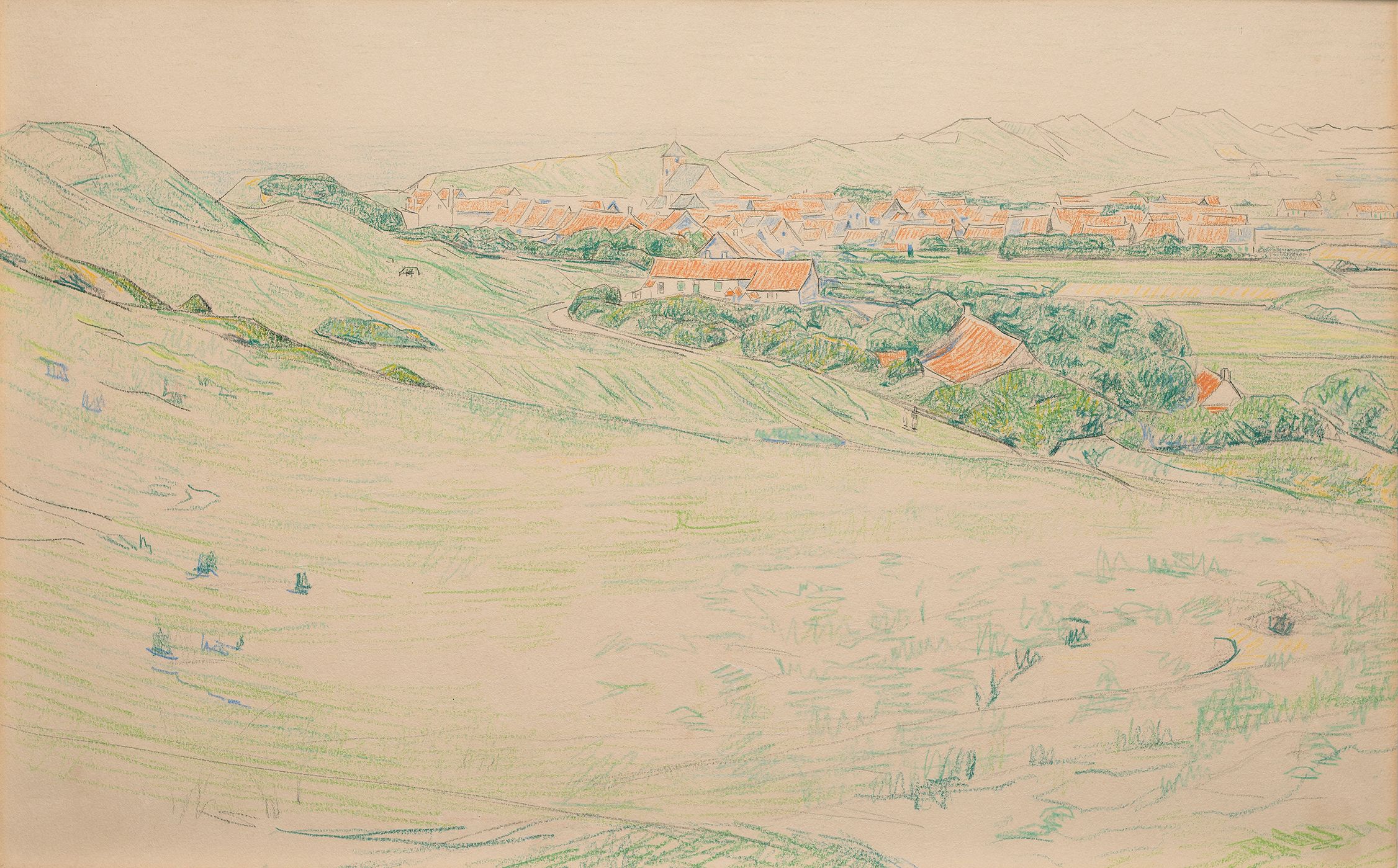
Watercolor / Paper: 23,8 x 43,8 cm
- This artwork can be viewed in our gallery
- Call us for more information: +31 26 361 1876
- World wide shipping available
Details
“But above all, the vastness of the fields, stretching to the horizon and to the distant village hidden among trees, where the yellow rye and the white buckwheat tremble in the light, and the undulating acres beneath hazy, warm skies, he knows how to make us feel superbly in his paintings of the Laren Eng,” wrote a critic in 1901 about a work such as this.
From a high vantage point, we look out over a wide, open landscape. In the foreground, fields of flowering buckwheat are surrounded by golden wheat or rye: broad, tranquil planes of soft yellow, pale blue, grey-green and white lying side by side. A narrow road cuts diagonally through the fields, drawing the eye into the distance. There, half-hidden behind trees, lies a village with red rooftops and two church towers. Above it all hangs a calm summer sky with light clouds. Half the sheet is taken up with sky; the lower third is an almost abstract composition of light planes and straight lines, and the strip of trees, farmhouses and churches between them is strikingly narrow. It is a simple motif, but Hart Nibbrig has made of it a still and poetic landscape.
The village visible in the distance is Blaricum, seen from the Blaricummer Eng. To the left stands the tall, slender neo-Gothic spire of the Roman Catholic Sint-Vituskerk, and, smaller and further away, the Protestant Dorpskerk lies in the centre.
Hart Nibbrig lived in Laren for much of the period between 1894 and his death in 1915, making this landscape literally around the corner from his home. The subject fits seamlessly with his lifelong preoccupation with landscape. Whether painting the dunes of Vlieland, the coast near Zoutelande, the hilly terrain of the Eifel or the fields near Laren, his concern was always with the experience of light, space and atmosphere. Here too, the village itself is not the main subject, but rather the way it merges in the distance with the rhythm of fields, rows of trees and sky.
In his oil paintings, Hart Nibbrig frequently worked with small dots and short strokes, but in watercolour he had to find a different way to capture the quality of light. Pointillism does not lend itself easily to the watercolour medium: the dots tend to bleed into one another. Yet the artist has achieved a similar effect in the landscape. The grainy haziness and stillness that characterise his pointillist canvases are present here too, in this far more direct medium.
The composition is strikingly modern. The fields are not rendered anecdotally but are arranged almost abstractly: large rectangular planes interlock to form a pattern of colour and space. The horizontal line of the village lends a sense of calm, while the diagonal road introduces movement. A subtle equilibrium emerges between the division of the surface and depth. Hart Nibbrig appears here not only as a landscape painter but as an artist who understands how planes of colour can carry an image.
In this, he stands among the painters who brought a new luminosity to Dutch landscape painting around 1900. After his training in Amsterdam and Paris, he was profoundly impressed by modern French painting, particularly luminism and pointillism. He assimilated those influences in a thoroughly
individual manner, using the insights of the French neo-impressionists to capture Dutch light: softer, moister, hazier, and less brilliant than its French counterpart.
This is precisely why this small watercolour carries such weight. The division of the landscape into distinct, clearly separated planes creates a lucid composition. The abstract planes of the fields make the landscape feel spacious, still and luminous, and the village edge on the horizon seems almost to float between earth and sky. Everything has been reduced to essentials: fields, trees, rooftops, towers, clouds. Hart Nibbrig presents an everyday Dutch landscape yet elevates it beyond the ordinary. In the soft colours of the fields and the pale sky above Blaricum, we find the essence of his art: the pursuit of light, not as an effect, but as the true subject of the painting.
Width: 43,8 cm
Collection Paul Brandt, Amsterdam
Gem. Van Reekum Galerij, Apeldoorn, Landschappen en stadsgezichten uit vier eeuwen, 11 Nov. – 11 Dec. 1972
Singer Museum, Laren, De tijd wisselt van spoor, 12 Apr. – 28 June 1981, cat. no. 440
Singer Museum, Laren, Ferdinand Hart Nibbrig 1866-1915, 25 Aug. - 3 Nov. 1996
Over F. (FERDINAND) HART NIBBRIG
Ferdinand Hart Nibbrig was born in Amsterdam on 5 April 1866. He studied at the Amsterdam National Academy from 1883 to 1888, and finished his schooling in Paris at Ecole Julien and the Cormon studio. There he was influenced by the work of Vincent van Gogh and Georges Seurat, although he would only use these influences in his work later on. After returning to the Netherlands, in his initial years as an artist, Hart Nibbrig mainly worked in the impressionist style of the Amsterdam School of Breitner and Isaac Israels. When he moved to Laren, his style gradually became more realistic, but increasingly he also painted pointillistic landscapes. Whether depicting people or landscapes, Hart Nibbrig continually strove to penetrate the essence of what he perceived. People in their environment, with special attention for labourers, weavers and farming types, were depicted realistically, and approached psychologically and in a flat style. His aim was to reveal their characters. When painting landscapes he strived to portray the light in all its manifestations. His work is characterized by an abundance of light and bright colours. Except in the artist’s village of Laren, Nibbrig worked and lived for shorter or longer spells in Rhenen, in Vlieland, in South Limburg and in Zoutelande in Zeeland. He also took trips to North Africa and Germany. On 12 October 1915 Hart Nibbrig died in Laren at the age of fifty-two. Although his career as a painter ended far too early, his artistic heritage has remained important. Hart Nibbrich was one of the first artists to introduce luminism in the Netherlands. A large collection of his work can be seen in the Singer Museum in Laren, not far from the villa and atelier where much of his best work was made.