Oil / Canvas: 65 x 52 cm
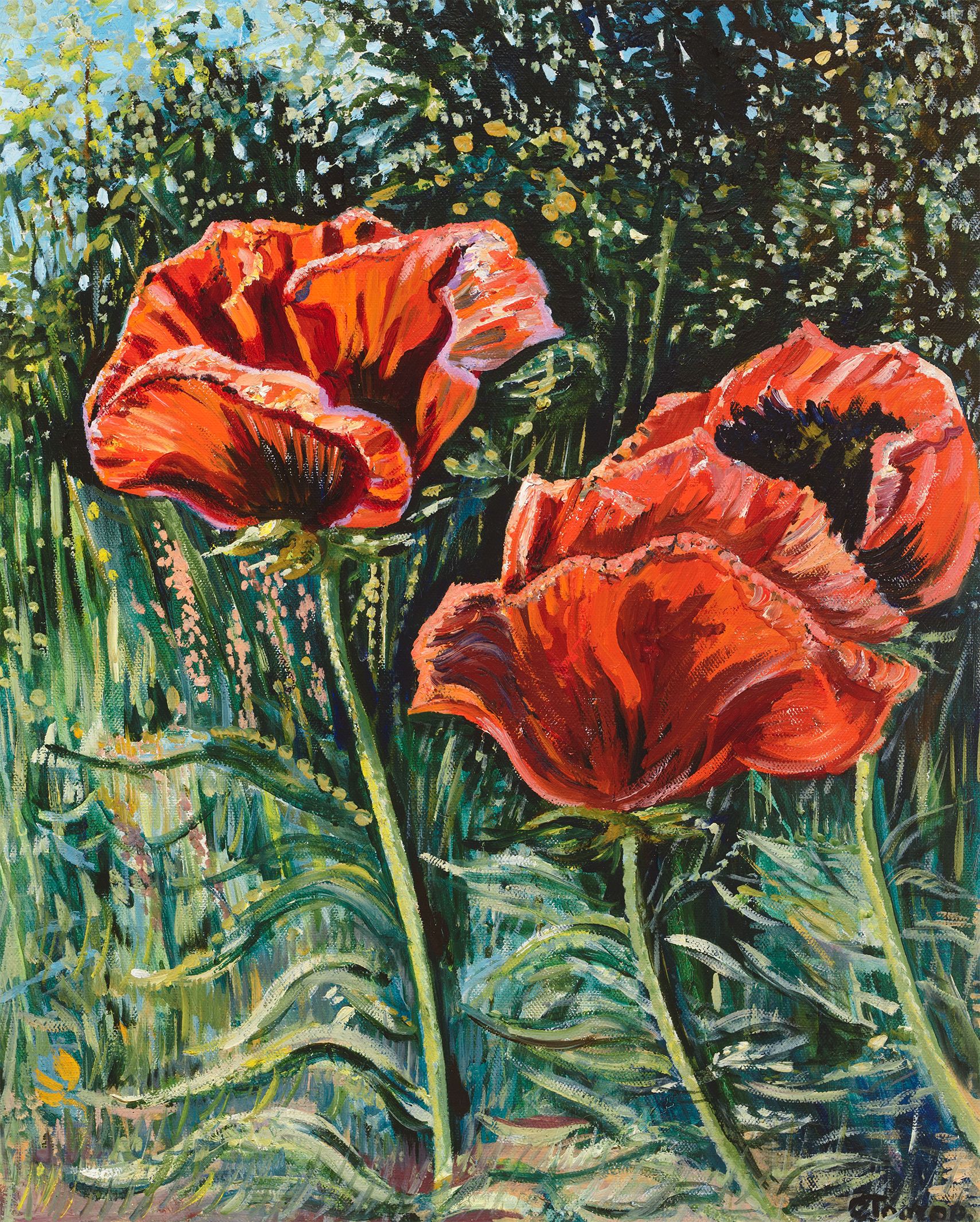
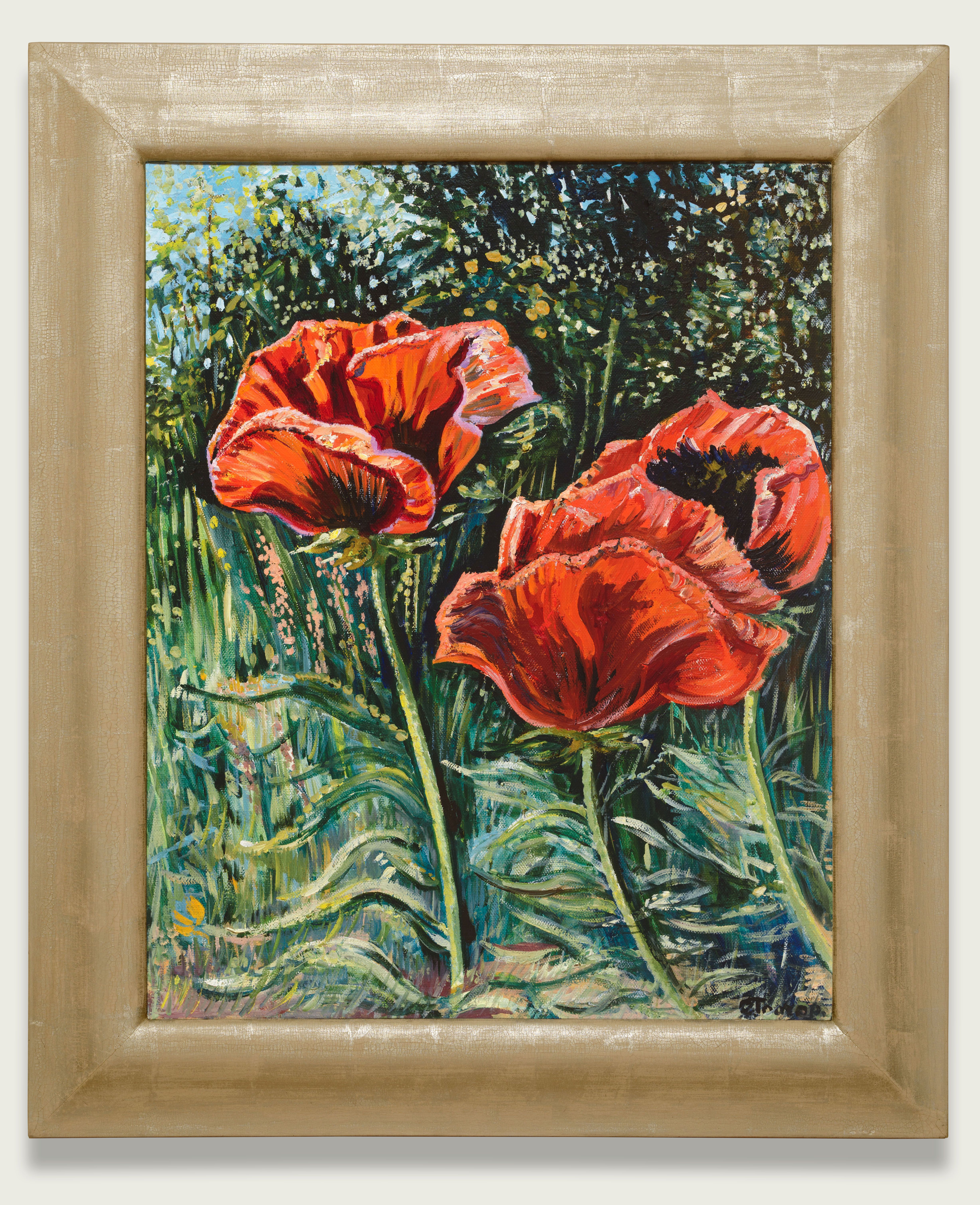
In the painting Poppies, three flowers are depicted in close-up. They completely fill the picture plane, against the background of a small wood. We can even see a patch of sky. Yet there seems to be hardly any space in the painting. The deep, saturated reds of the poppies stand out vividly against the cooler, often bluish or grey-green background. This colour contrast increases the intensity of the representation and inevitably draws the eye to the flowers. The interplay between warm and cool tones enhances the sense of depth and makes the poppies come forward almost tangibly. It is a portrait of three poppies, as intense as the portraits for which Charley Toorop became famous.
This painting was a gift from Charley Toorop to her friend Jaap Hemelrijk, on his 40th wedding anniversary in 1956. Hemelrijk was headmaster of the Murmellius Gymnasium in Alkmaar and lived in Bergen, where Charley Toorop had also lived since 1921 in her studio home De Vlerken. This villa, which she had built with her father's help, was an important place for her. Here she had a good studio, where famous painters, architects and writers such as Leo Gestel, Gerrit Rietveld and Adriaan Roland Holst were frequent visitors. Charley Toorop travelled extensively and moved house often, but she kept De Vlerken all her life. Hemelrijk certainly belonged to the group, mostly artistic, friends who gathered there. He had a great interest in modern art. He filled his school with paintings he had borrowed from the Bergen art collector Piet Boendermaker and was involved with the artists of the Bergen School. In 1932 he was one of the initiators of the Bergen Art Circle. Well-known painters, including Charley Toorop, contributed a painting, and the residents of Bergen could bid on them. The highest bidder got the painting; the proceeds were used to support struggling young artists.
As the daughter of the successful artist Jan Toorop, Charley had art in her blood from birth. Judging by the many childhood portraits her father made of her, she spent much time in his studio. Yet she was not destined to become an artist: her parents wanted her to pursue a career as a musician. With characteristic determination, she nevertheless managed to establish herself as a painter with her own unique style: a solid, intensely expressive realism. Initially she worked in a cubist and expressionist style. In the early 1930s she found her own form, in which she created an idiosyncratic oeuvre: a powerful realism, with sharply defined forms and expressive colours. This made her one of the most important Dutch artists of the 20th century, who occupied a prominent position in the then male-dominated art world.
Toorop became famous for her penetrating portraits with large eyes. Initially she painted mainly landscapes and (self-)portraits. From 1930 onwards she focused on workers and farmers. During the Second World War her interest turned to ordinary people who suffered under the misery of the war. Particularly in the second half of her life she also often painted still lifes, flowers and trees. Poppies shows, like the portraits, the same intense way of looking. For the viewer, the poppies become more than flowers: they are inescapably present. That intense representation of reality was what Toorop strove for, in search of her own committed artistry. Realism was her starting point. From there she took her first steps towards what she herself called 'inspired imagination': a more intense experience of nature. In Poppies, Toorop shows her pursuit of that 'inspired imagination'. Realism remains the foundation, but the expressive power and monumental composition elevate the subject above the everyday. She remained faithful to visible reality, but at the same time wanted to tap into a deeper emotional layer. According to H.P. Bremmer, art adviser to Helene Kröller-Müller, she was Van Gogh's successor. He said: "[Charley Toorop] is someone who dares to face life, as only few possess this ability."