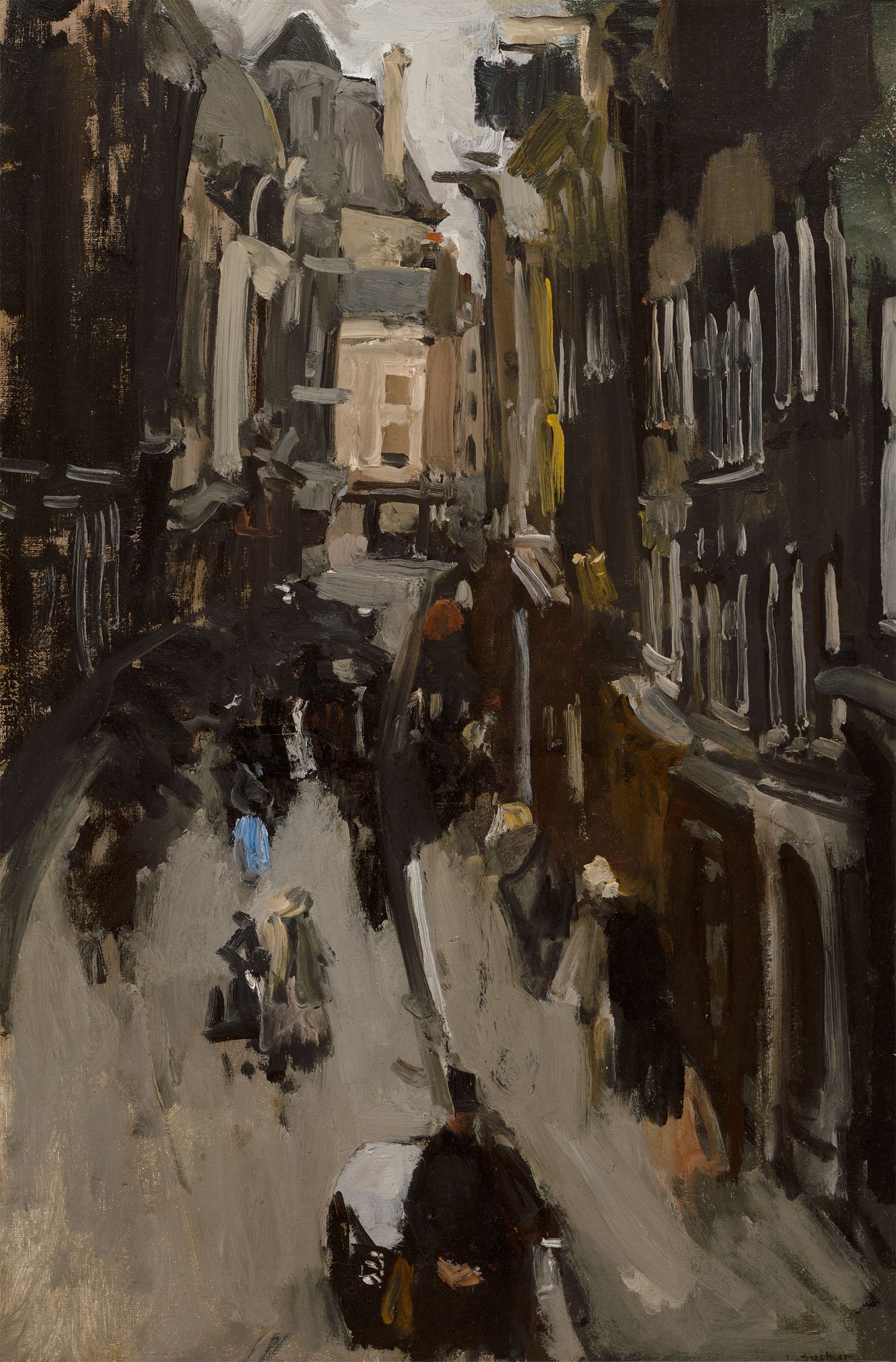
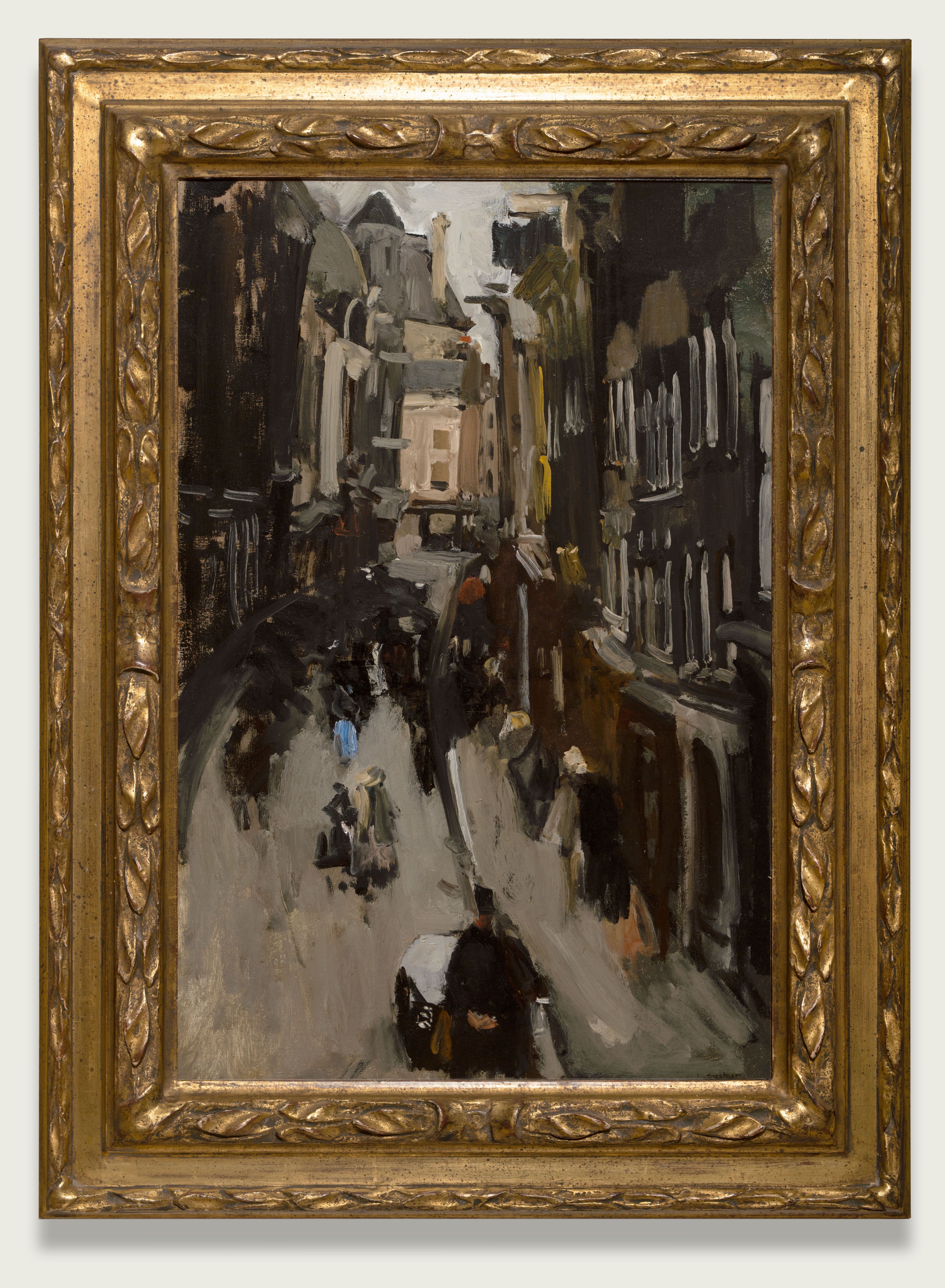
G.H. (GEORGE HENDRIK) BREITNER 1857 Rotterdam - 1923 Amsterdam Kalverstraat in Amsterdam
Oil / Canvas: 75 x 50,5 cm
- This artwork can be viewed in our gallery
- Call us for more information: +31 26 361 1876
- World wide shipping available
Details
This view of the Kalverstraat, one of Amsterdam’s major shopping streets, has all the characteristics of Breitner’s best work: the diagonal composition, the high horizon, the distorted buildings, the smeared paint and the dark palette with colourful accents are unmistakable. Amsterdam was Breitner’s favourite subject. He frequently depicted the city’s streets and residents in dark, atmospheric paintings in the period when the city was undergoing fast changes. Breitner took thousands of photos in the city, often with unusual points of view from which he drew unusual compositions for his paintings. Around 1900 Breitner was the most successful and the best-selling artist of Amsterdam. His work continues to be popular today.
Width: 50,5 cm
Mr. H.E. Tenkink, Amsterdam
Dr. W.L. Ladenius and A. Boersma, Haarlem, 1957
Art Gallery van Reekum, Apeldoorn, 1971
Mr. P.H. Hellinghuizer, Amsterdam, since 1971
Art Gallery Van Voorst van Beest, The Hague
Mr. B. Meijer, Wassenaar
Private collection The Netherlands
Amsterdam, Stedelijk Museum Amsterdam, Breitner: tussen de Schilders van Amsterdam, 23 Dec. 1957 - 2 Feb. 1958, no. 22, (as ‘Kalverstraat bij regenachtig weer’)
Assen, ’t Zaaltje, George Hendrik Breitner: Tentoonstelling van Schilderijen uit de Collecties van het Rijksmuseum en van de Gemeentemusea van Amsterdam, 24 Oct. - 28 Nov. 1959, no. 2
Eindhoven, Van Abbemuseum, G.H. Breitner: Schilder Fotograaf, 6 April - 13 June 1971, no. 34 (as ‘Kalverstraat bij regen)'
Comp. J.F. Heijbroek, K. Keijer, e.o., "G.H. Breitner. Schilderijen, tekeningen, foto's", Bussum 1994, p. 158-159, no. 79, 80, 81 (ill.)
Comp. K. Keijer, "Breitners Amsterdam", Bussum 2004, p. 25-41 (ill.)
Comp. J.F. Heijbroek, E. Schmitz, "G.H. Breitner in Amsterdam", Amsterdam 2014, p. 36-37, no. 79, 80, 81(ill.)
Over G.H. (GEORGE HENDRIK) BREITNER
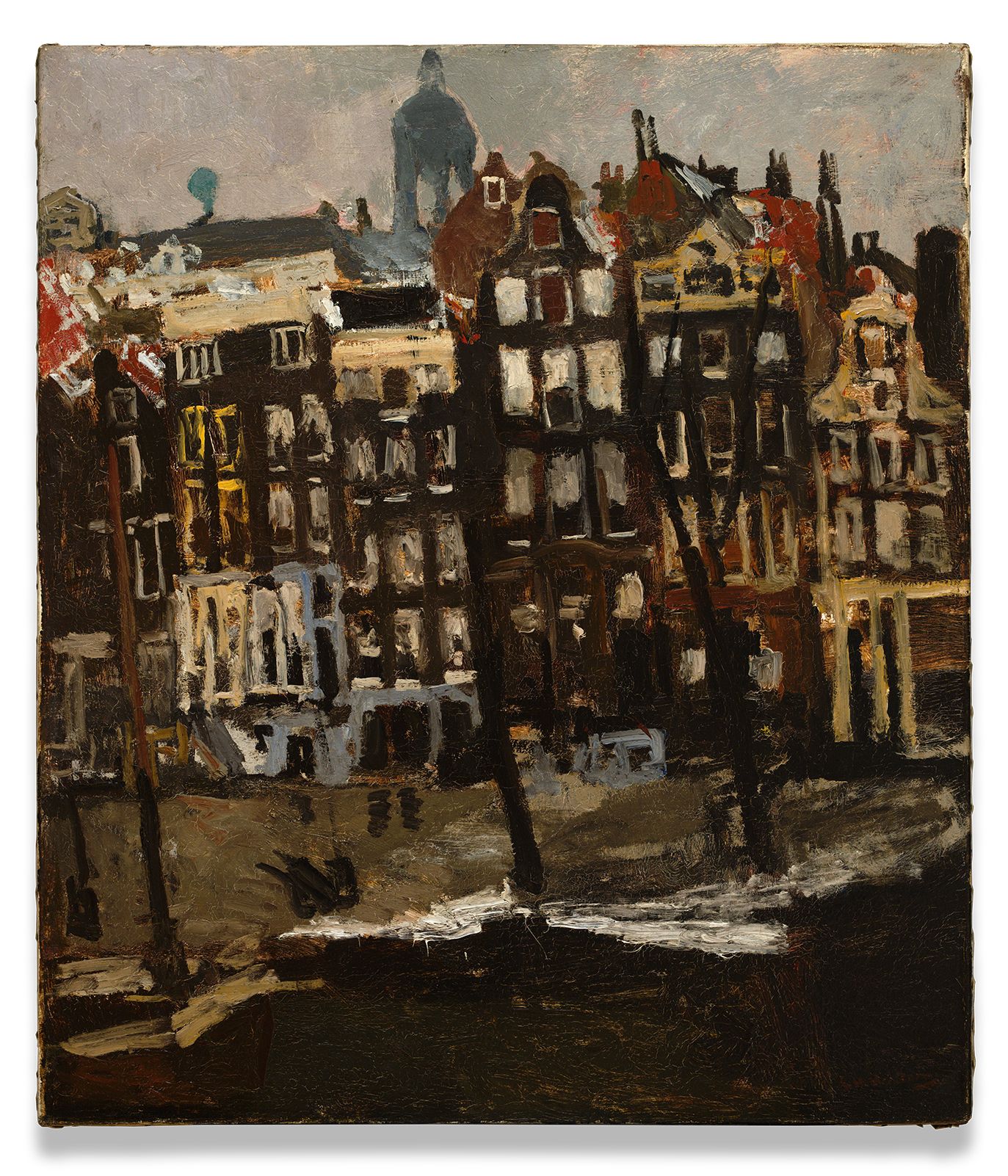
George Hendrik Breitner began his artistic training at The Hague Academy in 1876. Influenced by the painters of the Hague School and their new realistic approach to nature, Breitner developed a modern and impulsive style of his own and was soon considered an extraordinary talent by fellow artists. He became a member of the painterly society Pulchri Studio and helped paint the Panorama Mesdag (1880-1881), which can still be viewed. Among other things, he painted the cavalry there, practicing on the beach. In 1882 he decided to take a new path. In a letter, he wrote, 'myself, I will paint man on the streets and in the houses the streets and houses they built 't life above all. Le peintre du peuple, I shall try to become or rather I am already because I want it to be.' In the years 1882-1883, he regularly hung out with Vincent van Gogh, with whom he walked the streets a lot 'to go looking for figures and nice cases.' Dissatisfied with the cultural climate in The Hague and attracted to the dynamic and inspiring city of Amsterdam, Breitner left The Hague and joined the Amsterdam Academy in 1886. In that same year, a group of young bohemian writers founded the literary journal 'De Nieuwe Gids,' in which they published their reflections on contemporary artists and passionately propagated the 'L'art pour l'art' ideal in the visual arts and literature. The group, also known as the 'Tachtigers,' included painters like Willem Witsen (1860-1923), writer Adriaan Roland Holst (1888-1976), painter Jan Veth (1864-1925), composer Alfons Diepenbrock (1862-1921) and others. The Tachtigers considered the personal impression much more important than the depiction of realistic details. All the important members were focused on Amsterdam, changing the artistic scene from The Hague to Amsterdam and giving Impressionism a city rather than landscape orientation. Hence Amsterdam Impressionism.
An ambitious painter of modern life, Breitner, along with Isaac Israels (1865-1934), became one of the leading figures of the Amsterdam Impressionist movement. In the eyes of his contemporaries, Breitner was the artist who knew how to depict on canvas those elements that defined the attractive elements of the city. As 'Le peintre du peuple,' he did not want to paint classical themes or create realistic historical paintings in an academic manner, but rather to depict everyday life above all.
Breitner often roamed the streets with his sketchbook and camera to capture the daily lives of construction workers, laborers, maids and playing children. With powerful brushstrokes, he captured what he saw: a fleeting moment, a fragment in time. To convey an impression was painting at its purest; the eye does the rest. Bustling city life would become a recurring subject in his oeuvre. After 1914, he painted less and hardly ever took photographs. He died on June 5, 1923, behind his easel, palette and brush in hand.