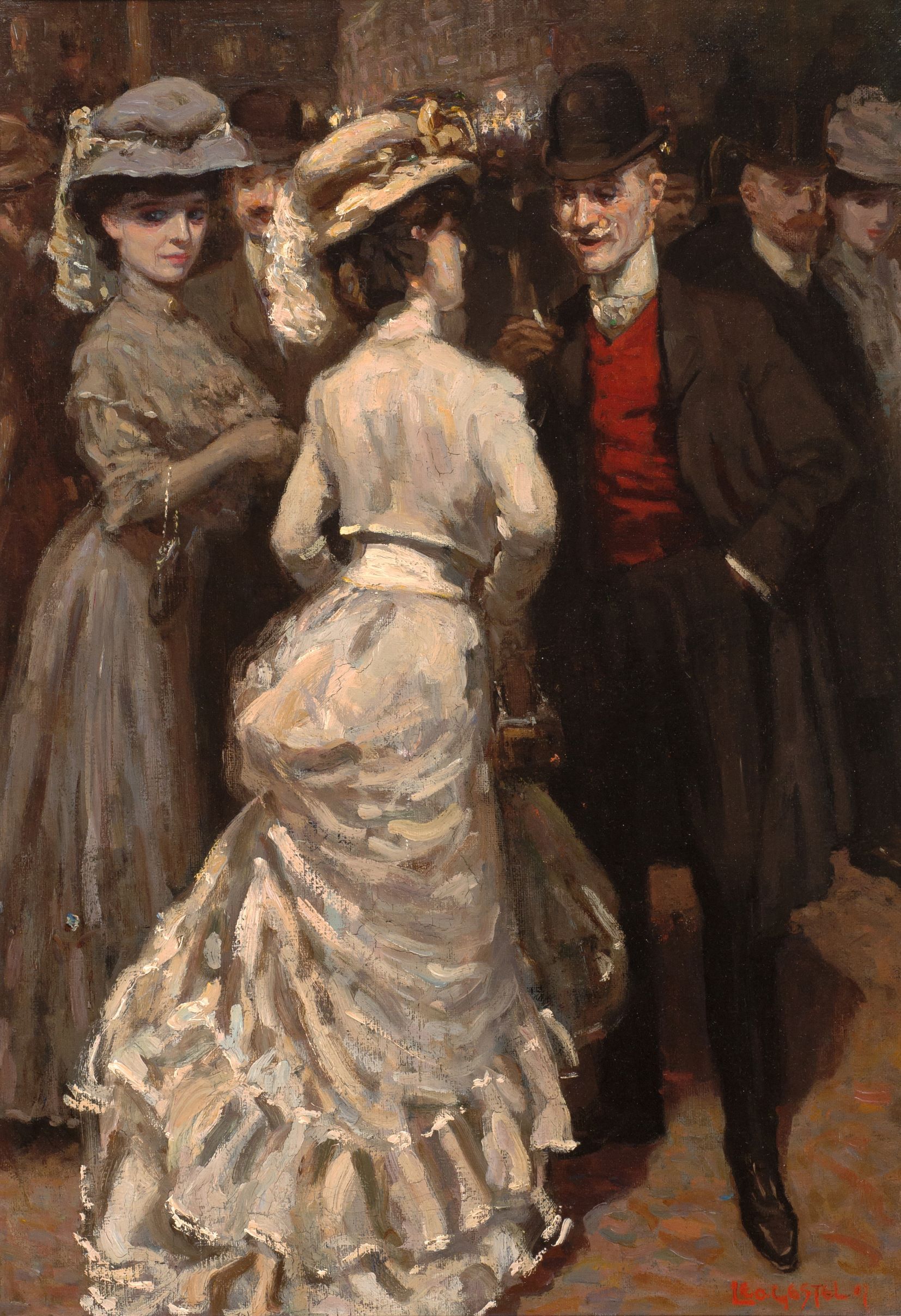
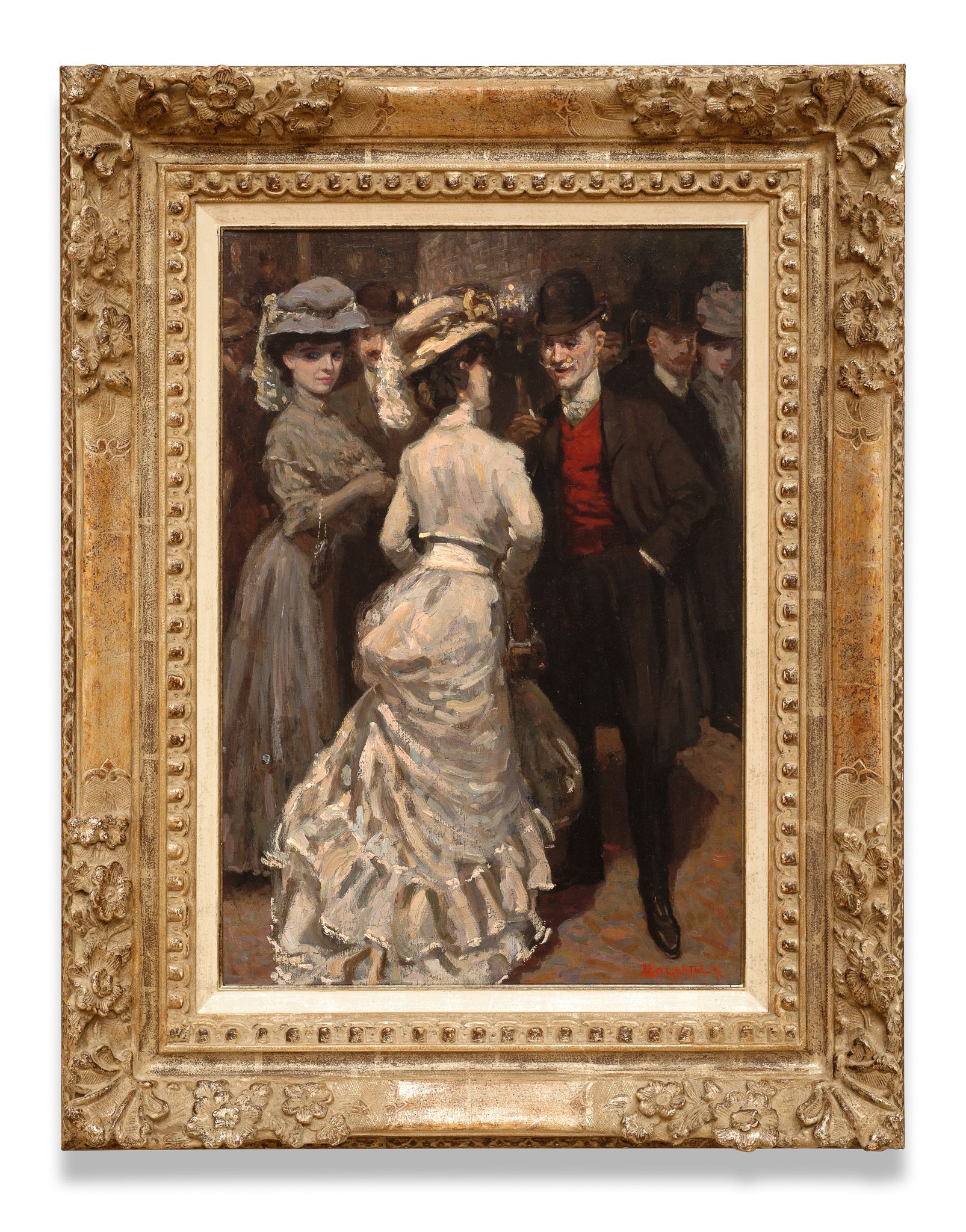
L. (LEO) GESTEL 1881 Woerden - 1941 Hilversum Sortie du theatre, Paris
Oil / Canvas: 49 x 34,5 cm
- This artwork can be viewed in our gallery
- Call us for more information: +31 26 361 1876
- World wide shipping available
Details
In this charming painting, Leo Gestel takes us on a night out in Paris. We move with the stream of theatregoers spilling out of the building. The pavement is crowded with people discussing the performance and exchanging the latest gossip. Light from the theatre spills over the elegantly dressed figures in the dark street. In the distance, the façades of houses glow in the light of streetlamps. One of the ladies in the foreground group glances at us with curiosity, seeking more interesting company. Her gaze draws us further into the scene.
At the beginning of the twentieth century, Paris was the undisputed capital of modern art. Young Dutch painters travelled there to immerse themselves in the city's new artistic discoveries. Kees van Dongen, Piet Mondriaan, and Jan Sluijters each found new directions to pursue, and even an Impressionist such as Isaac Israels considered Paris his second home. Leo Gestel, too, was a frequent visitor. For him, these trips were revelatory. He was captivated by the Fauves' use of colour and by the subjects and compositions of the Impressionist painters, absorbing all these new ideas with great enthusiasm. Following a visit to Paris in 1911, made together with Jan Sluijters "to discover Cubism", Gestel became one of the most significant Dutch modernists of the early twentieth century. His studio on the Jan Steenstraat in Amsterdam, known as the "Jan Steenzolder", became a meeting place where Dutch artists shared their impressions of Paris.
In 1907, when Gestel painted this work, the modern art world in Paris was in a state of ferment. The Fauves’ vivid Expressionism was at its height, a major exhibition of Paul Cézanne made an enormous impression on a younger generation of future Cubists, and Picasso was at work on his Demoiselles d'Avignon. Little of that modernity is visible in this painting. What seems to have captivated Gestel is Parisian fashion. The figures are dressed in the very latest style, though Gestel appears to have pushed this slightly into caricature. The gentleman with his impossibly high collar and elaborately waxed moustache, and the women with their unnatural silhouettes, carry a gently satirical edge. The ladies display the fashionable S-bend silhouette of the time, achieved with the aid of a Droit-devant corset, which pushed the abdomen back while thrusting the bosom forward and thrusting the hips back.
Gestel was a man of many talents, turning his hand to a wide range of disciplines. He was not only a painter but also initially earned his living as an illustrator for books and newspapers, taking on numerous commercial commissions. His gift for caricature is clearly evident in this work. This versatility led his friends to call him Leonardo. He subsequently signed his work as Leo Gestel rather than his given name, Leendert, as a nod to the most versatile artist in history.
Width: 34,5 cm
Private collection The Netherlands
Museum Flehite, "Nachtlicht 1880-1940", Amersfoort, 5 April - 27 June 2011
Image location BD/RKD/1600 - MHK/The Netherlands/Paintings and Drawings (ill.nr. 0000274847) Permalink https://rkd.nl/explore/images/210971
Over L. (LEO) GESTEL
Leendert Gestel (Leo is short for the nickname Leonardo given to him by his Amsterdam friends.) largely determined the face of Dutch modern art. Together with Jan Sluijters and Piet Mondriaan, he was the frontrunner of Dutch Modernism. By this term we mean the Dutch version of the then international avant-garde movements pointillism, fauvism, cubism and futurism. Gestel sought inspiration in each of these directions. In 1903, despite his father's opposition, he was able to call himself a free artist. By now he was living in Amsterdam, obtained his teaching certificate in drawing and had begun the evening course at the Rijksacademie at A. Allebé. His studio at 2nd Jan Steenstraat in Amsterdam became a meeting place for artists. His trips together with Jan Sluiters to cities like Paris, Antwerp and Brussels became of lasting influence on his work. In 1912, he settled in Bergen with his wife Ann. His work was bought early on by collectors J.F.S. Esser, Piet Boendermakers and Hélène Kröller - Muller. His great talent for drawing, in addition to his development as a painter, has always remained important, especially after the modernist period. However, the smoothly drawn pastels were also popular at the beginning of his career.