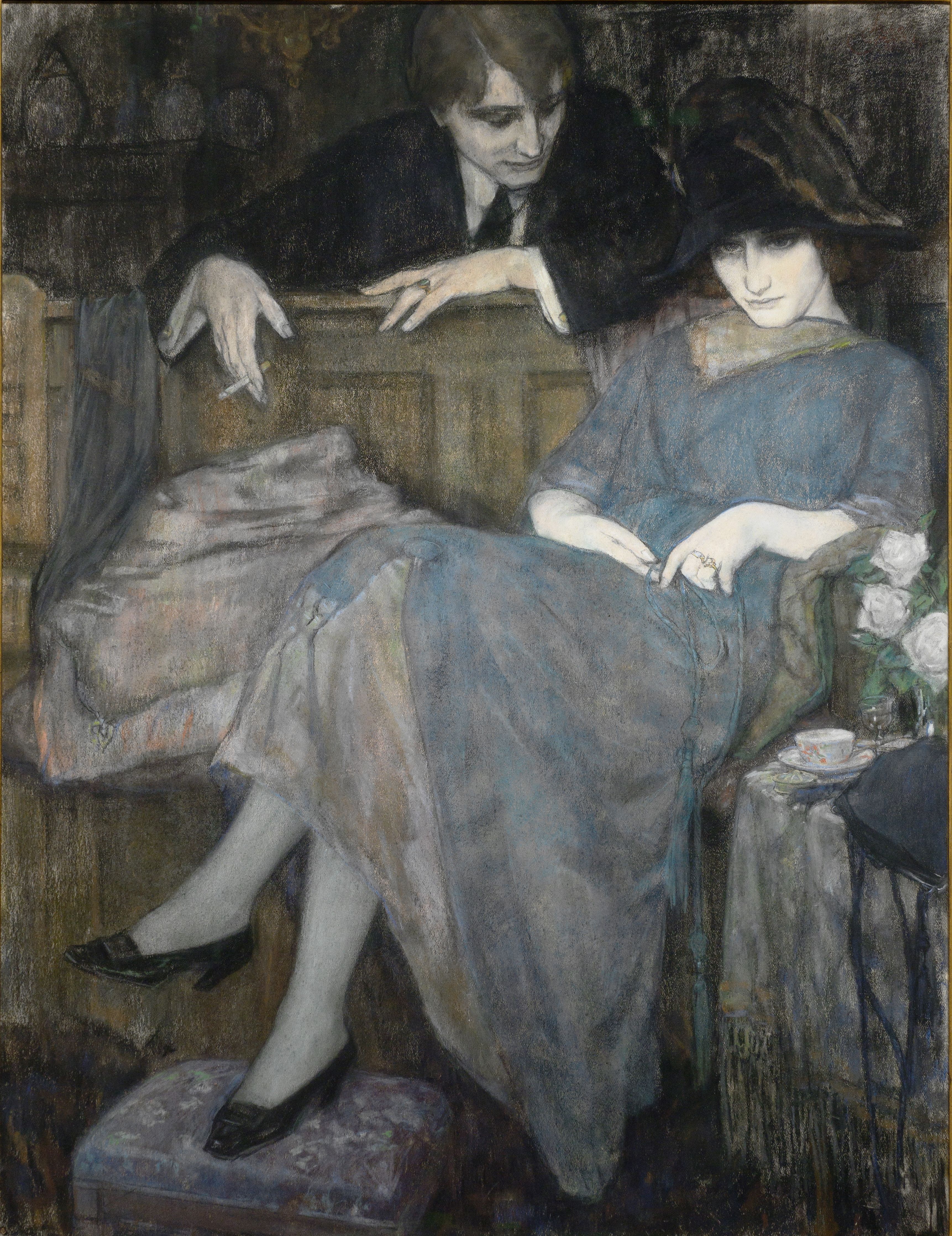
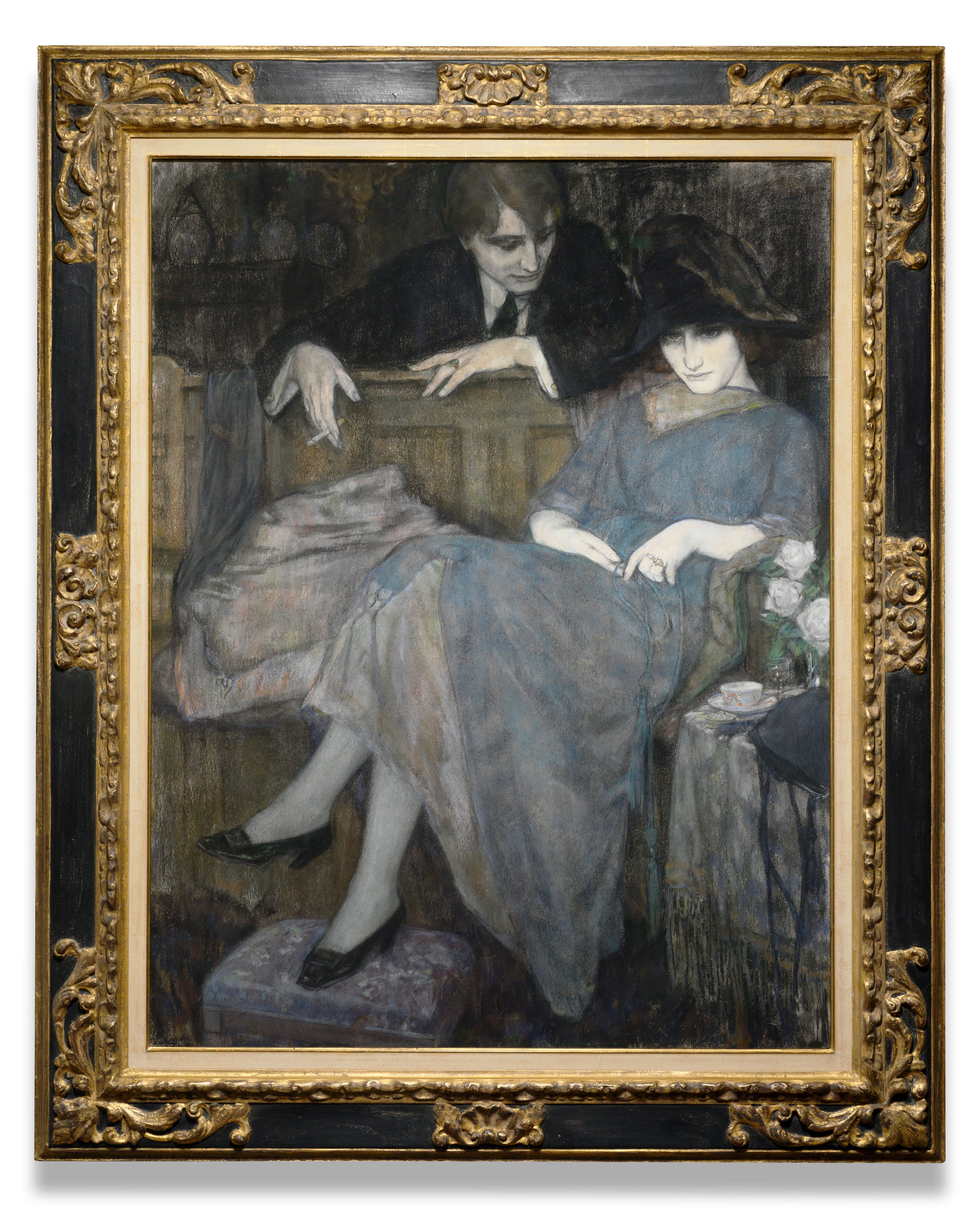
L. (LEO) GESTEL 1881 Woerden - 1941 Hilversum An Gestel and Violinist Dirk Gootjens (Flirtation)
Pastel / Paper: 109 x 84 cm
- This artwork can be viewed in our gallery
- Call us for more information: +31 26 361 1876
- World wide shipping available
Details
This remarkably large pastel demonstrates how virtuosic Leo Gestel was as a draughtsman. Executed primarily in cobalt blue and light brown, the work shows the violinist Dirk Gootjes leaning forward over the back of a bench towards a woman seated in a slouched position, gazing ahead. The brooding looks in her eyes, shadowed by her hat, reinforce the sultry atmosphere. The hands, with their long, elegant violinist's fingers, between which a cigarette is held, draw the eye. Smoking has carried an erotic charge in art for centuries, and it seems certain that Gestel deliberately intended this connotation. What makes the scene particularly pointed is that Gootjes is flirting with An Overtoom, the girlfriend and later wife of Leo Gestel himself.
During this period, Gestel enjoyed considerable success with his pastels. He was a gifted draughtsman, and his realistic, often anecdotal work was very well received. In 1911, he was awarded the prestigious Willink van Collenprijs for his pastel drawings, presented by the then conservative artists' association Arti et Amicitiae in Amsterdam. One of the two works for which he received the prize was Op bezoek, a piece that closely resembles Flirtation in format, colour, and atmosphere. A critic praised the composition's elegance and the accomplished rendering of texture. On the striking use of colour, he wrote: "Gestel worked in intense blue and sultry purple. Through the colour, those drawings had something 'perverse' about them, which was at times underscored by the composition." The word perverse was used more than once. Gestel was praised for his ability to emphasise, in depicting "female allure", above all the "kindling of perversity." The accomplished technique and charged subject matter of such works brought Gestel not only considerable press attention but also a wide public following.
This success made it tempting for Gestel to continue along the same path, yet in his painting, he had already moved in a different direction. Together with Jan Sluijters and Piet Mondriaan, he continued to search for new forms and styles, absorbing influences from Paris, including Pointillism, Fauvism, and Cubism. His work was a regular source of controversy. In 1911, for instance, two of his nudes were removed from the Stedelijk Museum in Amsterdam on the mayor's orders. Between 1912 and 1914, Gestel continued his formal experiments, which reached a high point in the celebrated series of landscapes from Mallorca.
Gestel had lived since 1904 in an atelier on the top floor of Tweede Jan Steenstraat 80 in Amsterdam, which became a meeting place for young painters, sculptors, and writers. The violinist Dirk Gootjes (1885–1963) was also a regular visitor, climbing the stairs to the so-called 'Jan Steenzolder'. Gootjes was a violinist in the Concertgebouw Orchestra, but his idiosyncratic style led the young Amsterdam art scene to claim him as one of their own. His playing, according to one critic, expressed not beauty but character and life, much like the work of modern painters. His playing was even described as 'futuristic'. When Gootjes gave a recital there, the Kleine Zaal of the Concertgebouw was filled with young, progressive-minded painters and sculptors.
Width: 84 cm
Rotterdam, Kunsthal, "Vier eeuwen roken in de kunst, tabak en taboe. Van Jan Steen tot Pablo Picasso", 2003 - 2004
Laren, Singer Museum, "Leo Gestel”. The most beautifull modernist”, Jan. – June 2015
E. de Jongh, "Rookgordijnen, roken in de kunst: van olieverf tot celluloid, Amsterdam 2003, pag. 45, nr. 19 (ill.)
H.C. ten Berge, "Ontluisd verleden", Amsterdam 20006, cover (ill.)
C. Roodenburg, A. van Lienden, "Leo Gestel”. The most beautifull modernist”, p. 55, (ill).
Over L. (LEO) GESTEL
Leendert Gestel (Leo is short for the nickname Leonardo given to him by his Amsterdam friends.) largely determined the face of Dutch modern art. Together with Jan Sluijters and Piet Mondriaan, he was the frontrunner of Dutch Modernism. By this term we mean the Dutch version of the then international avant-garde movements pointillism, fauvism, cubism and futurism. Gestel sought inspiration in each of these directions. In 1903, despite his father's opposition, he was able to call himself a free artist. By now he was living in Amsterdam, obtained his teaching certificate in drawing and had begun the evening course at the Rijksacademie at A. Allebé. His studio at 2nd Jan Steenstraat in Amsterdam became a meeting place for artists. His trips together with Jan Sluiters to cities like Paris, Antwerp and Brussels became of lasting influence on his work. In 1912, he settled in Bergen with his wife Ann. His work was bought early on by collectors J.F.S. Esser, Piet Boendermakers and Hélène Kröller - Muller. His great talent for drawing, in addition to his development as a painter, has always remained important, especially after the modernist period. However, the smoothly drawn pastels were also popular at the beginning of his career.