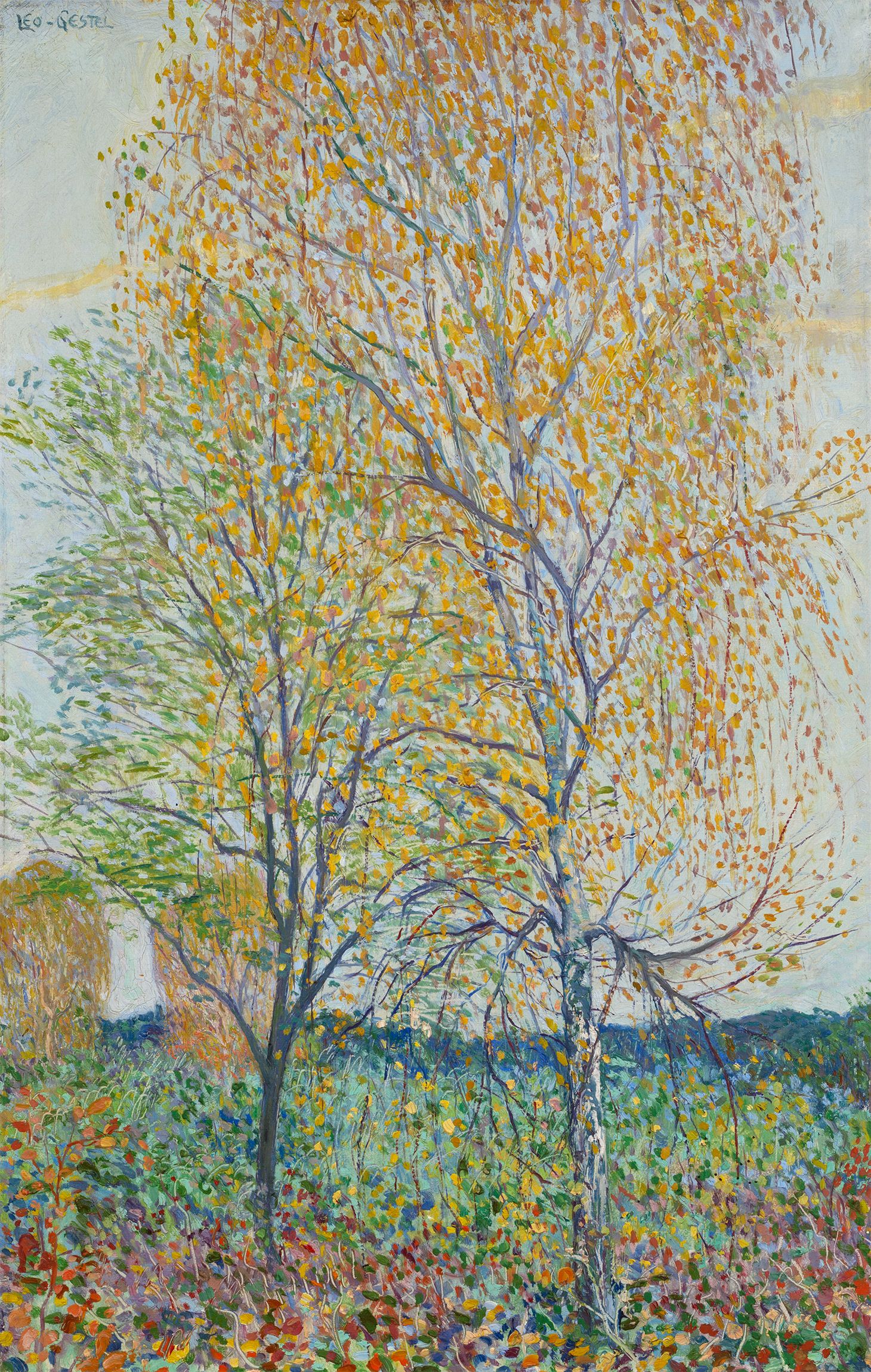
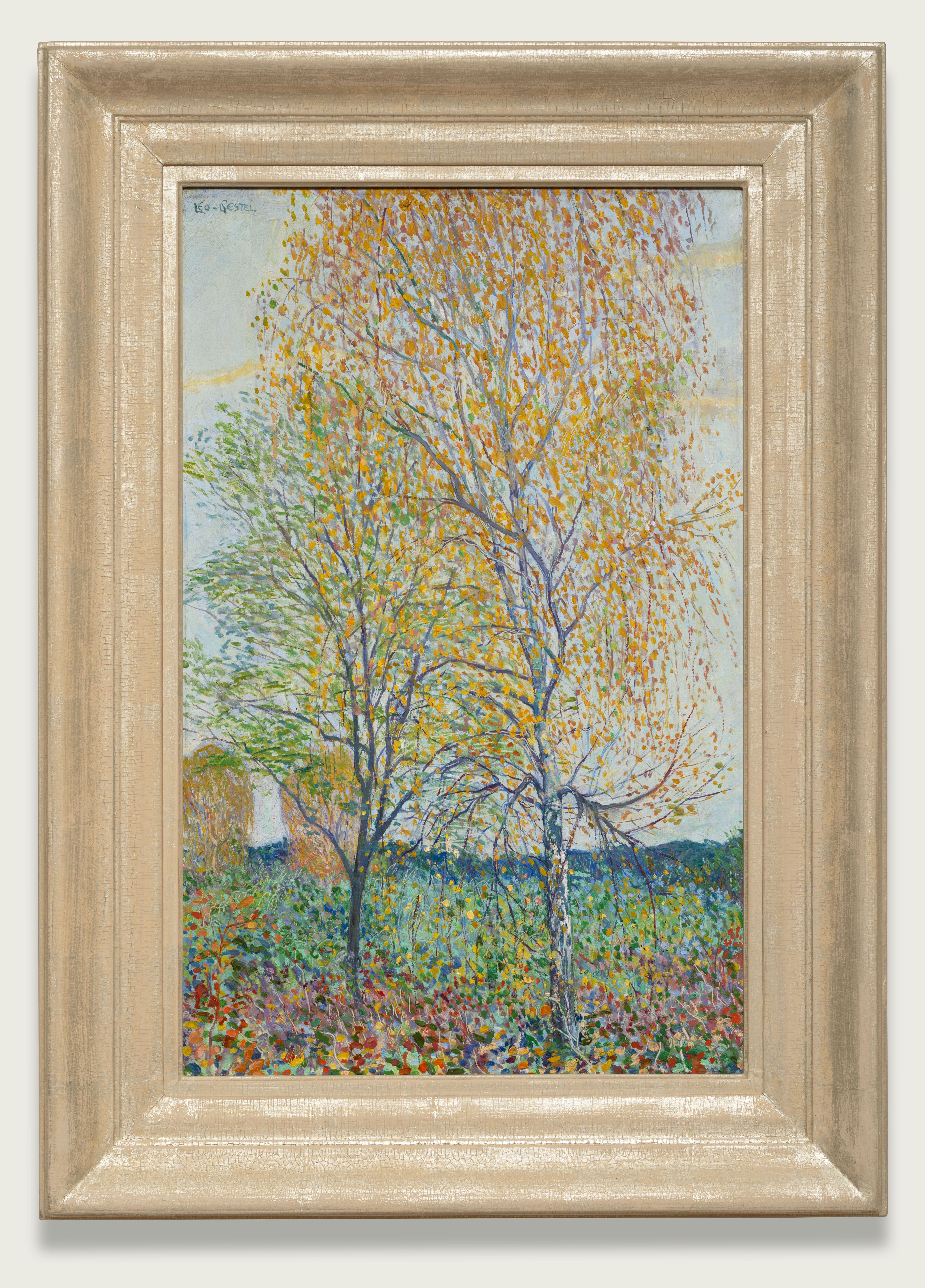
L. (LEO) GESTEL 1881 Woerden - 1941 Hilversum Birch Trees (Surrounding of Nijmegen)
Oil / Canvas: 54 x 34 cm
- This artwork can be viewed in our gallery
- Call us for more information: +31 26 361 1876
- World wide shipping available
Details
Leo Gestel painted this magnificent autumn landscape in 1909, during a turbulent period in Dutch art, when new developments followed one another at remarkable speed. At the time, Gestel was one of the driving forces behind the modern movement in the Netherlands. Together with his colleagues Jan Sluijters and Piet Mondriaan, he was at the forefront of experiments that would change art forever. In 1909, inspired by the French Pointillists, he was preoccupied with the decomposition of colour. Following the French painter Seurat, he applied paint to canvas in contrasting dots of colour, intending the colours to blend only in the viewer's eye, producing a more intense sensation of light. In 1905, a major exhibition of Vincent van Gogh's work was organised in Amsterdam for the first time, fifteen years after his death. This, too, caused a sensation among modern painters in the Netherlands. Added to this was the influence of the Parisian Fauves, who had taught Dutch painters a freer use of colour.
To absorb these influences, Gestel travelled to Hatert, near Nijmegen, in 1909. Here, he stepped back to focus once again entirely on what had always been the most important source of his art: nature. Initially, the work he produced there marked no break with realism. The small dots of paint he laid down correspond perfectly to the small, round leaves of the birch tree. The fallen leaves on the ground merge with other foliage and plants to form a many-coloured carpet that evokes the sensation of autumn with remarkable precision. The colourful birch leaves against the pale blue sky lend the painting an almost luminous quality. By employing new painting techniques, Gestel succeeded in depicting a realistic landscape that shimmers with colour while remaining true to the colours of autumn. Even so, the painting differs from the art of the preceding years: it is brighter, lighter, and more colourful. In the words of a contemporary critic: "…and then he experiences in Hatert near Nijmegen the golden raptures of autumn; his work from that period is one jubilation of colour, and he seems unable to satisfy himself with the exuberant hues."
This phase in Gestel's development was short-lived. On returning to Amsterdam, he exhibited his Nijmegen work in the spring of 1910 at the artists' association St. Lucas in the Stedelijk Museum. His work was hung alongside that of the most progressive artists, who by then were known as the Luminists. In this room, nicknamed the "sickroom" for the radical work displayed there, paintings by Piet Mondriaan, Jan Sluijters, Arnout Colnot, Dirk Filarski, and Jacoba van Heemskerk could also be seen. Mondriaan's work in particular caused a sensation, not least for Gestel himself, who returned to his studio to begin painting his Nijmegen autumn trees in an entirely new way. Studying nature in Nijmegen had been Gestel's means of taking the next step in his development.
Width: 34 cm
Private Collection Belgium
Art Gallery Albricht, Oosterbeek, 2005
Private collection The Netherlands
Over L. (LEO) GESTEL
Leendert Gestel (Leo is short for the nickname Leonardo given to him by his Amsterdam friends.) largely determined the face of Dutch modern art. Together with Jan Sluijters and Piet Mondriaan, he was the frontrunner of Dutch Modernism. By this term we mean the Dutch version of the then international avant-garde movements pointillism, fauvism, cubism and futurism. Gestel sought inspiration in each of these directions. In 1903, despite his father's opposition, he was able to call himself a free artist. By now he was living in Amsterdam, obtained his teaching certificate in drawing and had begun the evening course at the Rijksacademie at A. Allebé. His studio at 2nd Jan Steenstraat in Amsterdam became a meeting place for artists. His trips together with Jan Sluiters to cities like Paris, Antwerp and Brussels became of lasting influence on his work. In 1912, he settled in Bergen with his wife Ann. His work was bought early on by collectors J.F.S. Esser, Piet Boendermakers and Hélène Kröller - Muller. His great talent for drawing, in addition to his development as a painter, has always remained important, especially after the modernist period. However, the smoothly drawn pastels were also popular at the beginning of his career.