I.L. (ISAAC) ISRAELS 1865 Amsterdam - 1934 The Hague Rotten Row, Hyde Park, London
Oil / Canvas: 91,5 x 71,5 cm
- This artwork can be viewed in our gallery
- Call us for more information: +31 26 361 1876
- World wide shipping available
Details
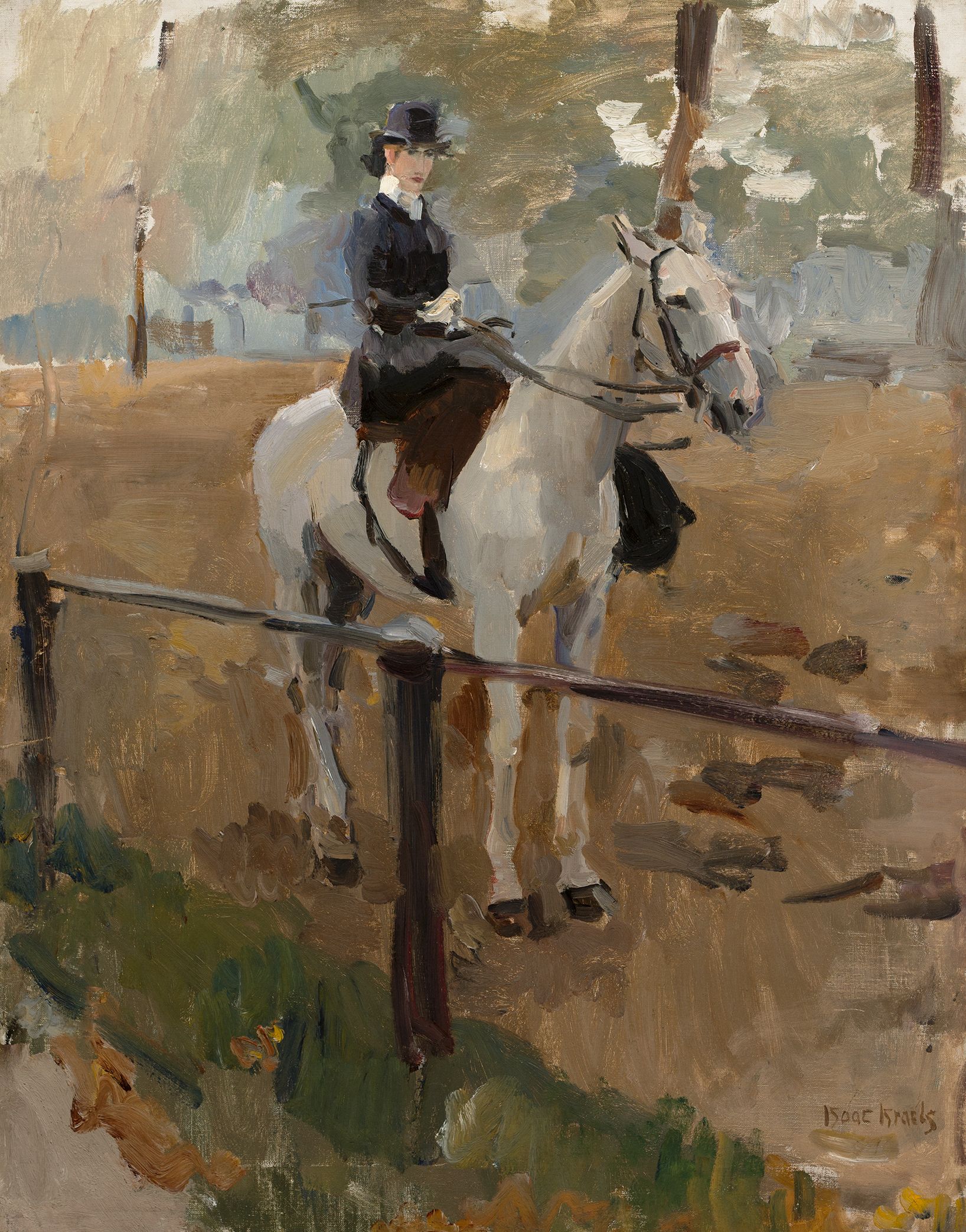
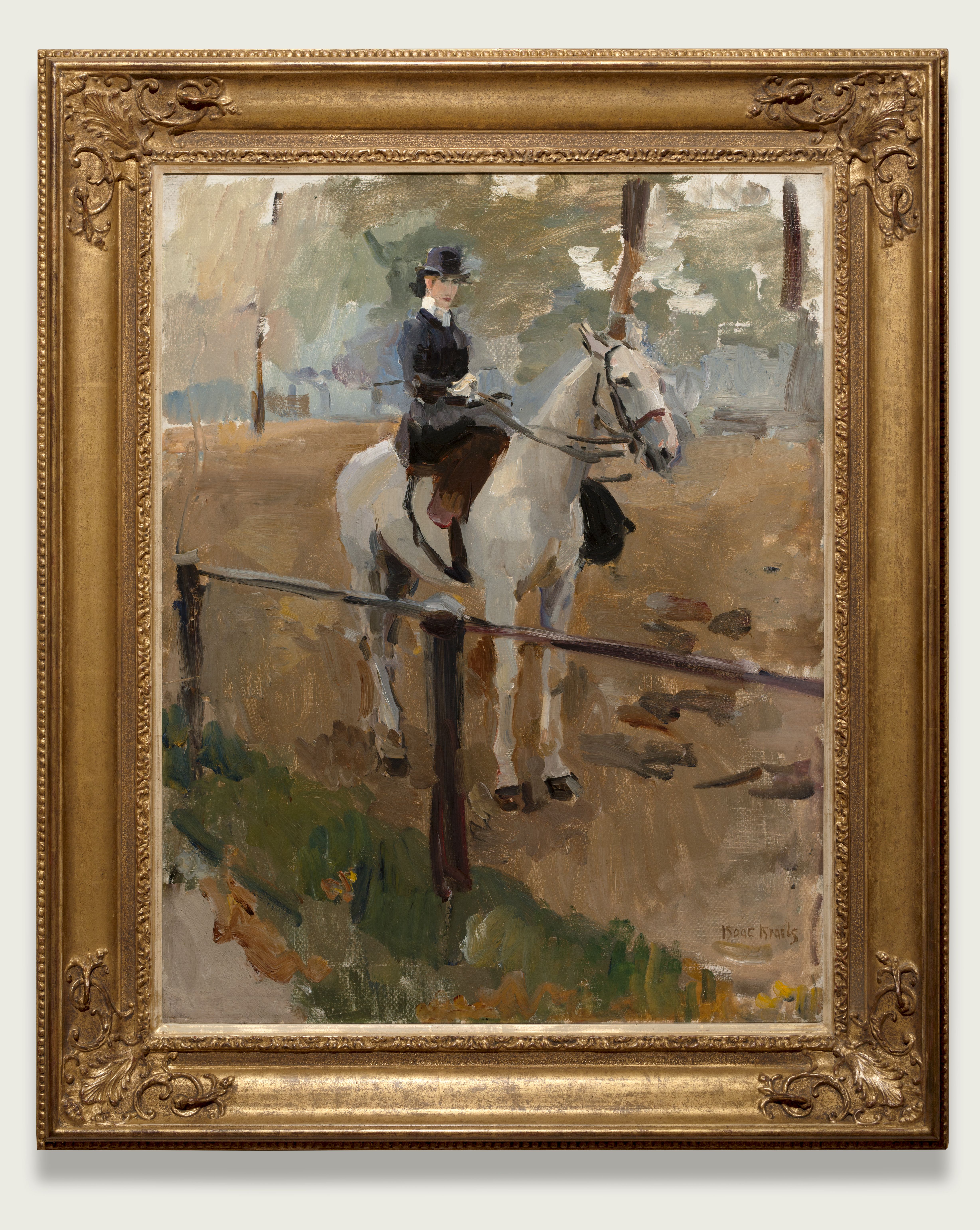
This painting is set in London, where Isaac Israels had moved in 1913. He often worked there in Hyde Park, as he had enjoyed painting strolling figures in the Bois de Boulogne in Paris or in the Oosterpark in Amsterdam. In Hyde Park, he was particularly struck by people who amused themselves by riding along the wide lanes. Rotten Row, a road in the park, is still used as a bridlepath today — a remarkable spot for the upper classes to relax on horseback amid the bustle of central London. The Household Cavalry division, which performs at ceremonial occasions, also trains its horses there. This fashionable meeting place for wealthy and distinguished Londoners, who rode there to see and be seen, must have held enormous appeal for Isaac Israels. He painted several works there, each revealing his remarkable gift for capturing a characteristic moment. The black-clad horsewoman in our painting appears to pause briefly before the painter, as if to pose. She gazes down at us with a certain hauteur, yet also with an air of graciousness, fully aware of the status her class confers. That ability to render a swift, incisive character study was Isaac Israels' great talent. The painting is, moreover, a portrait of the grey horse, which possesses at least as much personality as its rider. As in a formal portrait, the background has been left vague and without detail, so as not to distract attention from the horsewoman and her mount.
Isaac Israels was a restless traveller throughout his life, and this tendency intensified after the death of his world-famous father in 1911. At the time, Israels was living in Paris and was deeply uncertain whether to take over his father's house and studio in The Hague. To postpone that decision, he resolved to seek fresh impressions in a city he did not yet know well. Although his home city of Paris offered endless possibilities, he departed for London in 1913. He rented a studio in Fitzroy Street and stayed at a hotel on Trafalgar Square. In this new city, he found fresh variations on familiar themes. He again painted people enjoying themselves in the park or on the street, ballet girls, ladies taking pleasure trips on the Thames, and riders in Hyde Park. The urban scene fascinated him equally. He liked to sit at the front of the upper deck of a double-decker bus to observe busy streets such as Regent Street and Piccadilly Circus from above. In London, he painted streets from a high vantage point, as he had already done in Amsterdam. A shopkeeper placed his balcony at Israels' disposal so that he could paint from there. After the outbreak of the First World War, however, sketching in the street was no longer permitted. Israels therefore moved his work indoors, where he painted boxers in a hall he had hired, complete with an audience.
Despite the world war having set Europe ablaze, Isaac Israels travelled across the continent with relative ease. In 1915, he went to Switzerland, to the astonishment of his friends. "Isaac is in Bern and wrote to me that he was going to Paris. He doesn't know, I think, that there is a war on, because he doesn't mention it — nor how he intends to get there, now that Italy too is at war," wrote Theo Nieuwenhuis to Willem Witsen. "Well, he is rather small — perhaps they won't notice him." Israels did indeed return briefly to Paris, where he found life rather dull now that the social scene had ground to a halt because of the war. Shortly afterwards, he was back in London, though he would not remain there for much longer. By the end of 1915, he was back in The Hague.
Width: 71,5 cm
Mr. J.M.P. Glerum, Amsterdam (A. 133), 18 May 1920
Sale Mak van Waay, Amsterdam, 26 September 1933, lot 210 (Fl 210)
Acquired from the above sale by Mrs. Bos van Bruggen and thence by descent 1991
Art Gallery Van Voorst van Beest, The Hague, 1991, p. 74
Triton Collection Foundation, The Netherlands, acquired directly from the above
Artwork is included in the "Catalogue Raisonné" by the Dutch Institute for Art History (RKD), The Hague
Permalink: https://rkd.nl/explore/images/247466
Over I.L. (ISAAC) ISRAELS
Isaac Israels was the only son of the painter Jozef Israels. The family moved from Amsterdam to The Hague in 1871. Isaac also received his training at the academy at the same time as George Breitner, Floris Verster, and Marius Bauer, among others. He was a promising artist from an early age and won awards for his paintings. In the '80s, Isaac specialized in military subjects, an interest he shared with Breitner and Verster. Despite this promising start, he felt his education was not yet complete and went to Amsterdam, where he was accepted into the circle of the Tachtigers.
Turbulent city life became the common thread through his work. Between 1887 and 1894, things were quiet around him: few paintings are known from this period. Starting in the mid-1890s, Israels went back to The Hague in the summers, where he and his father would paint at the beach. They rented a villa in Scheveningen. His paintings of donkey-riding children were crowd pleasers and are still extremely popular. Israels joked that selling a painting was "the Highest of Arts." His donkey-riding children were eagerly purchased at high prices and can be considered highlights of his oeuvre for just that reason. Isaac Israels was not only the virtuoso painter of modern (city) life, but he was also a gifted portraitist. Especially in the last phase of his life, he commissioned portraits of important Dutchmen. Even in this genre, women remained his favorite subject. All his life, he preferred to draw and paint maids, Amsterdam street girls, telephone operators, mannequins in department stores, and nude models. His portraits of women are also highlights of his oeuvre, such as those of the spy Mata Hari, the first female doctor Aletta Jacobs, and the actress Fie Carelsen. Isaac Israels was accustomed to giving a quick characterization of his models. A crisp characterization had to appear on the canvas at once. As such, his best paintings are vivid, spontaneous, and struck just right. 'I had an attack of patriotism the other day when I looked out my window to my surprise. Surely the Hollandsche is to my mind the most beautiful thing there is,' Isaac Israels on his way to London from Hamburg to the painter Willem Witsen. That did not prevent him from traveling up and down the continent.
Israels always loved to travel. Even as a child, he went to Paris with his parents every year. He made trips to Italy, Spain, North Africa, Switzerland, Spain and Scandinavia to draw and paint. In the 1920s, he even spent some time in the Dutch East Indies. Starting in 1903, Israels had his own studio in Paris, where he found his favorite subjects among fashionable Parisians and was able to immerse himself in the modern art on display there. In the spring of 1913, he traded that city for London, where he had his own studio for a time. Despite all the travel and all the impressions, Israels always remained himself. He was a neighbor to Picasso in Paris, went into town with Kees van Dongen, admired the symbolist Odilon Redon, and for a time had one of Vincent van Gogh's Sunflowers on his wall. All these modern impressions, however, did not allow him to be diverted from his laboriously developed path. After his Amsterdam years, his palette became lighter and his subjects more mundane, but he stuck to his virtuoso impressionist style until his death. In 1923, he settled permanently on Koninginnegracht in The Hague, where he had left his father's studio vacant until long after his death.