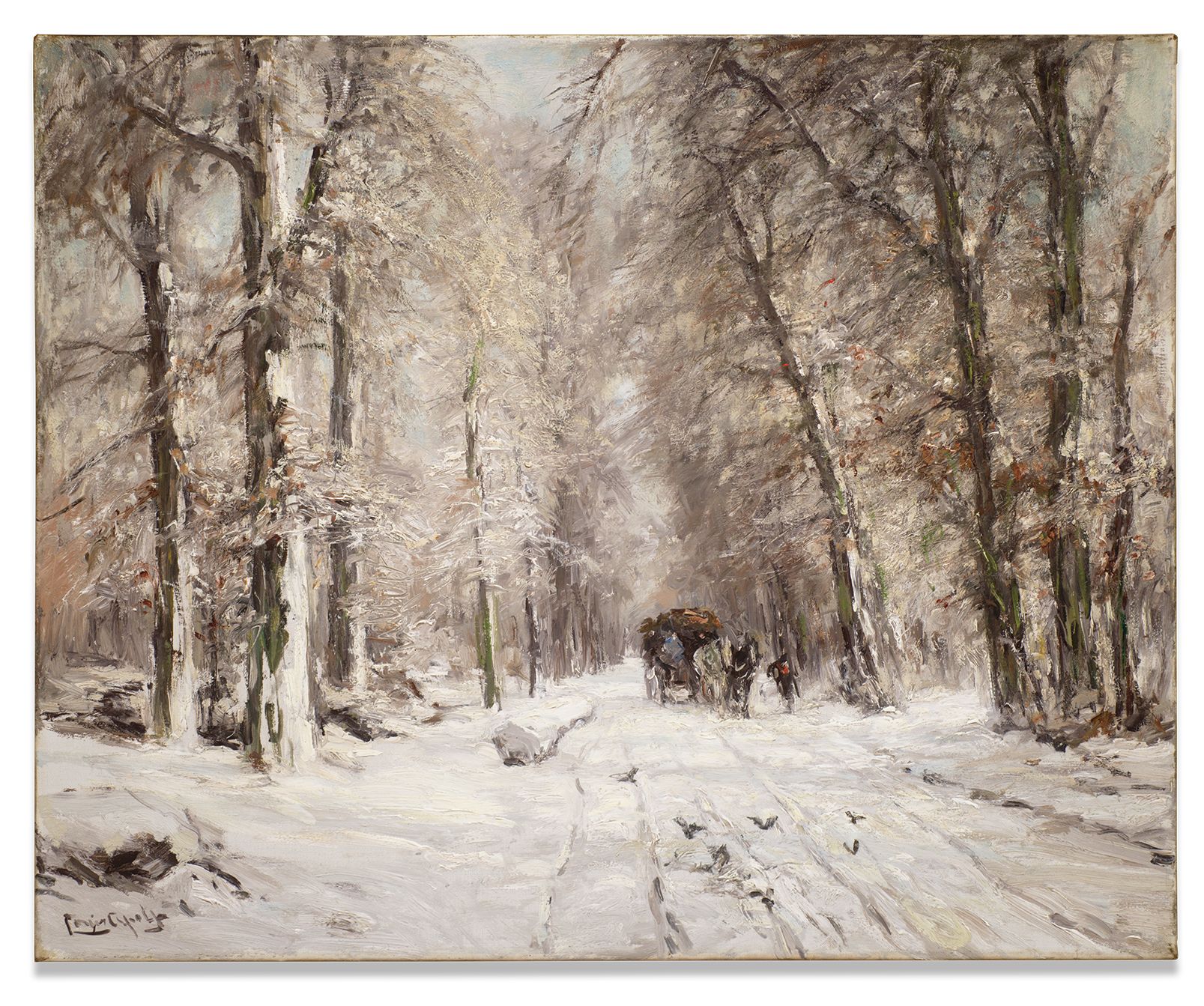
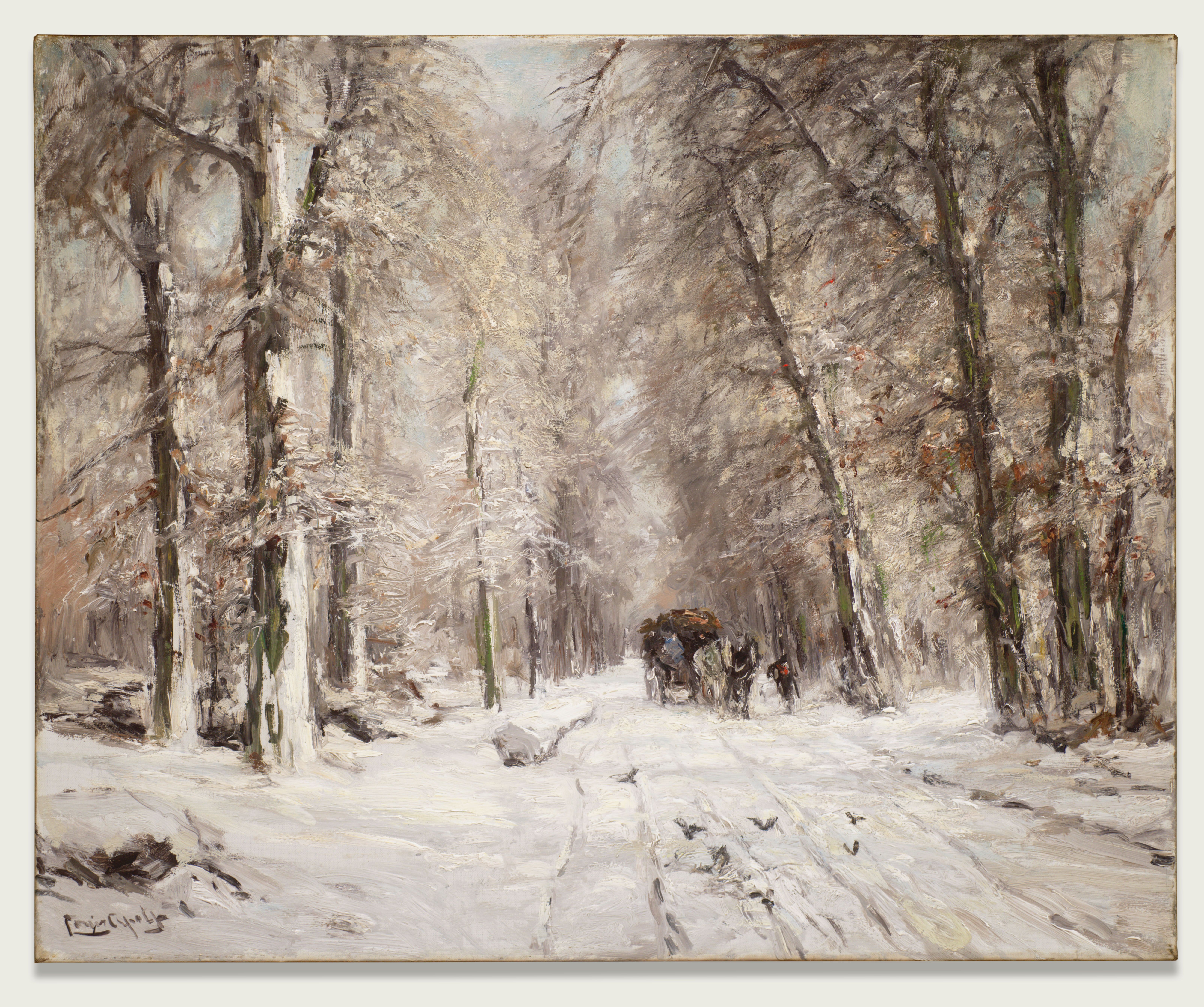
L.F.H. (LOUIS) APOL 1850 The Hague - 1936 The Hague Wooded Winter Landscape with a Horse and Cart
Oil / Canvas: 65 x 81 cm
- This artwork can be viewed in our gallery
- Call us for more information: +31 26 361 1876
- World wide shipping available
Details
A horse draws a laden cart along a snow-covered woodland path. Light falls through the snowy branches lining the way. A man walks beside it, small among the tall trees. The cart follows the track left by an earlier traveller. A few dark birds take flight, startled by its approach. The heavy trunks stand like columns along the path, their snow-laden branches meeting high above horse and cart to form an enclosed space, like a lofty vault. It has snowed heavily. Snow has settled on the branches and along the trunks, and the ground is almost entirely covered. Apol painted the snow in countless colours: cool greys and soft yellowish tints, with a hint of blue here and there. In the trunks we find brown and greenish tones. The dark trees make the snow appear all the brighter. With short, loose brushstrokes he gave the branches their fine layer of snow, while longer strokes follow the tracks on the path.
Winter scenes have been an established genre in Dutch painting for centuries. In the seventeenth century, lively scenes with skaters and sledges were especially popular. The Romantic landscape painters of the nineteenth century were fond of depicting the pleasures of snow and ice, and Apol’s teacher J.F. Hoppenbrouwers worked in that tradition. Apol took a very different approach. He shifted the attention to nature itself. Winter gave him the opportunity to explore how snow transformed the familiar landscape and how light could be rendered with a limited palette. In doing so he evoked, like no other, the wondrous sense of a world changed by snow. Apol became known as the winter painter of the Hague School, the group of artists for whom the mood of the landscape was so important.
Apol enjoyed great success with his snowy landscapes from an early age. When he was only 24, the Rijksmuseum bought one of his paintings: A January Evening in the Wood at The Hague. In a letter to his brother Theo, Vincent van Gogh wrote at length about colour, contrast and the use of black and white. He admired Apol’s ability to paint ‘white on white’: ‘Do you know that I often find the things by Apol, for instance, of white on white, very good. His sunset in the Haagse Bos, for instance, which is in Amsterdam. Truly, that thing is devilishly fine.’
Apol also took an interest in photography. During the years he lived in Gelderland, from 1886 to 1892, he photographed the landscape. His photographs include snow-covered branches and horses with carts seen almost directly from the front. He used such photographs as an aide-mémoire in his studio: some prints still bear paint stains and painted fingerprints. The camera helped him to capture motifs from nature and to consult them again later while painting.
For our painting, too, Apol probably made use of photographs, without copying them exactly. Here again the horse and cart are shown almost head-on. The foreshortening makes the horse and cart compact, while the long avenue stretches out behind them. The small scale of the man emphasises the height of the trees. He also brings a recognisable moment of daily life to the silent wood. Apol rendered him with just a few dark touches, so that the attention remains on the snow on the path and the gossamer network of branches. In this way he gives us the experience of a winter’s day, when a familiar woodland lane beneath the snow seems another world.
Width: 81 cm
Over L.F.H. (LOUIS) APOL
Louis Apol is one of the most important painters of the Hague School, best known for his winter landscapes and woodland scenes in the snow. The artist found his finest landscapes mainly in the surrounding countryside and parks of The Hague and around the (eastern Dutch) city of Arnhem. He joined the "Dutch Barbizon", an artist colony in the east of The Netherlands (Arnhem, Oosterbeek ) known for the “plein-air” painting and the un-Dutch hilly landscape. He met several well-known Dutch painters like Anton Mauve, one of the founders of the Hague School. Louis Apol was a pupil at the Royal Academy of Art (1867-1872) in The Hague. In 1871, he received the Royal Subsidy for Painting and in 1874 a silver medal at an exhibition in Amsterdam. As a young man he started his career with a good reputation, receiving from King William III of the Netherlands an important medal of merit and by selling a large painting to the Rijksmuseum in Amsterdam. In 1880 Apol travelled with a scientific expedition to Spitsbergen on the polar schooner Willem Barentsz to recreate a historical journey from the 16th century. During the trip, he sketched, drew and painted in watercolours the icy surroundings and the polar fauna they encountered, from a purpose build enclosed observation tower on deck. The impressions and sketches of this trip inspired him for his “Winters” for the rest of his artistic life. Many of the sketches are to be found in the collection of the Maritime Museums in Amsterdam and Rotterdam. His style is definitively impressionistic, developing from the more detailed academic to the loose and forceful brushstrokes he favoured in his later work. People play only a minor role on his canvases: no ice skaters or other joyful scenes. All attention is on nature, the wintery light and the all over atmosphere. His compositions invite the viewer to step into the scene, with paths and woodcutters’ trails opening up at the front. His many shades of white giving the landscape a realistic liveliness. His “greens” (i.e. non winter) paintings are rare. Apol's work is to be found in the Rijksmuseum in Amsterdam, the Teylers Museum in Haarlem and the Kunstmuseum in The Hague and in some major private collections.