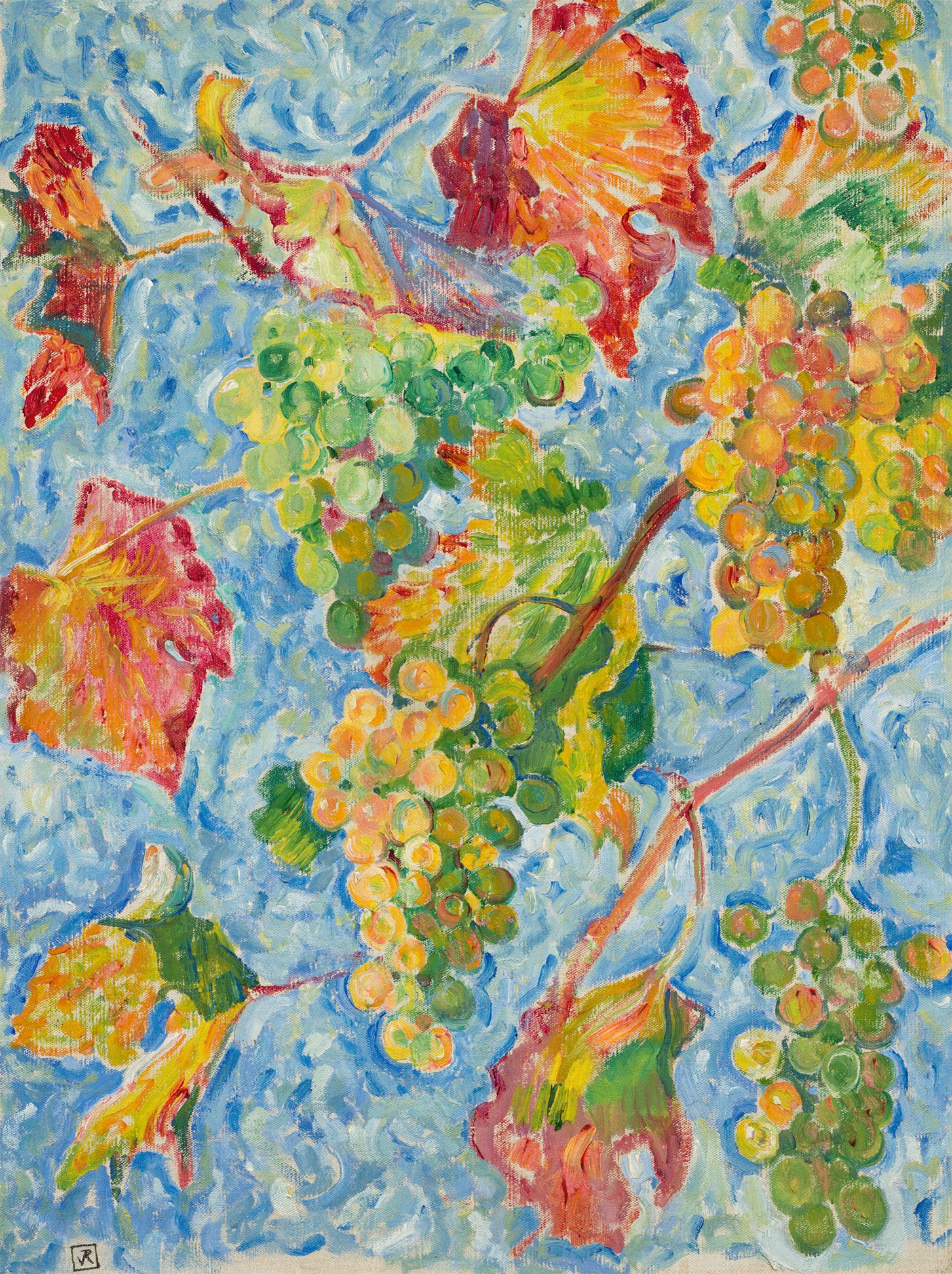
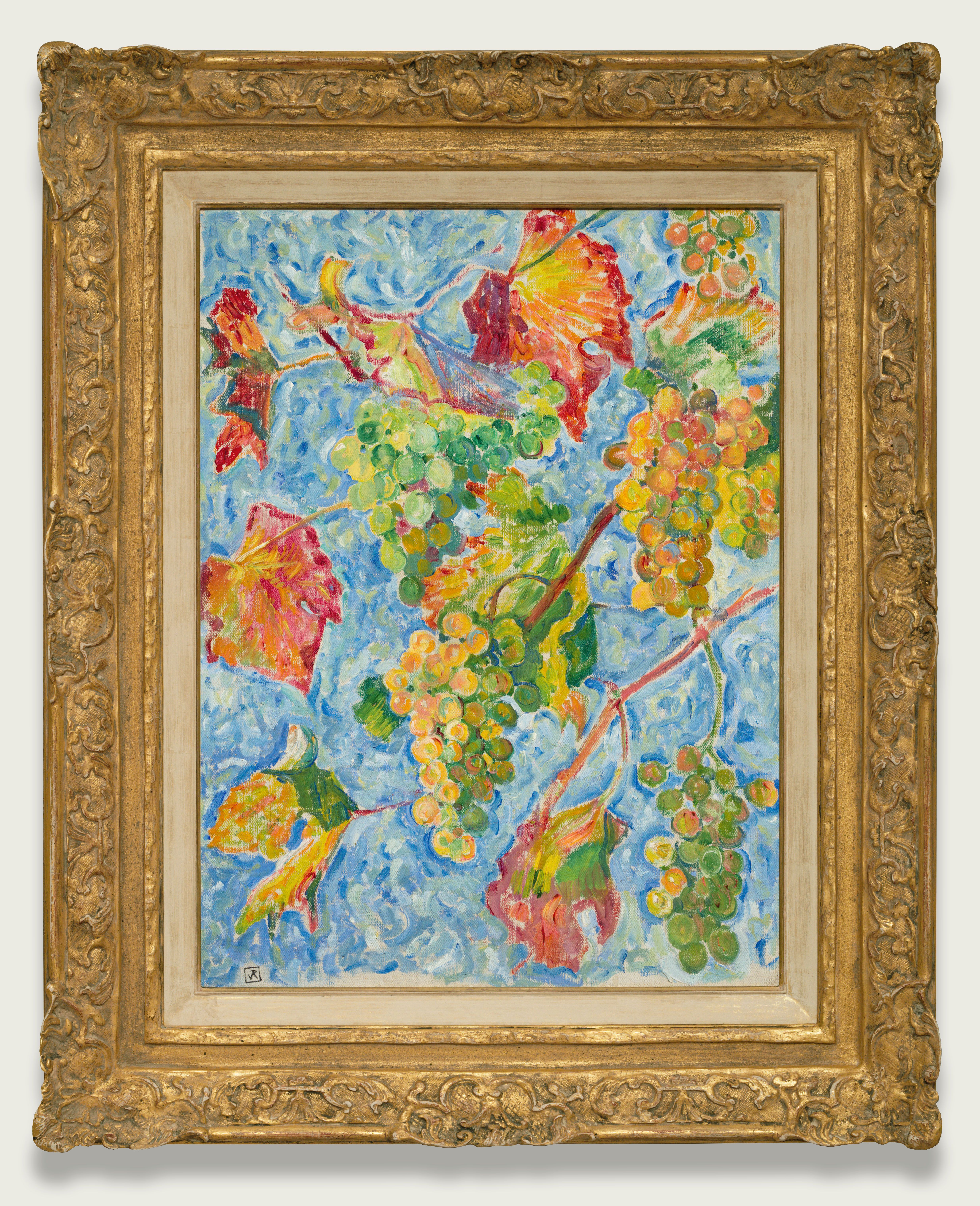
TH. (THÉO) VAN RYSSELBERGHE 1862 Ghent (Belgium) - 1926 Saint-Clair (France) Raisins sur la Vigne
Oil/Marouflé: 56,5 x 43 cm
- This artwork can be viewed in our gallery
- Call us for more information: +31 26 361 1876
- World wide shipping available
Details
This highly decorative painting is not what one typically expects from Théo Van Rysselberghe. In the decades around 1900, he was a central figure in the art circles of Brussels and Paris, introducing the Pointillist technique of Georges Seurat and Paul Signac to Belgium and playing a significant role within the avant-garde group Les XX. Alongside a prolific output of portraits and landscapes, he excelled equally in the decorative arts, designing posters, book ornaments, and furniture. Paul Nocard, owner of the perfume company Piver, commissioned him to create five wall panels and a series of medallions with floral motifs for the daylit atrium of his villa in Neuilly. The villa was later demolished, and the paintings were dispersed. A circular version of the present work is also known, possibly made for this villa, and the subject may have formed part of a larger decorative programme. The vine leaves have turned red, and the grapes appear sweet and overripe, evoking autumn or October; the remaining medallions may then have symbolised the other seasons.
Van Rysselberghe first travelled to North Africa in 1882, an experience that opened an entirely new world to him, and he would return for extended stays on three further occasions. A second defining discovery was Pointillism, encountered when he saw Seurat's Un dimanche après-midi à l'Île de la Grande Jatte at the eighth Impressionist exhibition in Paris in 1886. Deeply impressed, he became an early convert to the revolutionary technique, working in this manner for many years before gradually relinquishing it around 1907. Within Les XX, he played a key role in bringing new French ideas to Belgium and became a central figure in the dissemination of Neo-Impressionism. Jan Toorop was likewise a member of the group, and the French dotting technique proved equally formative for a substantial part of his oeuvre.
As his career progressed, Van Rysselberghe increasingly abandoned the strict application of the Pointillist method, yet his fascination with light, colour, and harmony endured. His work may have begun in theory, but it resulted in paintings that, above all, radiate life and light. The Pointillist technique became freer after 1903, and by around 1910, he had left it behind almost entirely. His brushstrokes grew longer and more fluid, his colours more vivid, his contrasts stronger, interspersed with softer tones. He developed into a master of rendering light and warmth.
This period marked the beginning of a new phase in his work. His exceptional sense of colour remained, but he handled the brush with greater freedom. His finest works from this period are occasionally reminiscent of Vincent van Gogh, a quality visible in this painting too, in the animated touch with which the blue background is rendered, set against the swirling forms and undulating lines of the vine tendrils.
Raisins sur la Vigne (1910) is a richly autumnal scene, built from a harmonious composition of colour patches. The vine branches and grape clusters are distributed decoratively across the surface, forming a pattern that seems to extend infinitely. It is as though Van Rysselberghe, after a long artistic development, through the Pointillism of Seurat and its gradual release in favour of a freer, more personal style, found a way to admit a more decorative, perhaps North Africa-influenced formal language into his work.
Width: 43 cm
Sale Parke Bernet, New York, 17 Apr. 1969, lot 147
Private collection, U.S.A.
Sale Tajan, Paris, 18 Dec. 2002, lot 14
Private collection, France
Over TH. (THÉO) VAN RYSSELBERGHE
Théo van Rysselberghe ranks among the foremost exponents of Belgian Neo-Impressionism. Trained at the academies of Ghent and Brussels, he co-founded the avant-garde circle Les XX in 1883. His encounter with the work of Georges Seurat in Paris in 1886 converted him to Pointillism, a technique he applied with exceptional refinement in portraits, landscapes, and marine views. He maintained close friendships with Paul Signac, Émile Verhaeren, and Henry van de Velde. After 1900, he gradually abandoned the strict divisionist manner in favour of a freer, broader touch. In 1911, he settled at Saint-Clair on the Côte d'Azur, where the Mediterranean light shaped his late work: sun-drenched landscapes, bathers, and portraits rendered in a warm, saturated palette.