A.C.P. (CHARLEY) TOOROP 1891 Katwijk - 1955 Bergen Sea with Sandbank
Oil / Canvas: 80,5 x 100 cm
- This artwork can be viewed in our gallery
- Call us for more information: +31 26 361 1876
- World wide shipping available
Details
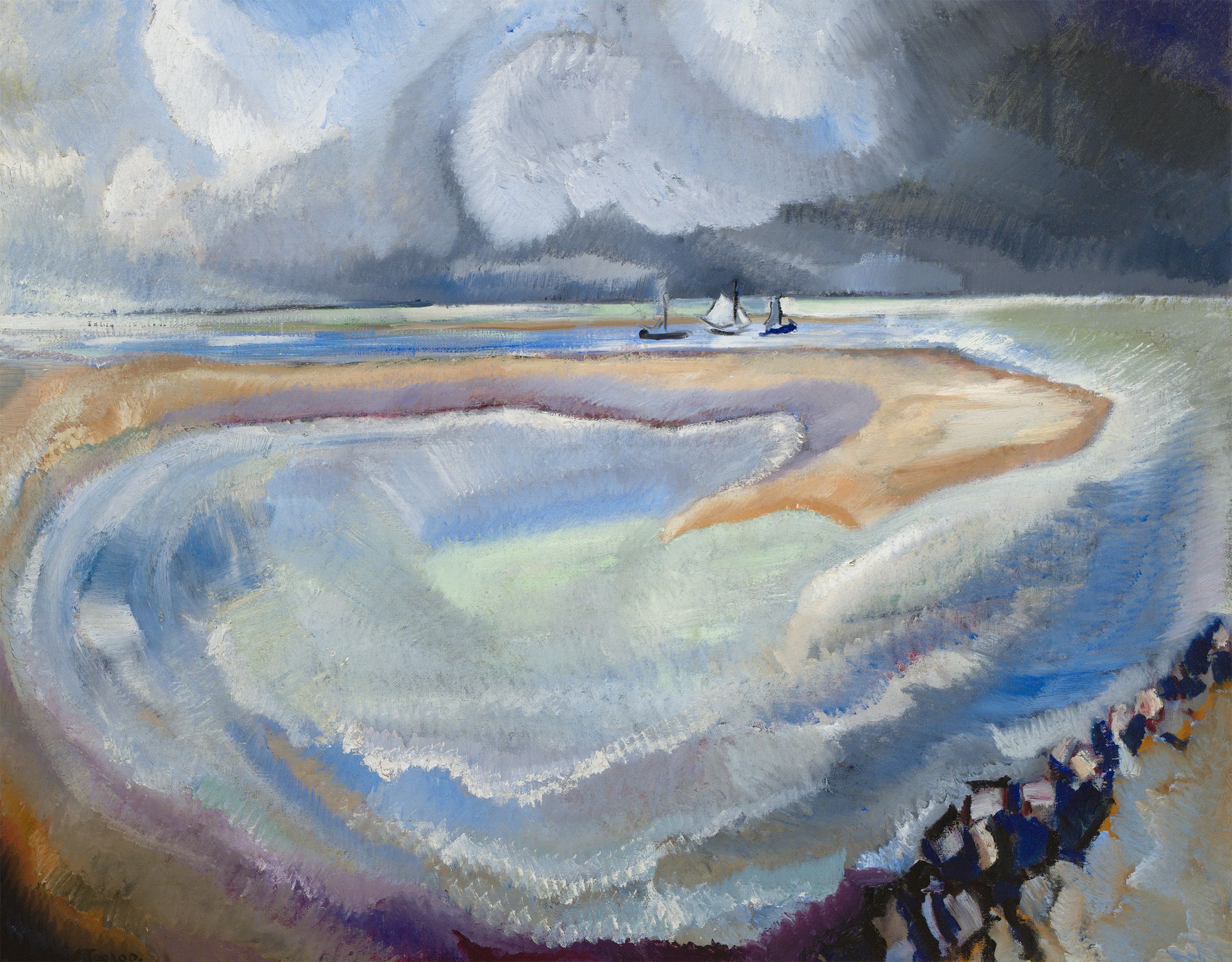
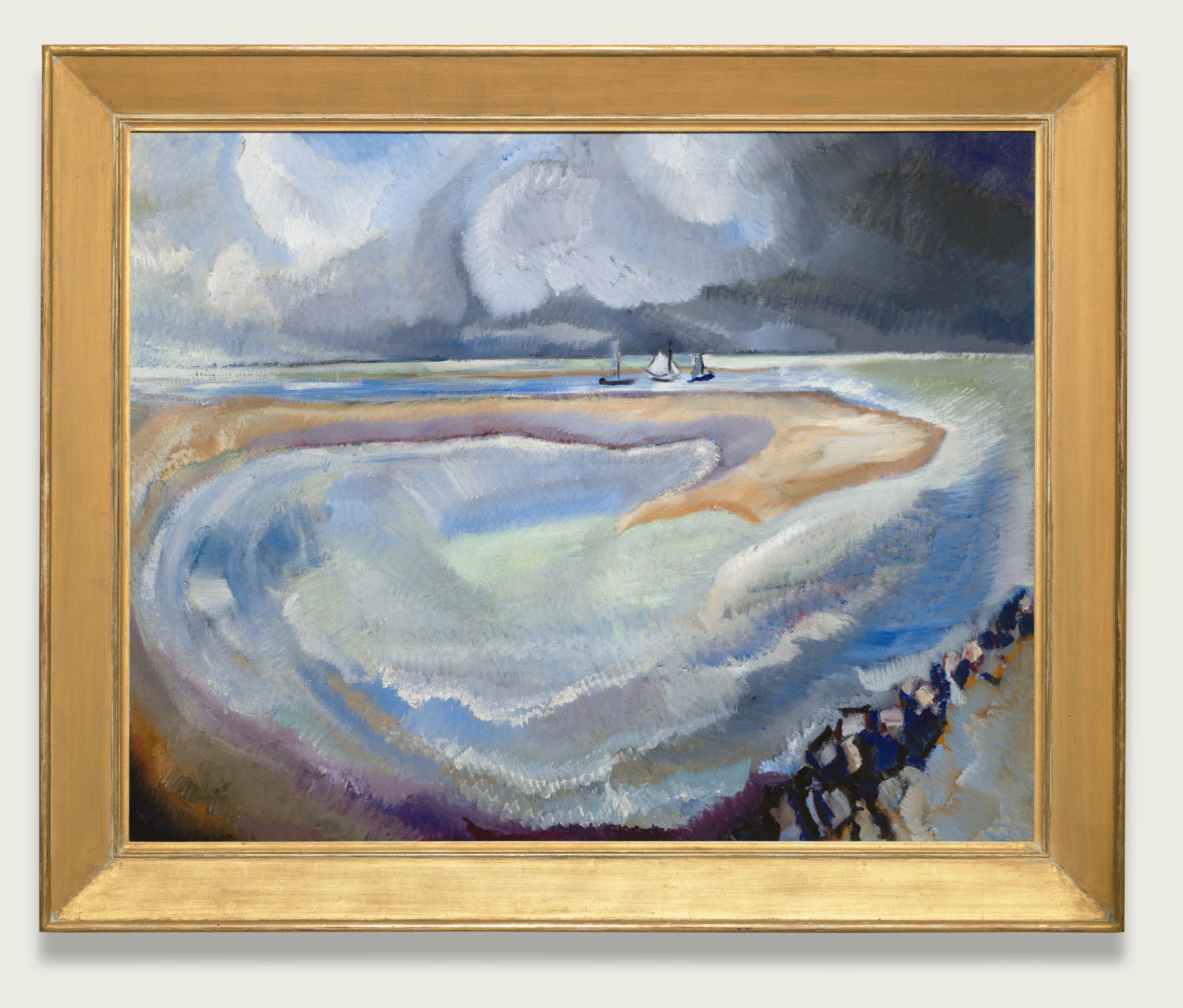
Charley Toorop’s Sea with Sandbank reflects her early search for a personal artistic style, independent of her famous father Jan Toorop. Having grown up close to the sea, she transformed the coastal landscape into a nearly abstract spiral of sea and sand, rendered in cool colours and rhythmic, hatched brushstrokes. The painting was made during a difficult period in her life, shortly after the birth of her daughter and amid the breakdown of her marriage. Exhibited in 1916 with the artists’ association Het Signaal, Sea with Sandbank exemplifies Toorop’s pursuit of a spiritually charged rendering of visible reality.
The more abstract qualities of the sea, its infinite gradations of colour, the singular coastal light, the shifting forms of water and sand, the horizon, present an ultimate challenge to any painter. For the Toorop family, this was particularly true.
The sea was never far removed from the life of Charley Toorop. She spent part of her childhood in Katwijk, where her father, the renowned painter Jan Toorop, created a celebrated series of seascapes. For years she accompanied him into the dunes of Domburg to draw side by side. Later, Charley’s son, the painter Edgar Fernhout, would also devote himself intensively to the subject.
In July 1916, Charley Toorop spent time with her father in Zeeland, not in Domburg, where Jan Toorop formed the vibrant centre of an artists’ colony each summer, but in Oostvoorne, then a seaside resort popular with visitors from Rotterdam. There she painted three works, including Sea with Sandbank. She had recently given birth to her daughter and was still recovering. Shortly before, her father had written to her: “I was very sorry to hear you are not yet well. You must nourish yourself properly and regain your strength,” enclosing seventy-five eggs with his note.
It was not an easy period in her life. Her marriage to Henk Fernhout had effectively collapsed due to his alcoholism and aggression; she now had three children to support, and establishing a serious artistic career had become an urgent necessity.
In 1916, Sea with Sandbank was exhibited at the inaugural exhibition of the artists’ association Het Signaal at the Stedelijk Museum Amsterdam. Within this group Charley found like-minded artists. The newspaper Algemeen Handelsblad described her work as “tragic in character” and spoke of a “tender merging of melancholy colour.” The painting was acquired by a close acquaintance of the Toorop family, Charles Drabbe, brother of the Domburg artist Mies Elout-Drabbe, whose studio functioned as a meeting place for artists and as the centre of the artists’ colony there, with Jan Toorop as its focal point.
Sea with Sandbank is a powerful example of Charley Toorop’s early search for an independent style, distinct from that of her famous father, with whom she was constantly compared. The seascape has evolved into an almost abstract composition. Sea and sand are rendered as a great spiral, executed in cool tones with abundant white and black, enriched by ochre, purple, and blue. The hatched brushstrokes she employed during this period recur frequently in her work. They lend the landscape a radiant, almost otherworldly presence, as though emerging from another dimension. Without the three small vessels sailing in succession through the channel, heading towards threatening storm clouds, the painting would scarcely be recognisable as a landscape.
“Is natural appearance reality, or is the form we can touch merely the most unreal aspect of what appears to us? This unreality, which is the most real,” Charley wrote in 1917, in response to the founding of De Stijl by Theo van Doesburg and Piet Mondriaan, who advocated a wholly abstract art. Such an approach did not appeal to Charley Toorop.
She remained committed to visible reality. The artist, she believed, must strive to realise a “spiritually animated vision” of the real. This conviction is already evident in this early painting, and she would adhere to this principle throughout her life, a principle she formulated at the age of just twenty-six.
The year 1916 proved pivotal in Toorop’s development. Not only did she join Het Signaal, but the collector Helene Kröller-Müller acquired one of her paintings through the art advisor H.P. Bremmer. Bremmer recognised in Charley Toorop an exceptional talent and even described her as a successor to Van Gogh, particularly in the unflinching intensity with which she rendered reality. “She is someone who dares to face life,” he remarked, “as only very few possess the capacity to do.”
Width: 100 cm
Private collection The Netherlands
Rotterdam, Museum Boijmans van Beuningen, Charley Toorop; Vooral geen principes!, 27 Sept. 2008 - 18 Jan. 2009, no. 4
Paris, Musée d'Art Moderne de la Ville Paris, Charley Toorop, 19 Feb. - 9 May 2010, no. 3
Haarlem, Frans Hals Museum | De Hallen, Naar Zee, 15 June - 2 Sept. 2012, no. 76
Museum Boijmans van Beuningen, “Charley Toorop; Vooral geen principes!”, Rotterdam, 2009, p. 34, 178, no. 4 (ill.)
Musée d'Art Moderne de la Ville Paris, “Charley Toorop”, Paris, 2010, p. 124, no. 3 (ill.)
Frans Hals Museum | De Hallen, “Naar Zee”, Haarlem, 2012,. p. 54, no. 76, (ill.)
Over A.C.P. (CHARLEY) TOOROP
Charley Toorop was born on 24 March 1891 in Katwijk aan Zee, the daughter of the artist Jan Toorop and the Englishwoman Annie Hall. Before committing to the visual arts around 1910, she studied the violin and voice. In 1912, she married the philosopher Henk Fernhout, with whom she had three children, including the painter Edgar Fernhout and the filmmaker John Fernhout. The marriage was formally dissolved in 1924. Toorop's early work was shaped by Expressionism and the Der Blaue Reiter movement. Since 1916, she has been a member of the artists' group Het Signaal and is associated with the Bergen School, characterised by emphatic lines and bold colour contrasts. In 1926, she moved to Amsterdam, where her painting was influenced by cinema: frontal, isolated figures, as though lit by lamps on a film set. Her still lifes show an affinity with Synthetic Cubism. From the 1930s onwards, she developed a powerful, expressively realist style, depicting portraits, self-portraits, nudes, and socially engaged subjects. Toorop was a central figure in the Dutch art world. Her house, De Vlerken in Bergen, commissioned by her father in 1921, became a gathering place for artists, musicians, and writers. She co-founded initiatives such as the ASB and the Filmliga, and maintained friendships with Piet Mondriaan and Bart van der Leck. Her most significant work, Three Generations (1941–1950, Museum Boijmans Van Beuningen), depicts herself, her father, and her son, Edgar. Charley Toorop died on 5 November 1955 in Bergen. Her work is held in the foremost Dutch public collections, with the Kröller-Müller Museum alone holding over forty of her paintings.