K. (KAREL) APPEL 1921 Amsterdam (The Netherlands) - 2006 Zürich (Switzerland) Blues in the Night
Oil / Canvas: 80 x 64,5 cm
- This artwork can be viewed in our gallery
- Call us for more information: +31 26 361 1876
- World wide shipping available
Details
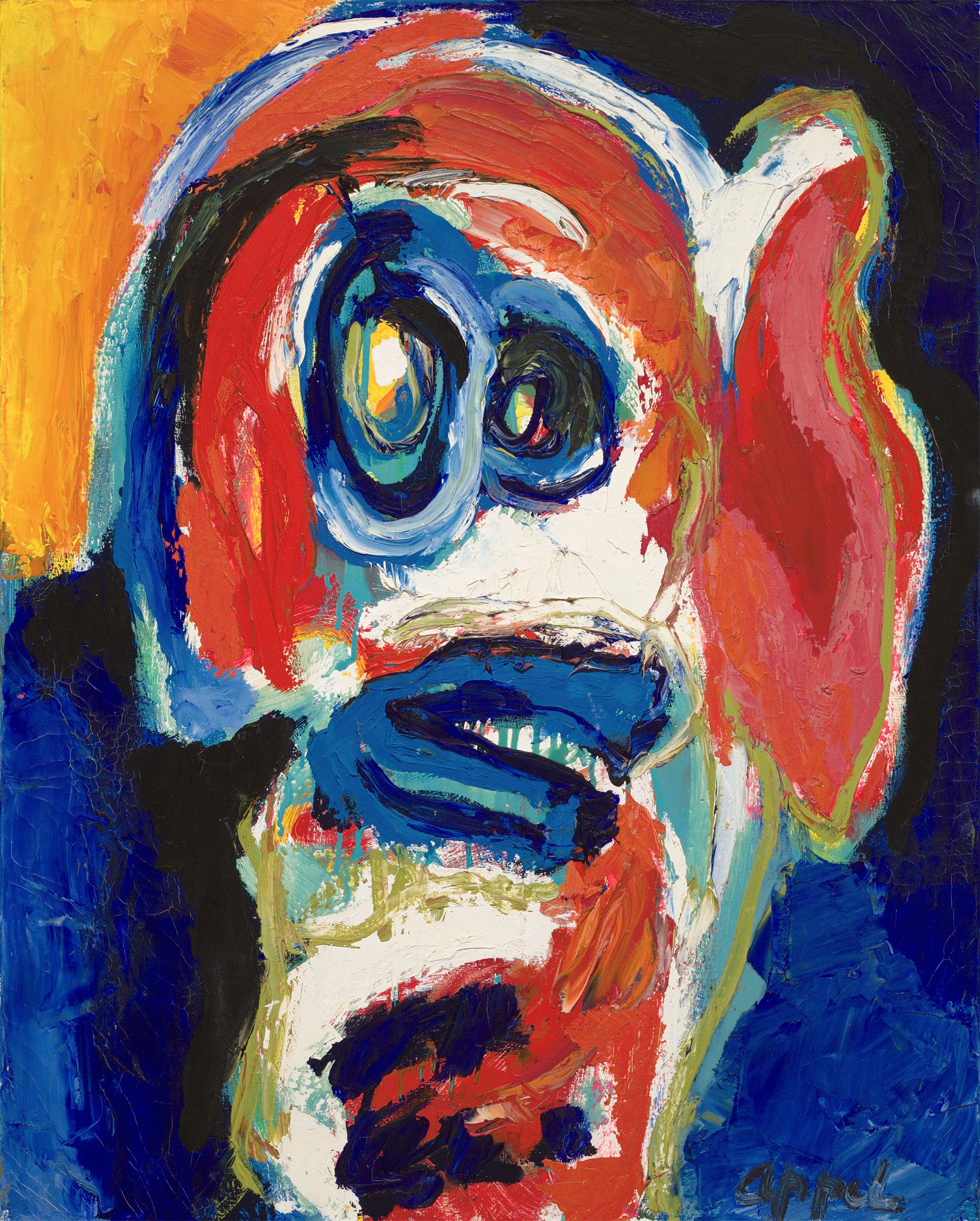
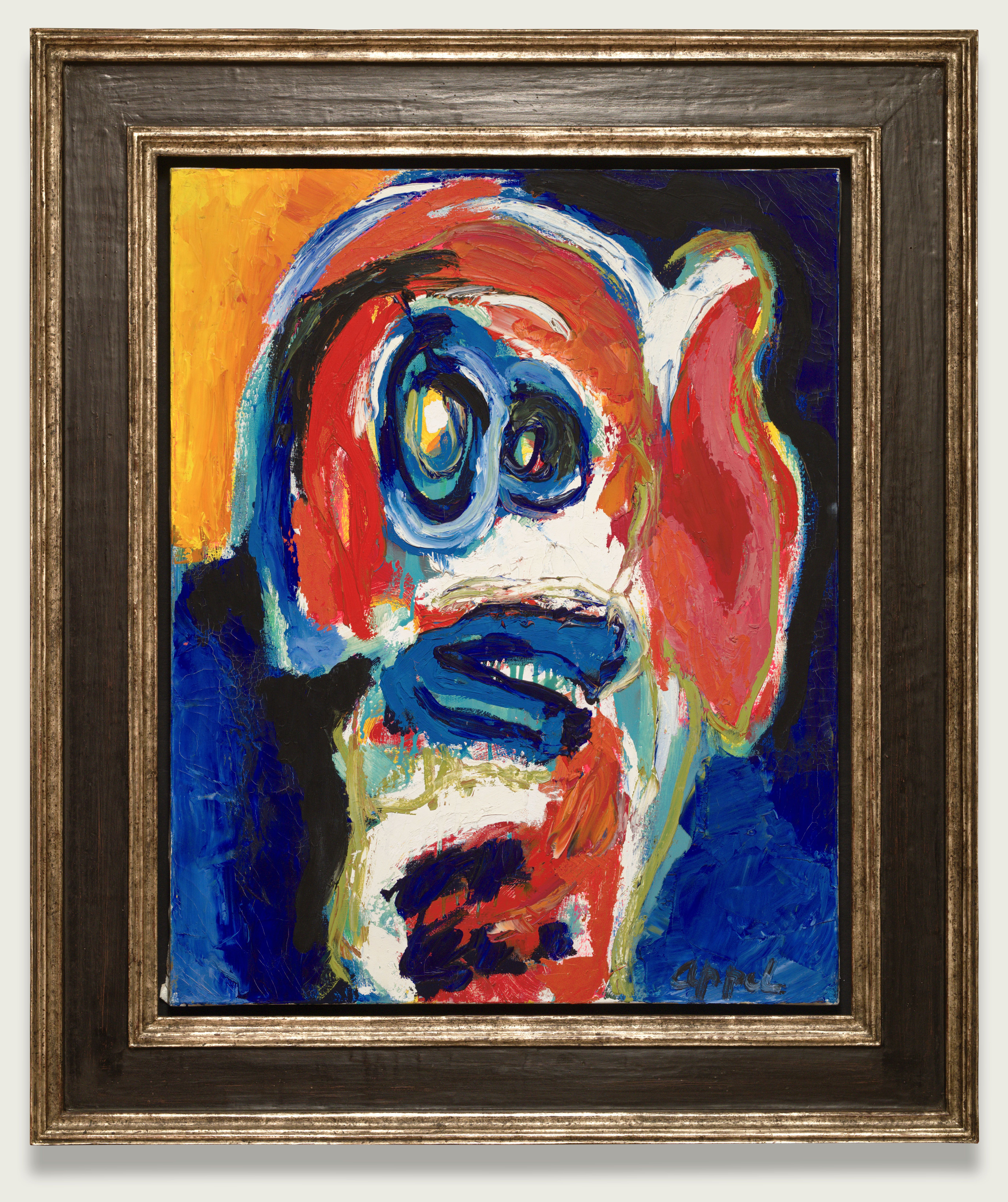
Blues in the Night is an iconic Appel. He painted it in his finest years, having absorbed the Cobra experiments into a mature style without ever surrendering the freedom he had gained in that period. The urge towards the spontaneous, the unspoilt, and the instinctive speaks from this painting too. A mask-like head emerges from the deep blue night, built up from thick brushstrokes and aggressive contours in vivid colours. The face is half human, half skull, at once body and dream image. The eyes are wide open, the mouth a dark blue grimace. On the left, an orange field glows like a last remnant of light; on the right, a large red field flares up like a listening ear. Everything is in motion. The paint does not seem simply applied but smeared, scraped, and modelled. This could only be an Appel.
Appel's way of working had much in common with that of a jazz musician: improvisation within a fixed structure, spontaneity kept firmly in check. The title, too, refers to jazz. Blues in the Night is a celebrated American jazz standard, written by Harold Arlen and Johnny Mercer for the 1941 film of the same name. The song is melancholy and steeped in longing and mistrust. Its famous opening lines, in which a man recalls his mother's warning that a woman is not to be trusted, set the tone at once. It is a song about disappointment in love, loneliness, and the restlessness of the night. Yet Appel did not illustrate a song. Rather, he translated the feeling of jazz into paint: the unrestrained flourishes, the unexpected accents, the collision of rhythm and emotion. The blue ground is a dark chord against which red, orange, white, and black blaze out.
Jazz meant a great deal to Appel, and its significance grew after his first visit to New York in 1957. The city opened up a new world for him. It was raw, fast, loud, and free. There, he met not only the painters of the New York School but also jazz musicians such as Dizzy Gillespie, Sarah Vaughan, Count Basie, and Miles Davis, whom he also portrayed. From then on, he spent much of his time in New York.
For Appel, jazz was akin to painting. Not because jazz happened to be modern, but because jazz, like his painting, revolved around freedom within form. A good jazz musician improvises, but never simply plays whatever comes to mind. He knows his instrument, the rhythm, and what is possible. Appel worked in the same way. His famous remark 'Ik rotzooi maar wat an' ('I just mess about') was often taken literally, but it was misleading. Appel liked to give the impression of pure release, of a painter hurling paint at the canvas. In reality, he kept his spontaneity within firm bounds, like an improvising jazz musician. He looked long and hard, mixed his colours carefully, sometimes turned the canvas round, and kept searching until the image was right. Appel began without a preconceived plan, but as he worked, a structure emerged ever more clearly, allowing an expressive image to arise from apparent chaos.
In Blues in the Night, the deep blue sounds like a bass line. The orange and red passages blare like brass. The black lines supply the rhythm, the white accents air and counterpoint. The painting has no quiet centre; it moves, grates, and pulses. The head thrusting forward out of the blue seems not only visible but audible, as if the paint had become a scream, a laugh, a lament, or an improvised solo. This is where the painting's power lies. It is a nocturnal image, charged with energy and melancholy. Appel painted the blues here not as sorrow alone but as vitality: dark and fierce at once, raw and alive, unsettled and yet utterly convincing. The work confirms Appel's standing as one of Europe's most important post-war artists. He transformed paint into an event, one that here almost becomes music.
Width: 64,5 cm
American Art Gallery, Copenhagen
Sotheby’s, London, 23 October 1997, lot 26
Art Gallery Frans Jacobs, Amsterdam
Private collection, The Netherlands (acquired from the above in 1998)
Private collection The Netherlands, (acquired by descent from the above)
Over K. (KAREL) APPEL
Dutch painter, sculptor, and poet Karel Appel was born in Amsterdam. His father was a barber and Karel was to follow in these footsteps. He chose art school instead (Rijksacademie voor Beeldende Kunsten). After the Second World War he travelled to Liege and Paris. In November 1948, COBRA was born: an international movement of artists who worked experimentally that evolved from the criticisms of Western society and a common desire to break away from existing art movements. Experimentation was the symbol of an unfettered freedom. Appel was one of its founding members. He drew inspiration from primitive art, children’s drawings, and outsider art, which he called unspoiled and pure. Appel painted spontaneously and created his compositions as he worked. He used to say: 'I just mess around'. Appel painted and made collages and sculptures using simple forms and vivid colours. In 1953, he made his name internationally at the São Paolo Biënnale. This led to exhibitions around the world. By 1990, he had studios in New York, Connecticut, Monaco, and Tuscany. His work is to be found in all major modern museum collections in the world.